
A GUIDE TO EMAIL MARKETING
Do You Have a List? How to Use Email as a Marketing Tool
Email marketing has a higher success rate than many other marketing and sales techniques. Here’s how it works.

Since it rose quickly to prominence and the internet about 25 years ago, email marketing has become widely used by businesses.
Email is widely used as a marketing tool for businesses to communicate with their target market and as a relationship management tool to communicate directly with existing customers.
In 2020, a vast majority of people now used email daily to communicate with each other. Either with friends and family, work colleagues, or perhaps to sign up to receive more information about a brand or product that interests them.
This article guides best practice for using email marketing, giving strategy tips and advice to make it easy for you to implement into your business.
What is Email Marketing?
Short for electronic mail, email sends messages to one or more recipients, distributed by electronic means via the internet.
Email marketing is a digital marketing strategy that uses email to develop relationships with prospective customers and maintain and strengthen relationships with current customers.
The end goal is to influence these people to make a purchase and be ongoing customers.
“Companies often list email as one of their most powerful marketing channels. To this day, the size of your email list is a demonstration of your reach and thought leadership. However, your email marketing campaigns should be part of a holistic approach to educate your contacts about your company.” (Georgieva, 2012)
Email marketing's popularity has been a part of the ongoing trend away from a product-focused marketing strategy to a customer focus of customisation and relationship management to satisfy each customer's needs.
Email marketing has been growing since the mid-1990s and is a widely used marketing tool by most B2B and B2C companies.
In 2015, one study indicated that over 80% of firms use email as part of their marketing strategies (See Zhang, Kumar, & Cosguner, 2017).
The benefits of email marketing
Email is a powerful marketing tool, with several benefits for businesses using it to build customer relationships and increase sales.
Businesses can design a personalised email marketing campaign for their different groups of leads and customers. Some of the benefits of email marketing are:
- Speed — a quick output and quick response for lead generation.
- Brand awareness — keeps the brand top of mind and people informed about what you offer.
- Segmentation — allows you to selectively email members of your database depending on their behaviours.
- Cost-Effective — Low cost per contact for customer acquisition. A better return on investment many other forms of marketing.
- Targeted — you are sending relevant materials to your audience.
- Customer Dialogue — encourages a two-way dialogue with customers, where communication is one way with many other marketing methods.
- Trackable — Analytics allows you to track the performance of your emails.
- Conversion — turn prospects who are interested in your industry or your products/services into customers.
- CRM — customer relationship management helps maximise customers' lifetime value by increasing customer retention and repeat purchases.
Objectives of email marketing
Email Newsletters are great not only for marketing to prospects but also for nurturing your existing customers. Some of the objectives of using email marketing are:
- Send recipients to other marketing content such as landing pages with exclusive offers, blog posts or other valuable content.
- Communicate with a community, customers, employees or other stakeholders to generate a reaction or a result.
- Inform the reader about a new offer or send them to a blog post.
- Maintain and develop long term relationships with current customers.
- Motivate customers to finish a purchase who have items they have abandoned in their shopping cart.
- Increase sales by converting more leads into customers and selling more to previous customers.

Analysing the results of your email marketing
One of the significant benefits of email marketing is the ability to monitor subscriber engagement and interest.
It is a process of continual improvement — testing and tweaking your email content and database management. There are several key metrics to analyse your email marketing performance to measure campaigns against previous benchmarks.
For example, analysing the interaction that people have with your website after they click on a link can help you pinpoint how to improve your website's user experience. A firm should try two alternate landing pages to test which one receives better results.
The open rate is the proportion of people who opened the email. But this can be an inaccurate gauge as customers who are active in opening a firm’s emails may not be involved in purchasing and vice versa. Some people are more responsive to emails. Others may purchase but never open their emails.
Therefore, it is essential to track more factors than just your open rate, such as monitoring your click-through rates and conversion rates.
Bounce rate is the number of emails sent by your firm that they cannot deliver to the recipient’s inbox. If a campaign has a lower than average delivery rate (high bounce rate), examine the subject line and content of that message to check if something could have flagged it as spam.
The list growth rate is how fast your email list is growing. Firms calculate this by subtracting opt-outs, and hard bounces from the number of new email subscribers gained per month.
“Be clear to your target market about what they will get out of subscribing to your emails. Give them a clear description of what the value proposition is. For example, will your emails offer: (1) tips and tools on how to run their business more efficiently, (2) product updates from your company, or (3) special offers via email? Your audience will want to know “why” they should subscribe before they decide to clutter their inbox with even more emails.” (Georgieva, 2012)
Unsubscribe rate is the proportion of people in your database who unsubscribe from receiving your emails. Unsubscribe rates are not always a reliable picture of your email list; however, many subscribers who no longer want to receive emails will not bother to go through the formal unsubscribe process.
They will stop opening email messages and delete them instead.
Click-Through Rate (CTR) is a foundation of email marketing analytics, as it indicates whether the message was relevant and the offer compelling enough to check out. This measure how many people click on the special offer or call to action in your email.
Conversion rate is the proportion of people who clicked a link and completed the desired action, such as purchasing a product. This rate depends on factors beyond the original email message, such as the quality of your landing page or the offer itself.
“Conversion rate is the ultimate measure of an email campaign’s effectiveness. The higher your conversion rate, the more relevant and compelling the offer was for your audience.” (Georgieva, 2012)
Revenue per email measures the ROI of an email campaign, calculated by dividing the total revenue generated from the campaign by the number of emails sent. This metric is only relevant if you create a lot of direct sales from email campaigns.
Database management
A database can be robust. But only if managed correctly.
A database should be continuously updated to make sure it stays relevant. If a user has been emailed 20 times and has never opened one of those emails, they probably should not be emailed once a week. You might email them once every six months or remove theirs altogether. Your metrics will tell you who is no longer engaging.
Database members should be categorised so you can best meet their needs. Group them based on some common characteristics and behaviours.
Continually work to add new contacts to your email database, as the natural churn rate of an email list can be 25% or even more per year. Ensure you are gaining new relevant people on your database by providing a benefit to them by being on your mailing list (exclusive offers, gifts, industry updates etc.).
Software such as Mailchimp or Constant Contact will help you manage your database and set up your email marketing. Some systems will also set up your whole sales funnel with landing pages for lead generation and analytics and reporting to monitor your email marketing campaigns' performance.
Email marketing strategy
Email marketing is about more than sending your latest offer out to your database once a month. Businesses must think of it like designing marketing communication campaigns — because they are! Your firm should clearly define the objectives of email marketing, such as who the target recipients are. Develop content to fit the purpose. Make sure it provides value!
The email campaign should be tested on a small sample, tweaked, and then sent to the database's segmented members. Measure the results to see what you can do better next time.
As well as immediate results, businesses should consider how their strategy will affect their future profitability. According to the schedule you set up, if your business sets up lead nurturing, emails are sent automatically to new leads.
Lead nurturing is all about understanding the nuances of your leads’ timing and needs. Use a tightly connected series of emails with a coherent purpose and full of useful content.
Tie a series of emails to a specific activity, such as joining a mailing list, and then sending them an automated series of emails to learn more about their behaviour and potentially influence a purchase. The lead is qualified over a period with automation, saving a business time and energy.
Segment leads into customer groups as you learn more about them, to meet their needs better and provide them value. Targeted marketing has a far better return on investment than mass marketing — so do not be tempted to send the same email to all your contacts!
Email is a vital component of a sales funnel — where the objective is to turn as many leads into sales as possible. But email should be part of an integrated marketing approach — email does not work in isolation.
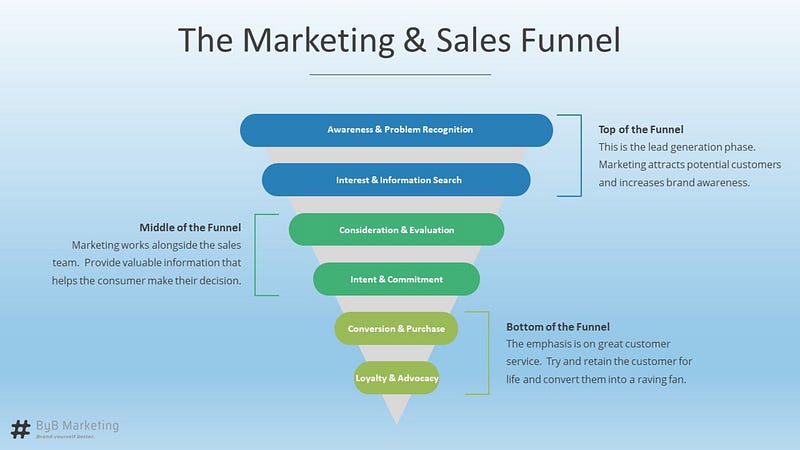
Other marketing efforts, such as search engine optimisation and content marketing on social media, should complement your emailing strategy. If you blog, send people to your blog via your email and encourage people to sign up for your newsletter at the end of blog posts.
Email content
What goes into an email? Of course, this will vary depending on the firm and its objectives. But there are some general rules when it comes to the content of email marketing.
The email title must convince the recipient to open the email — this is key. It must be related to the email content (stay away from clickbait), but at the same time be compelling enough that the recipient is curious enough to open the email.
Many people check their email via smartphones, so these will not display long titles in full. Aim for 5 to 9 words.
“In the Subject: line Each word makes a critical difference in whether your message is opened at all. Once its opened, you only have seconds to capture the readers imagination. You have to grab their attention and keep it.” (Sterne, & Priore, 2000)
Your content must be brief and relevant for the recipient. Grab their attention right away by containing the most information in the first paragraph. Try and keep the length to under 100 words.
Use a personalised greeting at the beginning of the email and a clear call-to-action at the email’s end. Include a couple of hyperlinks to other useful content such as a blog or video on your website or a custom landing page that contains more information (find out more, or order).
An option to unsubscribe must be available. Email marketing software automatically using an unsubscribe option.
The layout and design of email marketing are essential — especially if it is a newsletter. But you do not want to go over the top trying to make it aesthetic; simple can be beautiful. Try to use a maximum of two colours.
Include one or two images in the email; one of those can be the company logo for brand awareness.
Ensure the images have alt text for those not viewing the HTML email (some people have images that are turned off automatically in email, so they don’t load).
Your contact information and social-following buttons for your social media accounts should be at the bottom of the email.
How many emails should you send?
The right number of emails to send is challenging to pinpoint, as it will depend on your customers. If you are emailing qualified leads, it might be once or twice a week. Other customers, once a month or once a quarter, might work better. It will depend on the engagement level of your audience.
“Sending the right number of emails is critical for the firm’s profitability, especially since most customers tend to complain about the large number of emails sent by firms.” (Zhang, Kumar, & Cosguner, 2017)
Many companies start to send fewer emails to keep subscribers. However, the frequency of emailing does not necessarily negatively impact subscriber retention. There can be email overload, for sure. But also, ask yourself if you are emailing the right people with the right message.
Spam
Because it is so cheap and accessible (anyone with an email address can send a mass email), people and firms use email as a tool to spread ‘spam’ emails. Spam is unsolicited digital communication sent out in bulk to random email addresses without consent.
Spam has caused email marketing to leave a bad taste in the mouth for many people. We’ve probably all received an email or two from a Nigerian royal or long-lost family member promising us millions of dollars.
“Low production costs spur greater production, inducing entry to the industry by legitimate and not-so-legitimate marketers, which further increases the volume of email messages sent. As a result, consumers are awash in a sea of ads and information, some useful and some not.” (Pavlov, Melville & Plice, 2007)
The significant difference between spam and genuine email marketing has an opt-in policy.
If businesses keep rigorous with this, they only email people who consented to receive them, and the company will not get into any trouble.
Most countries worldwide now have anti-spam laws, so it's best businesses are cautious with who goes into their emailing database.
Thank you for reading.
In sum, email marketing is a powerful tool for businesses to utilise. It helps to both nurture potential customer with information and value. Hence, they are more likely to become customers, and it is a discreet way to stay in contact with previous customers.
This article has provided tips on how businesses can optimise their email marketing strategy.
If you enjoyed the content, you might be interested in the following article on targeting.
Read as many articles as you like!
Non-Medium members can only read 3 articles a month — become a Medium Member for unlimited access.
If you liked the content and would like to read more articles like this, sign up to become a Medium member for only $5 a month.


