
How to Thrive in a New Culture
Learn to Navigate Cultural Changes like a pro at work

Moving to new countries for work is fascinating and full of learning.
You would imagine moving from Sydney to Los Angeles for work won’t be much difference because you speak the language. Or moving from China to Canada would require an understanding of a new language.
In reality, there are several factors to adjust to when moving countries or continents, besides the language.
Understanding cultural differences is top of the list.
When I moved from India to France and later to Belgium, I spoke English at work. I couldn’t have been more wrong about the cultural differences though. It was awkward, and I didn’t know what I could do differently.
The same was true when I moved from Germany to Canada. It was a shock, but thankfully; I found a better way to understand the cultural differences.
As I looked for knowledge to help me settle into work easier, I drilled it down to five major things after reading an amazing book ‘The Culture Map’ by Erin Meyer and attending some training.
Learn about these to navigate cultural differences like a pro and thrive in new environments.
“When interacting with someone from another culture, try to watch more, listen more, and speak less.” ― Erin Meyer
Master Communication
One of the biggest factors influencing your settling-in period is your communication. In parts of the world, such as Asia, communication is often ‘high context’, i.e. indirect and implicit.
It means you need prior background to follow the conversation. If you were talking about flight schedules this month in China, and don’t know what was the trend last month, chances are no one will explain unless you ask.
In North America, communication is low context, i.e. explicit and direct. People provide a brief background, so no prior knowledge is essential.
In Europe, you’ll have some details, and you’ll need to figure out the rest.
This may seem simple, but trust me, it doesn’t come naturally to you if you are navigating new cultures.
When I moved to Canada, I often missed sharing past context during discussions. Now I know how helpful it is for someone in a work setting. You cannot assume others to know or remember.
Knowing this nuance is essential to communicate information so others can understand. It helps you get the desired response. Unfortunately, it takes years to practice this change.
Learn to Give and Receive Feedback
Whereas the feedback style in Asia is mostly indirect, it was far more direct in Europe.
I needed to get used to receiving more direct feedback. It can be unnerving.
In Canada, the style is more indirect. Here is an example of the 3 continents I experienced.
India (Asia): You did well, but can improve on X and Y.
Europe: You need to improve X, Y and Z.
Canada (North America): You are doing A, B and C well. If you improve X and Y, you’ll do even better.
Feedback is critical for growth. It’s a gift, no matter how it’s delivered. Especially the feedback which stings. Try to let it sit and evaluate it with a neutral outlook before jumping to react.
Understand how to influence
You are used to preparing a pitch via an email, a presentation or a document to explain your idea in work settings. The argument you make is an essential component of influencing.
However, the way you make an argument will change across cultures. For example:
In Europe, you explain the concept first and then give examples. In Canada, you’ll start with the application of the concept first and then detail the concept secondarily.
The book ‘The Pyramid Principle’ by Barbara Minto details this concept. Again, this is something which takes a while to practice.
How well you know this will define how people perceive your information, and how successfully you influence others.
Understand Leadership structure
This one is critical to follow at work.
In Asia, leadership is more hierarchical. It’s an unsaid expectation. You follow the leader without challenging. I worked with many leaders who didn’t fit this description, though I know this is often an implicit rule.
In Canada, the leadership style is more egalitarian. You seek input from everyone across the board. In Europe, the style was somewhere in the middle between egalitarian and hierarchical.
My experience was I came across as rebellious in Europe. I openly shared my contrarian views because of having worked with leaders in North America before who valued dissent and difference of opinion. This didn’t go down well, and some leaders resented my style.
Knowing this difference will make or break your career.
Earn Trust the right way
Trust is more relationship-based in Asian countries, and more task-based in Western countries.
It takes much longer to build trust based on the relationship, as there are no set guidelines available. Doing a task well and establishing trust based on it is comparatively easier.
Relationship-based trust, once formed, lasts longer than task-based trust, which could be superficial and temporary.
Other Factors
The above factors aren’t the only ones which influence an environment.
The concept of time changes across different countries. For some cultures, time is a fluid concept and for some, it’s fixed. For example, 5 pm means 5 pm for some and for some 5 pm could mean before 6 pm.
The relationship boundaries also vary across cultures. They will determine what’s considered appropriate to share at work and what’s not.
Other than that, the decision-making is egalitarian or hierarchical with the expectation to follow without questioning in some cultures.
Last, but not least, the degree of emotional expression changes. For example, no one may be interested to know why you got late to work in India.
But in Canada, people can share how their dog being sick leads to emotional turbulence and ultimately leads to a delay. This will be great for connection.
In cultural contexts, think about time and relationship boundaries. Understand the decision-making process at work and the degree of emotional expression you see to avoid being labelled as a novice.
For a Dutchman, the word “excellent” is saved for a rare occasion and “okay” is . . . well, neutral. But with the Americans, the grid is different. “Excellent” is used all the time. “Okay” seems to mean “not okay.” “Good” is only a mild compliment. ― Erin Meyer
What does this mean for you?
Prepare diligently before you move to new countries or continents.
Know these aspects and remind yourself as you go about the change. Check your assumptions by understanding others’ styles around communication, feedback, leadership, influencing and trust.
This will help your transition go smoother. Here is an example of the cultural parameters I encountered in 4 out of the 5 countries I lived in, along with an assessment of my personal style in 2019 and 2023.
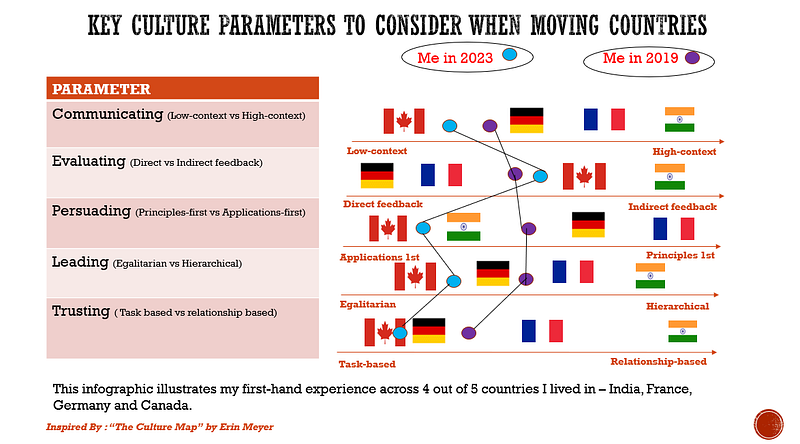
Notice the evolution between now and four years ago in 2019.
Once you are ready to consider these factors, do it with a pinch of salt. Remember, human beings are too complex to be boxed. You’ll come across exceptions, but this will work for most scenarios.
Even if it doesn’t work for you, it’ll enable you to ask the right questions and learn the truth about others’ preferences.
Living in new countries means your feelings will range from ‘I don’t belong anywhere’ to ‘I belong everywhere’. With time, you’ll learn to embrace it and look more towards the bright side of the experience.


