
Productivity | Self Improvement
How to Take Advantage of Laziness and Skyrocket Your Productivity
You don't need to “beat” laziness — embrace it and take it to your advantage.

Productivity seems like an alluring “talent” that almost everyone wants, especially since the rise of hustle culture — overworking yourself to the point of having a restless sense of striving until you burn out and start to go crazy.
And yet, you don’t want to miss out on this modern world, so you try to adopt this lifestyle into your life.
You wonder how to beat laziness and 10x your productivity. You think about how to do so many things in the shortest amount of time. You want to know how to become Elon Musk who can own five successful companies while still having the time to keep trolling millions of people on Twitter.
“My Twitter is pretty much complete nonsense at this point.” — Elon Musk
Chances are, you need to stop wondering. And stop trying to be Elon Musk for that matter.
Most people believe that being lazy means being unproductive. When the truth is that it’s not always the case. For most of us average people (please admit that already), we shouldn’t “beat” laziness — instead, we need to embrace it and take it to our advantage.
No matter how counter-intuitive it seems, having a sense of laziness can be very beneficial for our lives.
I’m a seriously lazy person. And by “lazy” I mean I have very low energy to physically move out from my space — if not necessary.
But these tips below worked for me and have helped me to have four streams of income at 23 while still have time to take care of myself, rest and rejuvenate. Who knows, maybe they can work for you too.
Here is how you can take advantage of laziness and skyrocket your productivity.
#1: Take ownership of your time
Truly productive people don’t focus on doing more tasks, quite the opposite — they do fewer things.
I know, it feels amazing to keep adding more, more, and more items to your to-do list.
It feels good to write “wake up, be amazing, meditate, go to work, visit Uncle Jay, do yoga, take an oil painting class, go to Paris” — on a piece of paper and reward yourself with a nice long nap after checking two things on the list.
Writing it releases your stress and makes you feel like you’re a fruitful human being who actually got things to do instead of just being a lazy slug all day.
But if you rely heavily on your to-do list, it may be more harmful than helpful for you. According to research, keeping to-do lists will make you bypass complicated tasks in favor of what’s easier to do.
You need to take ownership of your valuable time rather than letting some (probably unimportant) checklists tell you what to do — and worse, ended up not doing it.
Nir Eyal, the author of “Hooked: How to Build Habit-Forming Products”, can say it much better than me:
“It’s not that keeping a list of things that you need to get done is a bad idea. It’s the fact that people run their days on their to-do lists. That’s what very harmful.” — Nir Eyal
Nir Eyal recommends that instead of creating a to-do list, you can create a scheduler with specific time limits to help balance your time and tasks. Like this one:
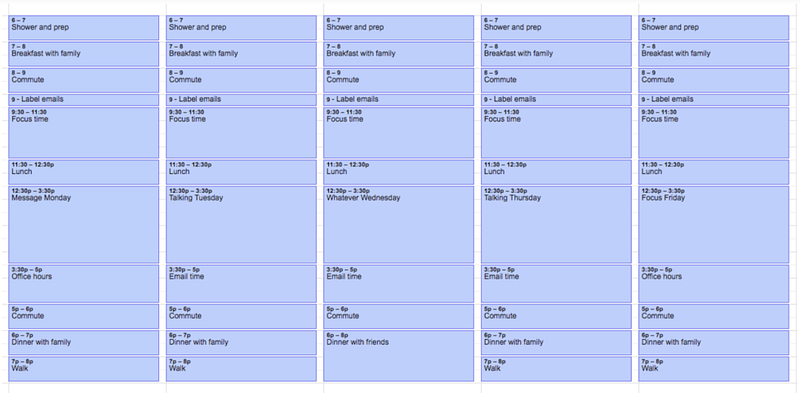
Use your laziness to prioritize tasks by doing fewer things and focusing on accomplishing things that matter. Create a weekly schedule template and always, I repeat, ALWAYS put time constraints. Do not just write “finish assignment” and let your mood decide when to do it.
You know for sure you may destroy your self-image by not doing it until the very last minute.
#2: Minimize task switching
Here’s the (scientific) truth: changing tasks over 10 times a day drops your IQ to an average of 10 points. You heard that right.
If you want to use laziness to be more productive, don’t move from one task to another as you wish. Not only it will make it difficult for you to get rid of distractions, but it may also cause mental blocks that can slow you down.
In case you didn’t know, Elon Musk doesn’t multitask, nor does he switch between tasks. Part of what makes him crazily productive is he focuses on one company at a time.
No, seriously. His weekly schedule goes like this:
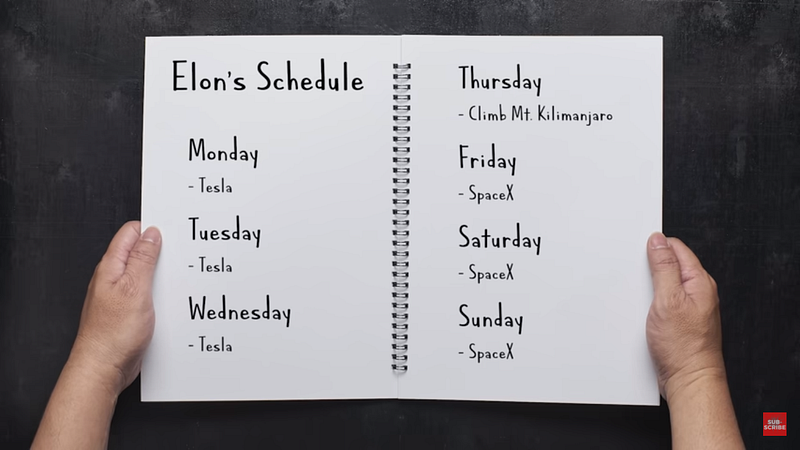
He gives 80% to 90% of his time to Tesla and SpaceX. What about his 3 other companies? Of course, he still takes care of them, but only for like 2–3 hours a week (for each).
As it turns out, what Elon (and many other productive people) do is backed up by research; switching tasks drain our mental energy far more than putting effort to do one work.
Use your laziness to manage your energy better. Don’t jump from one thing to another all the time. Besides, another research found switching tasks reduces productivity by as much as 40% — makes us more likely to make a mistake. No good in that.
#3: Use the habit of successful people as inspiration, not imitations
The truth is, you’re not Bill Gates who needs 16 daily habits to fulfill your productive life.
Forget morning routine, night routine, dawn routine, or whatever routine you heard from all the pros. Yes, they might work for some people. But not lazy people, I’m afraid.
Instead of mindlessly imitating all the pro habits into your life until you run out of steam, start with 1 pleasant habit — and stick to it.
Now, since you’re perhaps too lazy to even get out of bed, here is the key: make it like an effortless habit that is so easy you can’t say no.
For example, you know that Bill Gates has a daily habit of reading.
Cool! How can I do that too?
First, don’t set a goal to read 50 books a year (that’s what Bill Gates does, not you), but commit to reading 1 sentence every day. Then, let that one sentence lead you to one paragraph, one page, one chapter, and so forth.
- Want to build an exercise habit? Exercise for 1 minute each day.
- Want to start a writing habit? Write 1 sentence each day.
- Want to create a healthy eating habit? Eat one healthy meal this week.
Use your laziness to start small and stay persistent. There’s a whole TED Talk about this seemingly lazy method that may actually lead you to reach your big ambitious goals. You have to start somewhere.
#4: Be stingy with your time — but don’t let the hectic fool you
Often, our instinct claims that we don’t have enough time in the day to get everything done, but that’s not entirely true. The average American spends 5.5 hours per day on leisure.
What? 5 hours? There’s no way I’d have that much free time in a day!
You think so?
Well, just add up all the time you spend surfing the web, scrolling through Instagram, and doing other non-work-related tasks — chances are you’ll find the time.
“People are frugal in guarding their personal property; but as soon as it comes to squandering time, they are most wasteful of the one thing in which it is right to be stingy.”
— Seneca, Stoic philosopher
Seneca’s quote above still holds true to this date.
The vast majority of people wake up every morning with no actual plans for how they want to spend their day. They don’t guard their most precious asset: their time.
I plan to daydream at least 2 hours a day — anywhere I can. And contrary to popular belief, it shouldn’t be viewed as an enemy of productivity.
Daydreaming is where things like problem-solving, creativity, goal-driven thought, and so on find space to exist.
Use your laziness to be stingy with your time — but don’t let the hectic fool you. You don’t have to be so busy all the time. Set a time to daydream, get lost in thoughts, or just simply do nothing. Science says it can increase your productivity and make you more creative, anyway.
Bottom line
I need to make this clear. Yes, laziness is bad (in fact, super bad) if you’re just withdrawing yourself from life and aren’t doing anything about it. Having laziness as a trait is no prob, but laziness as an attitude is a no-no.
You can be tactically lazy and set self-development as your important life goal — just like I do. Finding balance is what matters, as Nir Eyal once said:
“It’s fine to watch a video, scroll social media, daydream, or take a nap, as long as that’s what you planned to do.” — Nir Eyal
Embrace the laziness side in you by following the four tips above. You’ll see how easy (and totally possible) it is to be lazy and productive at the same time.
Now if you’ll excuse me, the time I plan for writing this article is up — time to move on to the next task.