
How to Say No Without Feeling Guilty
— It gets easier with practice.
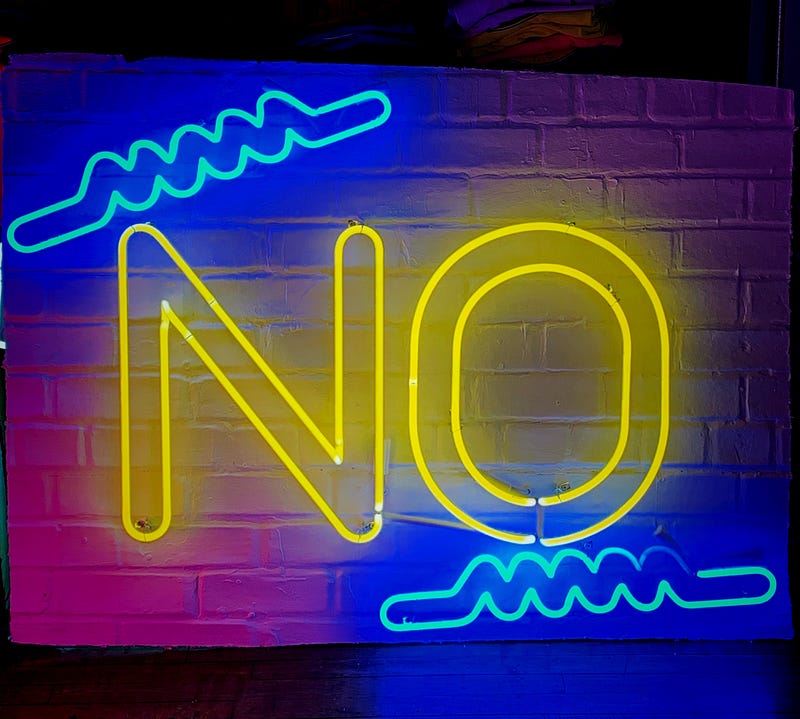
Do you find it hard to say no?
Do you find yourself saying yes when you want to say no?
Don’t worry, that can change.
I don’t have a problem saying no anymore, but I used to. Now and again, I come across a pushy person who catches me off guard, but still, I don’t say yes when I want to say no.
Instead, I say something like:
“Hmm, I’m not sure if I can, let me think about it and I’ll get back to you.”
I could never understand why people were so intrusive. I hated it.
The worst were people who called themselves “friends.” They were always looking for something but didn’t want to give anything in return.
I would let it go and say nothing, but then I started to resent it.
I was way too nice for my own good and almost everyone took advantage. I didn’t know how to stand up for myself, but when it started to cause me pain, I knew I had to do something.
Most of this happened when I was in my twenties, and by my thirties, I was reading books on ‘how to be assertive.’ I knew I had a long way to go, but I got stronger as I became more aware.
I don’t know where you are on your journey, but you can learn to say no without feeling guilty and enjoy a happy life.
You just have to learn to set boundaries.
What are Boundaries?
Simply put:
“A boundary is a property line.”
— Dr. Henry Cloud
A boundary defines property ownership. A wall or a fence divides one piece of land from another. That way neighbors can’t trespass. They can only come onto your property with your permission.
It’s the same with people — we have boundaries “to keep the good stuff in and the bad stuff out” (Dr. Cloud).
We set boundaries with people who are not dealing with their issues and are causing us stress or anxiety.
You set a boundary to take care of your heart, mind, and soul.
You have a right to your personal space. Your boundaries are defined by what makes you feel comfortable. It means you are separate from others.
You can respect your family, employer, and culture but if people cross your personal boundary, you have a God-given right to say no.
Why do people say yes when they want to say no?
The reason people say yes is that they are afraid to say no.
They could be afraid of:
- rejection — not being liked
- abandonment — they could be ostracized in some cases
- losing the relationship
- being seen as difficult (not nice)
- being thought of as selfish
- being seen as not caring (bullies will use this tactic to guilt trip you)
- being alone
Many people are caught in difficult circumstances, I understand that, so in that case, you could start with small no’s.
Ways to say no politely
Saying no does not have to be aggressive and if the person you say no to cannot accept your no, then maybe you need to question that relationship.
Let’s say someone is asking you to do something but you don’t want to do it, or worse still, they want you to do something that goes against your morals, values, or conscience.
It could be at work, home, or even church. Sometimes there’s guilt-tripping in the workplace, at home, and in churches. That’s just manipulation, so you have to learn to trust your gut and say no to them.
In the Bible, Jesus said,
“Let your yes be a yes and your no be a no.”
Here are some suggestions on how to say no politely:
- “Sorry, no thanks.”
- “I’m afraid I can’t this time.”
- “Sorry, I can’t commit to that right now.”
- “I’m sorry, that doesn’t suit me.”
- “That doesn’t work for me.”
- “Oh, I’m not sure if I can, I’ll let you know.”
- “Sorry, but I’m not available right now.”
Notice how I did not give any long explanation as to why I was saying no. Why? Because I don’t have to.
Maybe in some cases, it’s necessary, but that will be for you to decide. The best thing to do when saying no is to keep it short and sweet.
Resist the urge to explain yourself — it just makes you look weak.
If you feel intimidated in the case of a bully, hold your ground. Stay calm, stand firm and say what you have to say even if you’re petrified (of course, I am not talking about confronting violent people here).
I am referring to difficult people rather than violent people. You must not put yourself in harm's way.
With violent people, you would need intervention. Get professional help if you need to confront a violent person or inform the police if it comes to that.
Saying no is not easy if you’re not used to it, but you have to start somewhere.
Remind yourself that you want to be free, at peace, and not be controlled by the people in your life.
If you want this, it’s going to take courage on your part.
In the past, most people thought I was a pushover, but they don’t think I’m a pushover now. I would stand up to anyone today and I don’t care what they think of me.
When you stop caring what others think of you, you are on the way to true freedom. Take ownership of your life and learn to assert yourself.
Create the space to live the life you truly deserve. Nobody should be pushed around by anyone, so don’t make excuses.
If you don’t like how someone is treating you, then say no, and there's no need for you to feel guilty about it. They have a right to ask you for something and you have a right to say no.
Boundaries are a huge topic so I will only touch on it here. I will write about it in more detail in the future as I feel it’s so important.
Finally, here are some benefits of saying NO when you want to say no:
- Increased confidence
- Good self-care
- Balance and peace
- Time to think and be creative
- Happiness
- Freedom
- Energy
- Healthy relationships
Takeaway —
Saying no is something that gets easier with practice. The way to say no without feeling guilty is to remind yourself that you have a right to be happy and not to feel bullied by anyone.
When you see the benefits of being true to yourself and only saying yes when you choose to say yes, you will feel so much happier.
Giving will once again become a joy — the way it was always meant to be.
We are meant to give and receive freely.
So, be brave and start by saying “no” when you want to say no. When your mind is prepared, it will be easier for you.
And one last tip:
If it’s really hard for you to say no face to face, you could send a polite text or e-mail. Do what feels right for you.


