
How to Save Money at the Gas Station
Knowing when to pay cash or credit
Gasoline is pretty much an inelastic good. Meaning, an increase (or decrease) in the price of one gallon won’t impact you all that much.
No matter the cost, I still need gas in my car so I can drive to and from work every day. Hence, if gas is $1.99/gallon or $3.30/gallon I still need to buy it.
This past weekend, my gas light came on while driving on the highway. Without having any cash on me, I had to pay with credit at an overly expensive gas station. After this traumatic experience of not being able to save money on gas, I got home and loaded up Excel.
I pulled together most of the options someone would face when getting gas to help figure out the optimal financial strategy of when to pay with cash or credit.
Method
I had to set some parameters, as I didn’t want to overwhelm myself. But this information should apply to 97% of people.
The cashback options of using your credit card for gas were limited to 1, 2, or 3 percent. If you have a credit card that gives you more than 3% cashback on gas, I’d love to know who it's with and how I could get one too.
And I limited the price discrepancy between paying cash or credit to a maximum of $0.10/gallon. An example being a gallon costing $2.19 with cash and $2.29 with credit. That’s a $0.10 discrepancy and should cover most gas stations. If a gallon costs $2.19 with cash and $2.23 with credit, that’s a price discrepancy of $0.04.
I also limited the gas prices to a low of $1.79 and a high of $3.99. That should, again, cover most prices people pay. If you live in an area where a gallon is less than $1.79, let me know so I can move out there and lower my living costs.
A few formulas and clicks later I had what I needed.
It's worth noting there are two situations these results wouldn’t apply to.
- If the price of gas is the same when paying cash or credit, go with credit assuming you have some sort of cashback option. If you do not have a cashback option, go with whatever is most convenient.
- If you do not have a cashback option for your credit card, go with whichever option is cheaper (likely cash). If the prices are the same, go with whatever is most convenient.
Results
Now that all the assumptions are out of the way, here are the results.
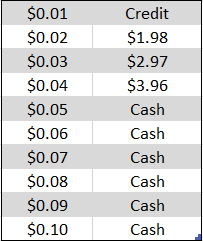
If your credit card gets 1% cashback on gas, and
- The price discrepancy between cash and credit is $0.01, pay with credit.
- The price discrepancy is $0.05 or more, pay with cash.
- The price discrepancy is $0.02, start using credit when a gallon costs $1.98. If the price discrepancy is $0.03, start using credit when a gallon costs $2.97. If the price discrepancy is $0.04, start using credit when a gallon costs $3.96.
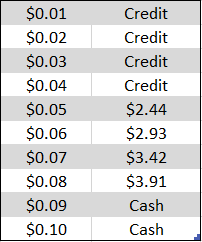
If your credit card gets 2% cashback on gas, and
- The price discrepancy is $0.04 or less, pay with credit.
- The price discrepancy is $0.09 or more, pay with cash.
- The price discrepancy is $0.05, start using credit when a gallon costs $2.44. If the price discrepancy is $0.06, start using credit when a gallon costs $2.93. If the price discrepancy is $0.07, start using credit when a gallon costs $3.42. If the price discrepancy is $0.08, start using credit when a gallon costs $3.91.
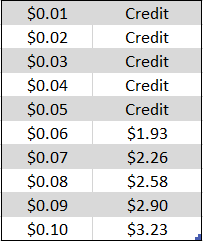
If your credit card gets 3% cashback on gas, and
- The price discrepancy is $0.05 or less, pay with credit.
- The price discrepancy is $0.06, start using credit when a gallon costs $1.93. If the price discrepancy is $0.07, start using credit when a gallon costs $2.26. If the price discrepancy is $0.08, start using credit when a gallon costs $2.58. If the price discrepancy is $0.09, start using credit when a gallon costs $2.90. If the price discrepancy is $0.10, start using credit when a gallon costs $3.23.
Summary
That was 30 different situations, of which no one has the time to remember or try to recall when pulling into the gas station.
Some general rules as a result of this information would be more valuable.
If your card gets 1% cashback, most of the time it will be cheaper to pay with cash.
If your card gets 3% cashback, most of the time it will be cheaper to use credit, but as the price discrepancy grows, then consider cash.
2% cashback is a bit of a mixed bag. But a good summary would be to use credit if the price discrepancy is small and cash when it is large.
Conclusion
I was (and still am) very frugal. At the corner by my house, there are two gas stations — one that offers no difference in the price if you pay cash or credit and the other one with a cash option that is always $0.08 less than the price of the other station. The credit card I use gives me 3% cashback on gas.
Back in college, I did the calculations to determine which place to go to, depending on what the cost of one gallon was.
Financial literacy isn’t always about what great investment to make or how to bring in a six-figure salary. Sometimes, cutting expenses can add up, no matter how trivial they may seem.
I always relish the opportunity to find a new way to save money. Hopefully, this helps someone out there — every penny counts!


