
Goals | New Year’s Resolutions | Visualization
How to Make Meaningful Change
Try the process that worked for me

If I had kept all my New Year’s resolutions over the years, I would be skinny, fit, healthy, and have an immaculate home. With a seven-figure coaching and writing business and a string of rental properties to boot.
Alas, I’m only human, and for forty years, my New Year’s resolutions went the same way as everyone else’s. One big fat fail.
The first time I made a meaningful change was when I received coaching at work as part of my development. The coaching helped me make some positive changes at work, including negotiating a change to my job description and job title.
Other outcomes were writing on LinkedIn and training to become a coach. LinkedIn writing eventually led to me writing on Medium.
So what was different? Why did coaching work, but New Year’s Resolutions fail?
Honestly, I think it because of two factors:
- I assigned a numeric score to where my current position and where I wanted to be
- I visualized what I wanted to do in detail
Now, if I want to make a change, I use this process.
Challenge: Grab a pen and paper (writing by hand increases the neural activity in your brain) and do it alongside me.
“The greater danger for most of us isn’t that our aim is too high and miss it, but that it is too low and we reach it.”– Michelangelo
Define what makes up your life
Think of all the areas of your life. You can have as many as you want, and they are relevant only to you.
My life areas for 2021 are:
- Family
- Social life
- Friends
- Finances
- Home
- Environment
- Career
- Job
- Hobbies
- Health
- Exercise
- Spirituality
- Holidays
- Diet
- Writing
- Peace of Mind
My categories don’t have to make sense to you. You may want to add others, such as religion or a specific family member. The list represents what your life consists of now and what is important to you.
When I made my list a couple of years ago, it was different.
Write your categories down the left-hand side of your paper.
Give each category a satisfaction score
Give each category a score out of ten, depending on how satisfied you are with each area (one for low and ten for high). For example, you might give yourself a four out of ten for exercise if you are not satisfied with what you currently do.
You don’t need to be overly precise; a gut feel for the score is enough.
Now you have a score for each category.
If you like, you can add up your scores and work out an overall percentage ‘satisfaction baseline’. I like to have a starting point so I usually work out my score. It doesn’t matter if you don’t.
If you have 10 categories, then the highest possible score is 100. If the total of your satisfaction ratings is 56, then your satisfaction baseline is 56%.

Give each category a desired satisfaction score
Now put the score out of ten that you would like to move to for each category.
Not everything has to be a ten. I rarely put a ten as I think everything can be improved.
For 2021 I have put holidays as a five which means a few weekends away. It is not practical to travel at the moment, and I need the finances elsewhere. A five is what I’m aiming for this year, an improvement over last year’s score of one.
Your ideal score for different categories may be different. You may be happy with a six for exercise but want a minimum of nine for your primary relationship.
Now you can work out the gap — the desired improvement for all of your categories.
The first time I did this exercise my scores were around six and seven for work, development, and career. I had a job but felt I could do more. I hadn’t had much development or training due to a lack of a budget in my workplace. I felt I wasn’t moving much in my career.
You will probably choose different priorities. This is your exercise, your year, and your life. If Covid and other circumstances mean you haven’t got the capacity for change, that’s OK too.
“Successful people do things that the average person is not willing to do. They make sacrifices the average person is not willing to make. But the difference it makes is extraordinary.” — Brian Tracy
Visualize your desired outcomes
Go through your list again and write some detail about what your desired score means.
For example, your relationship with someone might be a five, and you want it to be a nine.
- What could make it better?
- What needs to change?
- What does the relationship need to be like for you to give it a nine?
- Why did you only give it a five at first?
- What does your ideal relationship look like?
- What would you and your partner do and say?
- How would you behave and communicate?
When concentrating on improving my work experience, I tried to imagine what the ideal job would be like. I got stuck, so I used Google to get ideas and found various descriptions of a perfect job — this helped me with prompts for my vision of my ideal job.
If you get stuck with your visualizing, use Google, ask friends, or try journaling for clarity.
Once you have visualized what you want, think about how you will feel when you get it. If you want to improve your fitness, think about how it will feel and what you will do when you are fitter. What will being fit get you? What will your life be like if you are fitter?
Write your visualization of each area and how it will change your life.
With Covid affecting our lives, your ideal vision may be constrained, like my travel goal, so write what you think is possible given your situation.
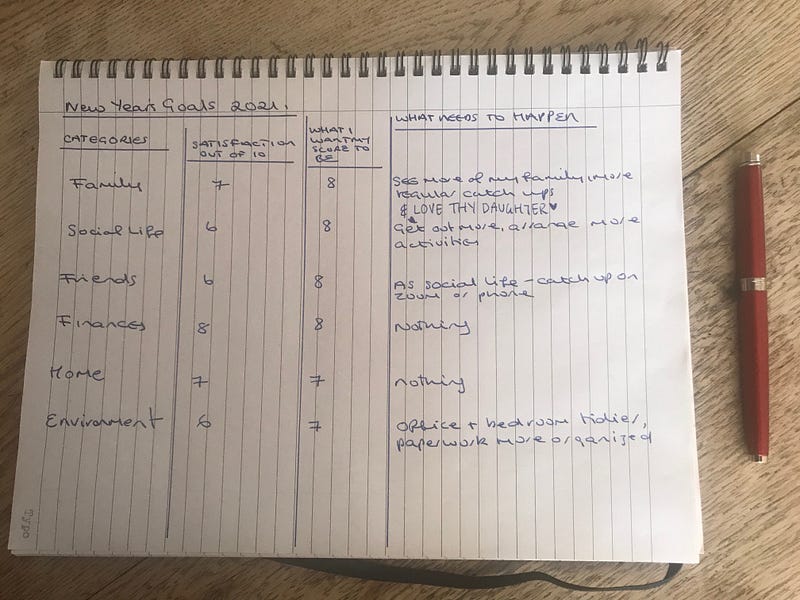
I’ve included a photo (above) of an example. Bear in mind, this is my attempt at neat handwriting, and my real one isn’t that tidy. It also has a lot more written under the ‘What needs to happen’ column. ‘Love Thy Daughter’ comment added by my daughter.
“My goal is not to be better than anyone else, but to be better than I used to be.” — Wayne Dwyer.
Prioritize
If you are like me, you will have an impossibly large list. Attempting to do too many changes at once won’t work.
Pick the three things that will make the most positive impact in your life. Or pick one or two, depending on your capacity to make a change. Don’t pressurize yourself.
Although I would like to see friends and family more often, my three areas are health, job, and the environment.
My goals for the year are to get a job, lose 20kg, and ensure that my home environment supports these goals.
I’ve avoided putting too much pressure on myself with my goals for this year. Unless I start earning big money very quickly on Medium or win the lottery, I will need a job. So rejoining the workforce is something I will probably need to do, anyway.
Losing weight is my most challenging goal. My partner likes to cook, and too many treats during Covid and after being made redundant have made me rather shapely. After all, round is a shape.
Adjusting my environment is a support goal. Cleaning out the pantry, tidying my office space, and getting enough sleep will suffice.
I’ve avoided putting a challenging goal for writing as I’m still learning about Medium as a platform. If I put too much pressure on myself, I’ll get anxious, which will be counterproductive.
Do yourself a favor and be kind to yourself when deciding what change to make.
Action plan
Once you’ve decided on the three areas you want to work on, make a list of actions to take for each area.
Make the action small and specific. The smaller, the better. A list of small actions or micro habits are much easier to follow. Do one small action a day that will move you nearer to your goal.
For example, for my goal of losing weight:
- Weigh myself to establish a start weight
- Download a calorie tracking app to my phone
- Throw or give away any chocolate, crisps, biscuits, sweets, and cakes
- Start eating a healthy breakfast
- Buy some fruit and vegetables
- Start tracking my calories on the calorie tracker app
- Set a goal for daily calories
If each daily action is small, you are more likely to work on three areas of your life at once.
If you can only cope with working on one area of change, do that.
Funding myself through a couple of coaching certificate certificates, writing on LinkedIn and Medium, and changing my area of responsibility at work were my goals two years ago.
Doing one small thing a day worked for me then and has worked ever since. Enrolling in the coaching course took many small actions, but I got there. One thing a day will still move you forward.
“A goal is not always meant to be reached; it often serves simply as something to aim at.” — Bruce Lee
Tracking and accountability
What keeps me accountable for my goals is:
Tracking — people who write down and track their progress are far more likely to attain their goals according to this article: 18 Facts About Goals and Their Achievement.
Write down lists, action plans, and progress. If something can be put into a chart form, either make a chart by hand or use Excel.
Accountability buddy — if you can enlist a friend, partner, or workmate to hold you accountable, this will help you. If you’ve been thinking about getting a coach and can afford it, go for it. I was lucky enough to have both a coach and my line manager holding me responsible for taking action when I reviewed my career and development.
Gail Mathew’s study also showed that people who sent weekly progress reports to a friend are much more likely to achieve their goals.
If you don’t want to share our goals or can’t think of anyone suitable, use your journal. Book an appointment with yourself every week to track progress and hold yourself accountable. If you can’t chart progress on excel, chart the number of actions you have taken.
I have a buddy that I talk to every fortnight on Zoom, and we hold each other accountable for action to be taken. I enjoy hearing about her challenges and goals, and we give each other lots of support and tips.
Rewarding yourself is also important. If you do something each day for a month to move you towards your goals, maybe buy that book you’ve had your eye on. The book you really want but think you should get from the library instead. The rewards don’t have to be huge but pick something that gives you joy.
Final Thoughts
If you are serious about making change, this process will work well if you put the effort in. It will take a while to get through all the steps, but it’s well worth it.
Several shorter sessions will work better than attempting to get everything done in one go. Having several sessions also means that you can reflect on the last session’s writing and review as you go.
Here are the steps again:
- List the categories of your life (work, family, spirituality, etc.) on a piece of paper’s left-hand side.
- Give each category a score out of ten for how satisfied you are now.
- Give each category a score out of ten for how satisfied you want to be.
- For each category, visualize what it would be like if you achieved the higher score.
- Decide which areas you will prioritize (no more than three).
- For the priority areas, write a list of small goals.
- Keep yourself accountable with a buddy or by journaling.
- Set up a system of small rewards that give you joy.
This process worked for me two years ago and launched me on a coaching and writing career, and enabled me to redefine my role at work. This process also helped me define what was important to me last year when I packed up ready to move house.
Covid has messed with our lives, but that doesn’t mean we can’t regularly redefine what we want. And if what you want is to put all goals on hold until you have more stability, that’s the right decision.
Good Luck!


