
How to Keep a Pulse on Your Team Members’ Stress Levels
What is the stress curve and how to use it?

As managers, we navigate a difficult balance between pushing and motivating our teams, as well as holding them accountable when they don’t perform. Nevertheless, we always have to keep stress in mind and make sure that we are not unduly pressuring them and creating a prolonged period of stress.
We also have to keep an eye on stress we cannot influence — stress that might come from their personal lives — but that has real implications on their work behavior and performance. Stress is cumulative and it doesn’t respect work-life boundaries. Everyone will have stress in their personal lives at some point and we have to be conscious of this and allow some level of flexibility when this (inevitably) happens.
For example, just this year I had several team members managing personal stress due to one trying to manage an MBA in their personal time, one with a complicated wedding (the venue cancelled on them, the date & location had to be changed), while another dealt with two moves in one year (due to problems with the first new apartment and needing to move a second time). It’s wishful thinking to believe that stress that happens outside the office will not impact their work.
Keeping the stress you cannot influence in mind is important, while keeping focus on the stress you can influence — stress at work — is key.
One of the techniques I do with my team is to regularly (and anonymously) poll where people are on the stress curve to see the overall stress level of the team. I like to do this in a context like a team half-year retrospective, just using Menti for a pulse check on the team overall.
The “stress curve”, sometimes also called the “pressure curve” is a bell-shaped trajectory that charts the relationship between pressure and performance. At one end of the scale we have boreout, and on the other end we have burnout (I’ll go into more detail later on each of the zones).
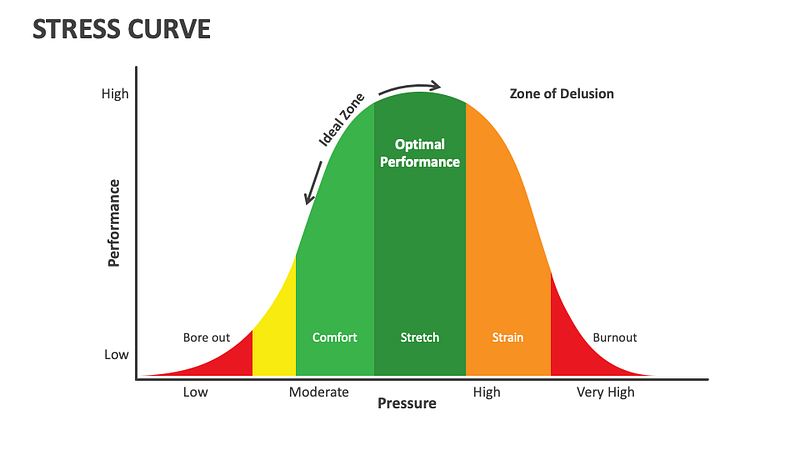
As my team already knows about the stress curve from various trainings, I simply show the curve on the screen, give a quick reminder to what each zone means, and ask them where they feel they’ve been for the majority of the last 6 months.
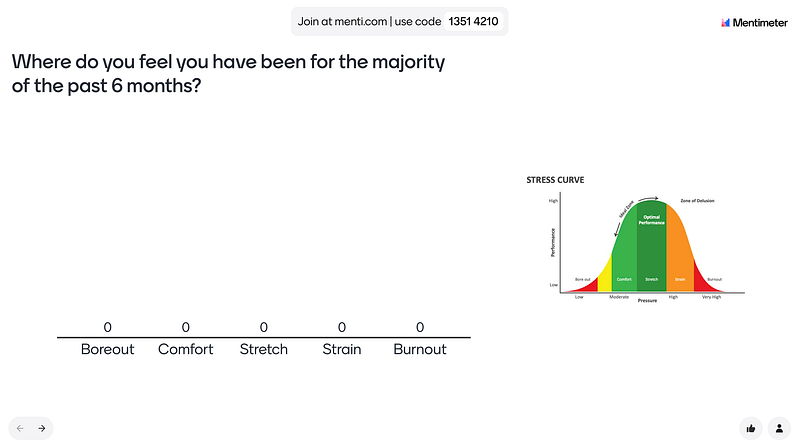
It’s a good chance to allow everyone to reflect on their own stress and also keep me accountable publicly (as everyone sees the overall team results).
Personally, I always feel a little bit of stress doing this pulse check as I feel quite vulnerable to do this in front of everyone. What if the results are poor? If they are different from what I expect, does that mean I don’t have a good relationship with my team members? But, I think the upsides for a potential discussion on the topic (if needed) outweigh any of my nerves.
Let’s go into a bit more detail now on the stress curve itself and what each zone means.
Stress curve zones
Zone 1 — Boreout zone
Boreout can occur when someone is without motivating forces and has no reason to do anything — imagine just drifting aimlessly, completely bored. It can be fun doing nothing for a while, but sitting watching TV in pajamas all day every day is not good for your performance and not good for your health.
It’s important not to confuse boreout with laziness. Boreout is being perpetually bored because of a lack of challenge. Everyone needs a minimum amount of pressure to motivate themselves. If a task is too easy, or there are no targets, deadlines or expectations to meet, then performance is usually poor. We rarely get much done unless we have a goal. Either somebody sets our goals for us or we create them ourselves.
Your team members may find themselves in the boreout zone if the work is repetitive, easy and mundane with little opportunity for social interaction. Even varied work that they see as having little value can lead to boreout.
Team members who spend time here in the boreout zone will be demotivated, disengaged, make show cynicism and lethargy in the workplace.
Zone 2— Comfort zone
The next zone is the well-known (and well-liked) comfort zone. You’ll recognize this as a moderate level of pressure that feels comfortable. It’s enough to motivate you to get things done and you can function happily here.
We can’t quantify what a moderate level of pressure would be. It’s not hours worked or problems solved. The levels of pressure are deliberately vague because one person’s idea of moderate pressure can differ from another’s.
For example, if I’ve spent the last 10 years in a job writing reports for senior management and today I have to produce an important report for the CEO, writing that report might be comfortable for me. An experienced writer used to an audience at that level should be in their comfort zone. However, if I ask a new joiner to produce the same report on their first day, that would be a very high-pressure situation.
We must consider people’s skills, capabilities, experience and personality traits because this is a perception of pressure, not an objective measure.
The comfort zone results in a good level of performance, but staying in the comfort zone all the time is not to be encouraged. Everyone needs to stretch.
Zone 3— Stretch zone
There are two good reasons to stretch: first, peak performance occurs when you stretch, and second, you cannot grow unless you stretch.
Taking yourself outside your comfort zone to the point of stretch is akin to reaching a flow state. Flow is being totally immersed in a task that requires your full attention and effort so you are fully utilizing yourself.
At the point of stretch, your body’s stress response releases the hormones adrenaline and cortisol, which help us perform at our best. We think more clearly, our vision is sharper, our hearing more acute. The fight-or-flight response raises our game to deal with short-term stress.
We don’t want people stretched all the time though. That would be exhausting. No-one can perform at their peak all day long. An ideal zone for work is one which cycles between comfort and stretch. It’s important for you to regularly communicate with your team members about their pressure levels, as well as reminding them to take regular breaks and utilize timeboxing.
When managing your team’s work, make sure to prioritze their breaks and act as a role model so they see you prioritizing breaks too. Evenings and weekends are important times to unwind and reduce the pressure over a longer period, but don’t forget about lunchtimes, mid-morning and afternoon breaks to rest during the day.
Timeboxing is also effective to chunk periods of stretch work and ensure there is more comfort zone work after. For example, if I have to work on a strategic plan in the morning that requires more thinking and creates a bit of pressure as I need to discuss with several difficult stakeholders, I might spend a few hours in the afternoon doing some easier work — work I anyway have to do — but this way I don’t have all the stressful work on a Monday, but I balance it throughout the week.
I know some people who prefer to do all their easy admin work on a Friday — but actually that is creating extra pressure on the other days of the week. If I had to spend my entire Monday working on the more stressful tasks, it would take me much longer to wind down at the end of the high pressure day, and this means I don’t come in on a Tuesday morning as rested and ready to perform as I could be.
Zone 4— Strain zone
If you’ve been in the stretch zone too long, the pressure’s increased and you’ve had no chance to recover — you enter the strain zone.
When pressure is too high, performance decreases. For a while it will exceed that of the comfort zone but soon the effects of stress take over, fatigue sets in and errors are made.
Stress symptoms will begin to develop. Frustration, anxiety, poor concentration and shame about not being able to cope take over. Performance begins to plummet.
If you notice this happening in your team members, start taking corrective action. Deprioritize tasks, be clear with (and/or reduce) your expectations, reshuffle responsibilities, escalate it with your own manager if needed, etc. There are many things you can do.
A team member’s responsibility for both the strain zone and burnout zone is — if they recognize they are in or heading for these zones — to reach out to you as their manager and communicate. You have the responsibility to be open enough with the team that they can come to you if they notice it happening and follow up if you’re aware of the risks.
Zone 5 — Burnout zone
When pressure is very high and sustained, we might enter the dangerous burnout zone. In crisis, we experience exhaustion from chronic stress. Our body perpetually draws on its survival mechanisms as it believes it is in physical danger and the “flight or fight” response takes over. Adrenaline and cortisol are now running the show and we have little chance of focusing on complex mental tasks or making good decisions. We need immediate rest.
In the short-term, the symptoms may not cause lasting harm, but long-term stress can take a toll on the body. Gastrointestinal disorders, heart disease and immunosuppression are all excacerbated by too much stress. As are several mental health conditions.
The subsequent absence and turnover costs organizations large amounts of money. If you find yourself or your team members heading for the burnout zone, take immediate steps to reduce the sources of pressure. You can’t demand more of them when their performance and health are suffering.
Both the strain and burnout zones belong to the overarching “zone of delusion”. This is where we falsely believe our performance will improve if we keep working harder.
It’s easy to focus too much on the task at hand and not on yourself or your team. Getting the job done is the priority, but we fail to see that we are not getting the job done because we are stressed.
Managers must be aware of our own tendency to enter the zone of delusion, but also look out for it in their team members. Staff may say they are working effectively, but actually have declining performance. We should step in and ensure they take measures to scale down the pressure where possible.
This can make it difficult if you have deadlines to meet, projects to launch, but you have to be that voice that says “no” louder and stronger if it is at risk of happening. I know it can seem worrying that if you don’t meet a project on time, you might hurt your professional reputation, career prospects, etc. But, trust me, having an employee with burnout in the team is much worse not only for your professional perception but also the future willingness for the rest of the team to go through periods of stretch.
I speak from experience — I’ve had an employee with burnout some years ago (who luckily recovered well and maintained his seniority). But, there were doubts about how effective my management was for years afterwards from HR — and from other people in the company who the rumors had spread to.
And not just that, but as the rest of the team was aware it had happened, every time there was a period of stretch necessary (not strain, just stretch) some fought adamantly against it and it made managing some members of the team difficult in the short- to mid-term.
So, take it from me, keeping a pulse of the team’s stress levels will benefit you immensely and help you be a more effective and successful manager.
Takeaways I hope you take from this article:
- The stress curve is a bell-shaped trajectory that charts the relationship between pressure and performance.
- The 5 zones in the stress curve are: boreout, comfort, strain, stretch and burnout.
- Team members should have periods of work in the stretch zone so they can grow, but this should be complemented by periods of comfort zone work.
- Rest and timeboxing are effective tools to help manage team members work-related stress levels throughout the week.
- Not all stress is from the workplace, be conscious of stressors in your team members’ personal lives and be flexible and understanding
Thanks for reading! If you enjoyed this article, please feel free to give me some 👏👏👏 or follow me on Medium for more.


