
In Need Of A Practical Way To Empower Your Direct Reports? Try The GROW Coaching Model.
The GROW model is a powerful framework for structuring coaching conversations.
I thoroughly believe that managers who work on honing their coaching skills earn one of the best tools to empower their teams.
I’ve already covered a few of the basics about coaching in some of my recent articles: asking open-ended questions and just what coaching is.
If you haven’t already read those — I suggest jumping there as a pre-requisite before today’s article, as you’ll be more successful at your attempts to use the GROW model:
What is a coaching model?
According to the Peak Performance Center,
“a coaching model is a method designed to guide an individual through a process from where they are currently to where they want to be.”
The purpose of a coaching model is to create a framework for the coaching session so the coach can more effectively guide the coachee (the team member being coached) through the session.
What is the GROW coaching model?
The GROW model is one of the most well-known coaching models. It is a powerful framework for structuring coaching conversations and centers around four key phases:
G — Goal
R — Reality
O — Options
W — Way forward (or Will)
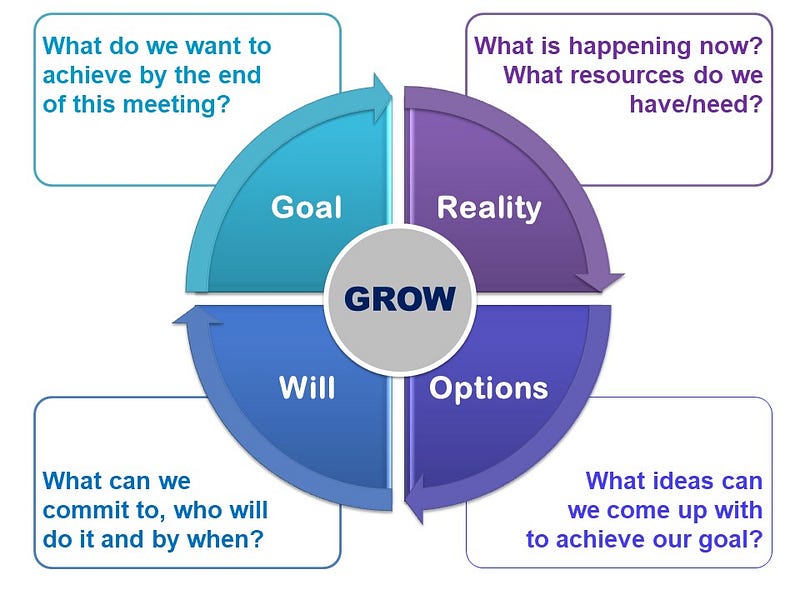
The model essentially helps you to structure the coaching conversation in a way that ensures you focus on actions.
If you’re not focused on an action — then you’re just having a chat, it’s not a coaching conversation.
Each phase offers a roadmap for constructive conversations that empower team members to identify goals, confront realities, explore options, and commit to actionable plans.
A good way of thinking about the GROW model is to think about how you’d plan a journey. First, you decide where you are going (the goal) and establish where you currently are (the reality) you then consider the various routes to your destination (the options) and finally you choose a path (a way forward) and commit to the journey ahead.

Let’s go into a little more detail for each phase:
1. Goal
You should start by asking the team member (coachee) to establish a goal.

The goal should be possible to accomplish within the particular session — so if it’s a large goal to be discussed, you need to help the team member narrow it down into more of a bite-size piece.
The goal can be:
- A performance goal
- A development goal
- A decision to make
- A problem to solve
And you can start by simply asking the team member “what do you want to get out of the conversation today?”
Just ensure that it is a clear goal — so follow the SMART methodology as closely as you can — making sure it’s specific, measurable, achievable, relevant and time-bound.
2. Reality
Next, it’s time to assess the current reality. Encourage an open discussion about the current situation, challenges, and resources available.

Help the team member to develop awareness of the current situation and explore how far they are from their goal right now. Discuss both external and internal factors.
3. Options
With the groundwork laid, it’s time to brainstorm potential paths forward. Encourage your team member to brainstorm options and strategies, daring to consider options they would take if there were no restrictions.

As the coach, you should not offer any options or direct advice on the options they share. Your team member is making the suggestions and will anaylze later what is most appropriate for them.
During this phase, simply note their options and ask for additional clarification. Challenge them with what they might do in hypothetical situations to foster their creativity.
A great question during this phase is simply “what else?” After each option — keep asking them — challenge them to really visualize all the options on the table.
4. Way forward
Again, this part is what differentiates a coaching conversation from a chat. In this conversation we are driving towards the goal and driving towards action. So this final phase focuses on creating a concrete action plan.
Based on the reality shared and the options discussed, ask the team member to choose the option they believe best. Establish a clear plan forward and ask how they will hold themselves accountable if it’s not already clear. Directly ask for commitments.

Some coaches also recommend to ask during this phase for how confident the team member is on a scale of 0 to 10 that they will follow through with their committment. And if the answer is an 8 or lower, to push with additional open-ended questions to see why and what can be done to get it to a 9 or a 10.
As I do my coaching solely in the workplace, usually with direct reports, there is already some inherent accountability in this coaching session (as I will definitely be asking my reports about their progress). So, I have rarely — if ever — asked that as one of my final questions.
The GROW model in action
I think the easiest way to understand how this works in reality — is to see some coaching in action. And unfortunately, we can’t do that easily with a blog and I’ve only ever found a few good examples online.
Here’s the first: a 3-minute animation (sorry, it’s a bit cheesy I know). You will certainly notice some caveats to this video — the coach doesn’t ask for many options and also they use closed-ended questions more than I would recommend. Nevertheless, as the first insight into how the GROW model all comes together in a workplace setting, I think it’s a nice overview:
What is the most important part of the GROW model?
During a GROW coaching session, you’ll find you tend to spend the vast majority of the time in the “reality” and “options” phases. It takes time to let the team member really think about their situation and clearly list all the options on the table. However, the most important parts of the GROW session — if you find yourself pressed for time for example — is the “grow” and “way forward” phases.
Remember, this is a coaching conversation focused on action — so if you’ve jumped into the reality without understanding where you need to go, you’re unlikely to finish the conversation in line with what the coachee was aiming for. And, similarly, if you’ve run out of time for the way forward part, then the team member has done a lot of talking, shared a lot of their problems, but has no solution when they walk out of your office.
So, both you and your team member will probably end up feeling frustrated. Even though talking through the reality might have helped somewhat, it’s surely not as impactful as walking away with a clear action item that the team member thought of and decided to go for themselves.
As a result, always keep one eye to the time, and make sure you are moving effectively through the phases so that you have a goal in mind and end the session with an action. Even if you didn’t have time to exhaust all the possible options, you’ve given your team member some time to think and that’s resulted in a commitment to move forward.
A longer and better example
I want to wrap up with my favorite GROW coaching reference video. It’s more in a traditional coaching context than a coaching conversation with a manger, but I’m confident this example will resonate with a lot of you and maybe is even a challenge your team members are struggling with right now.
I like how the coach continuously pushes for more options and then really nails down a commitment at the end that the coachee will follow through with. It’s a 7-minute video, but I think it’s well worth a watch:
Takeaways I hope you take from this article:
- The GROW model is a powerful framework for structuring coaching conversations
- GROW model stands for: goal, reality, options and way forward (or will)
- During a coaching conversation using this model you should drive towards the goal and towards action
Thanks for reading! If you enjoyed this article, please feel free to give me some 👏👏👏 or follow me on Medium for more.


