
The Manager’s Guide to Coaching
What is it really? How to get started?

There are a lot of misconceptions about coaching. What is it? Why should organizations and managers care? And, what’s the first step to even start?
What is coaching
COMENSA defines coaching as,
“a professional, collaborative and outcomes-driven method of learning that seeks to develop an individual and raise self-awareness so that he or she might achieve specific goals and perform at a more effective level.”
A simplified way of describing coaching is that it is really just asking questions to serve your team members’ thinking — not giving advice, teaching or telling.
One of the most important things about coaching is to understand that it is a skill that needs to be learned and honed over time.
It is a subtle insult to your team members to always be the one with the answers. You are suggesting that they themselves cannot get to the answer and taking away their capacity to think about it themselves and further develop their problem solving skills.
As a manager, I personally find this really difficult to do. I often have the tendency to jump in and try to (as I view it) “help” my team members and try to bring them solutions when they come to me with problems. So, I empathize with anyone else having issues trying to become a better coach in the workplace.
It can be extremely frustrating, right? We are experts, we have suggestions, we want to help the team achieve their goals. But the key to all of this is that it depends on the situation. You are not always a manager, we wear different hats.
Sometimes, of course, we act as managers to get something done in a specific way, by a specific person, for a specific time.
Other times, we act more as consultants or mentors for our team members, and we should also do our best to find as many opportunities as possible to act as coaches.
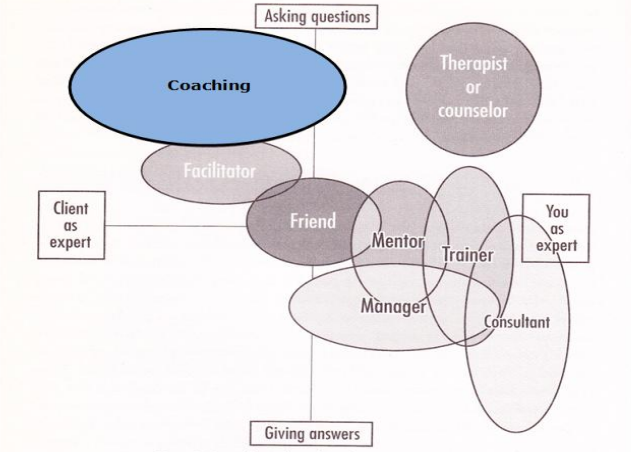
For example, one conversation might be:
“Hey, I need this report on Friday at 5 o´clock, following the same style as XYZ”.
And, another might be a conversation where you ask your team member open-ended questions to stimulate their own thinking. The most obvious would be a conversation around career development:
“Where would you like to go? What does the future look like? What strengths can you tap into?”
So as you learn more about coaching, don’t think that you always need to act as a coach. As a leader in an organization, your role will be constantly shifting, depending on the person and the context.
Clearing up some misconceptions about what coaching is / isn’t
Professional coaching is for “problem” employees or behavior correction — MYTH
Coaching can be a tool to correct behaviors, if that is what the client asks for help with or has been contracted.
However, when doing coaching as a manager then most of the time you are working coaching conversations into your typical feedback / performance discussions and using it as an enhancement tool to focus on supporting your team members to identify and capitalize on their strengths and solve business-relevant problems.
Coaching is mainly for junior employees — MYTH
Coaching is valuable to anyone who is motivated and wants to make a change or improve performance. It should be available to employees at any level within your organization.
Coaches give team members advice — MYTH
When you are having a coaching conversation as a manager, you must deliberately hold back your ideas for solutions. Coaches do not tell people what to do or give them direct advice.
The whole concept of coaching is that people don’t respond well — or learn well — when told what to do. They learn better through self-discovery.
When you are acting as a coach, you help your team to leverage their own experience, knowledge and creativity to solve their own challenge. It is a collaborative and not instructive experience.
This is why in my opinion managers cannot always be coaches.
There will be certain times with your team members where you choose to act as a coach to help them learn / see they can solve their own challenges.
But, other times you must act as a mentor with advice, and other times as a stereotypical manager to get something done a specific way.
Coaches need to be living examples of excellence — MYTH
Luckily for me, this one is also a myth. Coaches do not need to be perfect to coach others. It is the coaching methodology that helps people be effective coaches, not that they have done everything perfectly themselves.
So, how that we’ve cleared up what coaching is / isn’t, why should you and your organization care about implementing a coaching culture?
Why should organizations teach coaching to management?
1. Employees crave consistent coaching and feedback
Since 2018, there has been an 89% increase in the percentage of employees who want formal performance conversations monthly or more frequently. This trend is felt even more keenly with the younger generations.
According to a study by the Center for Generational Kinetics,
60% of Gen Z employees want multiple check-ins from their managers throughout the week,
with 40% of those wanting daily interactions with their manager. They seek to build relationships with their immediate supervisors and create channels of communication, enabling them to access the coaching and feedback they require and desire.
2. Coaching positively effects employee engagement
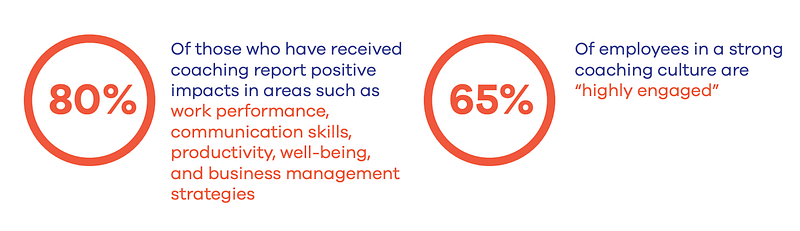
71% of executives say that employee engagement is critical to their company’s success; and yet only 20% of employees are engaged with their work.
In a study by Fuel50 and Quantum Workplace, it was concluded that 85% of highly disengaged employees don’t receive enough coaching from their direct leader.
Coaching — and having a good coaching culture in place — at an organization can have positive effects on overall employee engagement.
3. Coaching reduces turnover
According to a study conducted by Gartner, when managers coach effectively, their employees are 20% more likely to stay at their organizations.
“Much of today’s coaching simply isn’t effective, and yet we know that when managers get it right, the benefits of good coaching are clear,”
says Jaime Roca, Senior Vice President, Research & Advisory, Gartner HR Practice.
“Our research shows that employees who report to managers who coach effectively are 40% more engaged, exhibit 38% more discretionary effort and are 20% more likely to stay at their organizations than those who report to ineffective coaches.”
Employees who receive coaching in the moment, when it’s most applicable and useful, not only appreciate it, but value it and see it as a reason to stay with their leader and company.
4. Coaching helps the bottom line
When leaders have strong coaching skills, it benefits every part of the organization. Coaching can bring improvements to performance, productivity, improve communication and enhance creativity as well as reduce turnover, etc.
Organizations whose leaders have developed coaching skills are 130% more likely to see stronger business results
And, what’s in it for you as a manger?
As you’re reading this article, I’m already assuming that you care about being a better manager and trying to bring out the best in your team (you’re awesome for that by the way).
As an effective coach in the workplace, you can help to increase team performance by providing targeted guidance and support.
Encouraging team members to think critically and find solutions on their own, rather than relying on you to provide answers, will promote a culture of independent problem-solving. You’ll see that team members would approach a problem differently than you — and that can be a great opportunity for you to learn as well.
You’ll be able to understand your team members better. By guiding them to solve their own problems, you can see how they perceive something, what is the motivation and context behind a decision, how their confidence improves over time, etc.
You’ll be able to cultivate better relationships with your team members. And, when employees see that their manager is invested in their development, they are more likely to be engaged, motivated and loyal to the organization.
Lastly, as an effective coach, if your team is performing and has high morale, you become an essential asset to your organization. For any future career step inside (or outside) of your organization — this valuable (and marketable) skill will help you to be an effective leader now and in the future.
How to get started coaching your team?
There are a lot of coaching models out there. Some of the most popular that you may have heard of in various management trainings:
- Solution-focused coaching model
- GROW coaching model
- OSKAR coaching model
- CLEAR coaching model
- AOR coaching model
- FUEL coaching model
- WOOP coaching model
My personal favorite is the GROW coaching model:
But, if that list looks daunting and a bit overwhelming, I have good news for you. You don’t need to worry about using any coaching model to start trying out your coaching muscles.
Focus on active listening and in particular asking open-ended questions. These are a pre-requisite to becoming a good coach.
Once you’ve got the habit of asking open-ended questions, applying one of the models will come much more easily and help to bring structure and action to your conversations.
After all, if there’s no action from the conversation, then you’ve just been having a chat with the employee rather than a coaching conversation.
So if you’re considering a personal development goal for the next few months, focus your efforts on active listening and then come back to coaching afterwards to learn some of the other skills or try out one or two of the coaching models.
A quick recap of the key messages I hope you take with you:
- Coaching is asking questions to serve your team members’ thinking (focused on promoting action towards an outcome/goal)
- As managers, our role is constantly shifting — we can’t always act as a coach, but we should focus on finding opportunities where we can
- Organizations should support managers to become better coaches to improve employee engagement, reduce turnover and improve their bottom line.
- Managers should care about becoming better coaches because it will promote a culture of problem-solving, improve performance, morale and also provide a marketable skill useful for any future career growth
- The easiest way to get started is to practice asking open-ended questions as a first step, almost like a pre-requisite for effective coaching
Coaching doesn’t come without drawbacks. It requires more time and energy from you as a manager, changes don’t happen overnight, and a fast-paced company or period might not allow you to do as much coaching as you would like. However, the long-term benefits surely outweigh the cons, if you stick with it.