
How To Prevent Demotivation — According To The Theory.
Preventing demotivation is a topic all (good) managers care about.

Why should we even bother to look into the motivational theories? My view — there’s food for thought in each one. There’s no perfectly correct theory to choose from. (I wish there was, that would make our lives as managers much easier!)
So, in my view it’s worth taking a look at both some of the classic, and more recent, motivational theories to improve our base understanding of motivation. It’s interesting to see how different theories have evolved over time, and, for many of us, by the end of our careers there will likely be better research around to draw from.
The classic theories of motivation
Let’s start with “the classics”:
- Taylor’s Scientific management
- Maslow’s Hierarchy of needs, and
- Herzberg’s Two-factor theory.
Taylor’s Scientific management
Frederick Taylor was an American engineer and management consultant. He was born a decade after the end of the Industrial Revolution and lived from 1856–1917.
His approach to management was based on the measurement of:
- what can be done better and how
- monitoring to ensure targets are met, and
- control through analysis
He was laser focused on efficiency and productivity and his famous book “The Principles of Scientific Management” came out in 1911.
His scientific management theory was all around identifying the most efficient methods of production. He wanted to identify the most efficient workers and why they are so good. Then train the remaining workers to work like the best. And then reward workers based on productivity. So, for example, how many pieces of something they produced.
For Taylor, what motivated people was MONEY. And money alone. And in his view it should be based on targets, rewarding those who meet the targets and paying them based on a “piece rate” (unit of output).
A famous Taylor quote succinctly sums up his thinking when it came to managing employees:
“We do not want any initiative. All we want is them to obey orders we give them, do what we say, and do it quick.”
What did his theory mean for managers? The implications of this theory meant that managers should:
- maintain close control and supervision over their employees
- demonstrate an autocratic style of management (which created a them v. us mentality)
- motivate workers using piece-rate payment
And, before you think this theory all sounds so old-fashioned and in the past — think critically about the world we live in and the companies existing today.
Manufacturing facilities in emerging markets often use piece-rate payments. And what about an Amazon warehouse? Or a delivery job in the gig economy?
Maslow’s hierarchy of needs
Abraham Maslow’s hierarchy of needs is probably the most famous motivational theory. It was highly influential both at the time and still today.
Maslow’s “A theory of human motivation” was published in 1943 and centered around the idea that people have 5 sets of needs which come in a particular order.
How did that translate into something managers could use in the working world? For managers, the needs and levels for their employees would look like something like:
- Basic needs (food, shelter)
- Safe working conditions / job security
- Feeling wanted, sense of belonging, part of a team
- Self-respect, level of status
- Intellectual needs, fulfilling potential, achieving targets
Only once a lower level of need has been fully met, would a worker by motivated by the opportunity of having the next need up in the hierarchy satisfied.
The main takeaway for managers therefore was that a business should offer different incentives to workers in order to help them fulfill each need and in turn progress up the hierarchy of needs.
Criticisms of this theory in the workplace is that it assumes everyone has the same needs, people’s perception of what is important at work will still vary and it’s not realistic that most employees will reach the top of the hierarchy.
Herzberg’s two-factor theory
The next psychologist, Frederick Herzberg, strongly disagreed with Taylor’s approach. He was much more convinced about the importance of non-financial factors.
Herzberg’s two-factor theory was developed in 1959 and consisted of two dimensions:
- Motivators — factors that directly motivate people to work harder. For example, responsibility at work, or achievement and recognition
- Hygiene factors — factors that demotivate if not present, but do not actually motivate employees to work harder. For example, pay and other financial rewards or working conditions.
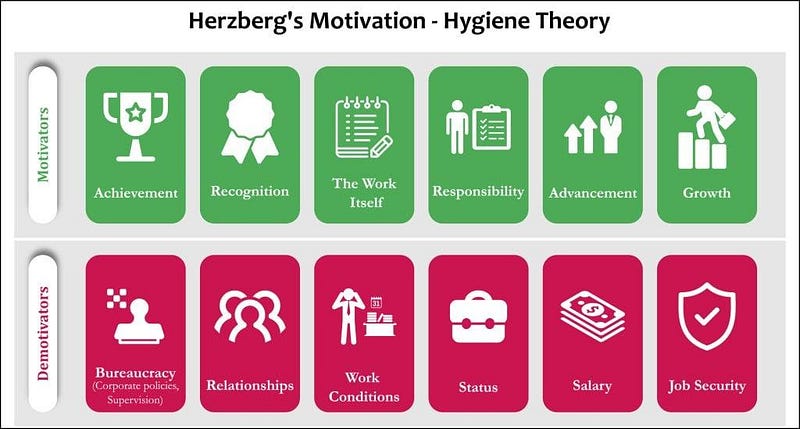
Herzberg suggested that managers should motivate using the motivators and ensure all hygiene factors are met. In his view, if you hadn’t got the hygiene factors met, then trying to motivate would be an uphill battle.
Two motivators in particular that he suggested to focus on was everything around job enrichment and empowerment.
- Job enrichment — wider variety of tasks, greater complexity & challenge, managing your own workload and having a greater sense of achievement.
- Empowerment — more responsibility and autonomy, allowing employees to make decisions independently, less supervision and showing trust.
(Side note — empowerment as a concept didn’t really emerge until the 1960s, so he doesn’t use the exact same term in his paper.)
Herzberg believed that certain motivators or hygiene factors may be more or less important depending on an individual’s personal and professional contexts. So for me, maybe growth is my biggest motivator for now, but maybe for one of my peers it’s the recognition. So it’s important to consider for a manager to consider the individual.
One of the main criticisms of this theory is that if hygiene and motivators are equal importance, then why are both not capable of motivation?
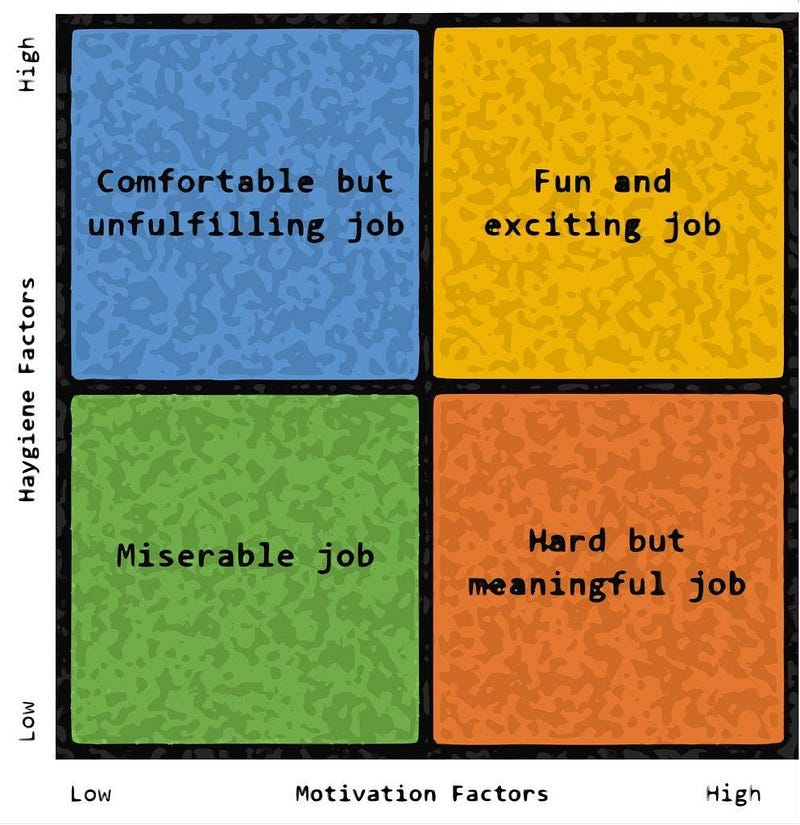
Another criticism is that it merges together satisfaction and productivity. While it might be true that being satisfied makes you work harder, Herzberg only investigated satisfaction levels and not work output.
More recent motivational theories
Now we’ve had a look through the classic theories of motivation. Let’s take a look at two more recent ones: equity theory and expectancy theory.
Equity theory
The next theory was written by someone still alive today. However, John Stacey Adams’ job motivation theory was published back in 1963.
As some graphics can help explain this concept better, I’m going to kick this section off with a short 2-minute video to introduce the theory:
Now that you have an intro to the theory, what are its implications for managers?
Following equity theory, managers of a demotivated employee should consider what the employee considers their inputs v. outputs. Then take steps to correct the imbalance.
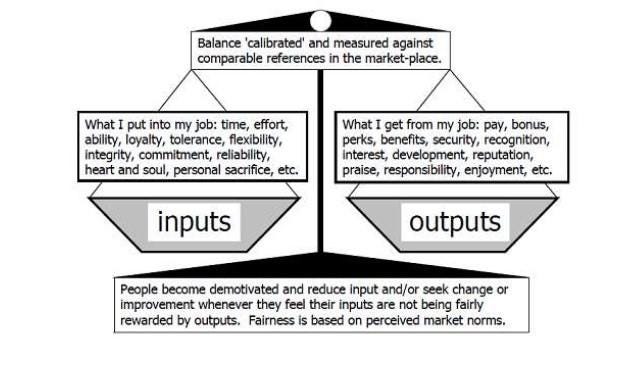
Limitations of this theory which you may have already considered are it can be difficult from an outsider view to first understand if an imbalance exists, and if so then what specific actions should be taken to re-balance the scale.
For example, the theory hasn’t considered the number of demographic and psychological variables that have affect people’s perceptions of fairness.
Silicon valley might be the best example of equity theory at work. In offering such a variety of perks, companies are inadvertently trying to balance the scales. But the success of these initiatives in relation to the theory is still inconclusive when it comes to measuring job satisfaction.
Expectancy theory
The last theory was developed by Victor Vroom in 1964. Expectancy theory believes an individual will be motivated when they believe that they can hit their targets, they know they will be rewarded for hitting those targets, and they value the reward.
The measure for expectancy theory is: Motivational force = E * I * V
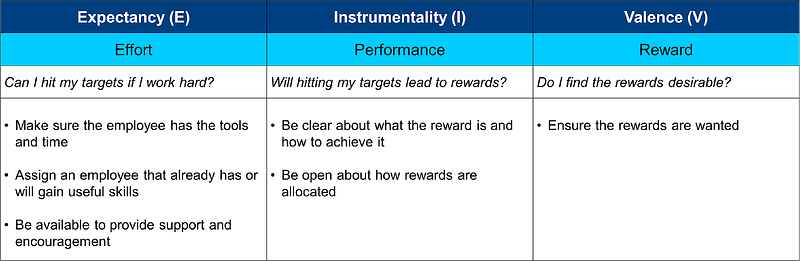
- Expectancy (E) — is the belief that if you work hard (effort) you will be able to hit the targets (performance) set by your manager.
- Instrumentality (I) — is your assessment of how likely you are to receive a reward if you hit the targets that have been set for you.
- Valence (V) — your perceived value of the reward (can be positive or negative).
According to expectancy theory, all 3 factors must be present to motivate employees effectively.
One of the major upsides to expectancy theory is how simple it is. In the table below, you see what the employee is considering at each variable, and the actions the manager can do to increase the value.
But that simplicity is also a downside. For example, this theory ignores external factors (ex. someone with issues in their personal life is likely to underperform no matter the rewards on offer) and it is also difficult to implement at-scale in a large organization.
For extra fun on the topic of expectancy theory, I can recommend this 7-minute podcast.
Summing up, we looked at 5 different theories which came out in the span of roughly 50 years.
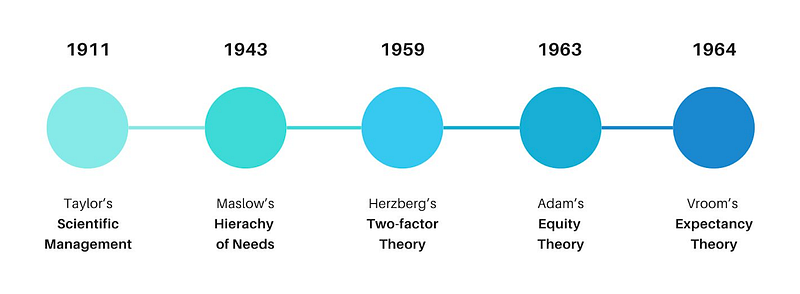
If anything, this should give you the confidence that motivating employees is hard — there’s no definitive answer on how to do it best.
There’s definitely things that can be taken and implemented from the different theories, which is why it’s worthwhile to understand the research out there.
But I hope that reading up on the theories inspired you, rather than overwhelming you.
Thanks for reading! If you enjoyed this article, please feel free to give me some 👏👏👏 or follow me on Medium for more.