How to Instantly Boost Your Web Store Sales
3 ways to unlock new revenue on your website

Working as an eCommerce professional, I’m very fortunate to gain real-world insights from an array of online retailing clients that I work with.
This article will reveal three tested and proven methods that online retailers around the world can deploy right now for immediate results.
Results that convert into instant revenue — real cash in the bank!
So belt yourself in folks, here we go.
1. Monetize your shipping
As a consumer, I always aim to get a deal. Or at the very least hit the minimum order value for free shipping. The target set by whatever brand I’m engaging with so I don't ‘waste’ money on delivery.
The reason I do this is that there are few alternatives to choose from if I want to feel like I’ve gotten some kind of deal — it’s usually the only deal in town.
My advice to online retailers is simple — Stop it!
Shipping costs money. Fact. Someone has to pay.
The only reason it’s undervalued by consumers is that we’re conditioned to think that way. Yes, online retailers either shout about it or at least include as standard on their home page, as you can see on Brown Thomas below.
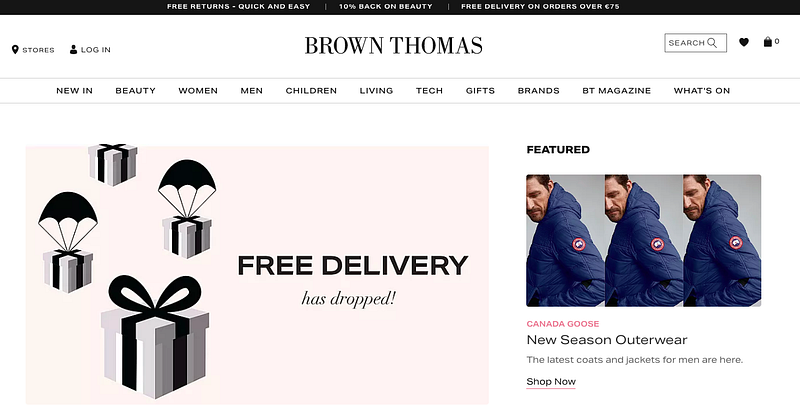
So having trained customers to expect free shipping, by spending €50, €75 or even €100, most online retailers are missing out on an opportunity.
Think about it. Take the €75 example above. As a retailer, the actual cost to ship is €4 to €5, minimum, for a tracked and signed service. The financial impact is:
→ Margin lost: (€5 / €75) = 7.5%
Seven or eight percent is a big chunk of margin to part with so easily.
So why not try to reduce this and do so by giving customers more choice?
The example below is from a real-world case study, a business that tried the ‘choice-method’, for one month in 2019, during peak demand.
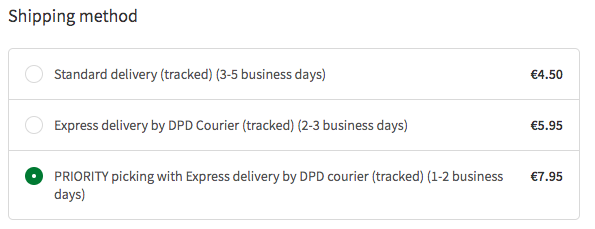
“Standard delivery” was still available for free if the buyer triggered the €100 threshold, which was the case at times.
By contrast, when the company shipped 45,000 orders during their peak month, 50% of consumers chose “Priority picking with express delivery”.
→ New revenue A: (45,000*0.5)*€7.95 = €178,875
Another 10% chose “Express delivery” at €5.95
→ New revenue B: (45,000*0.1)*€5.95 = €26,775
In a single month in 2019, the business realized new revenue totaling:
→ €205,650
This was quite simply a stunning result.
Psychology
The lead-time to cost ratio was a powerful proposition (if less than €100). What I mean by that is for €7.95 the customer was guaranteed next day delivery, but for €4.50 they would have to wait 5 times longer.
The real masterstroke by the company was therefore grounded in psychology. The logic inferred by most customers was:
For less than double the standard delivery cost I can get express delivery and shave 80% of the lead-time — Deal.
Given the choice, over half the number of customers who purchased during that month in 2019 opted for the premium delivery service.
2. Friction can pay
I read an article about auto-populating the Shopify discount field directly from your email campaign. The thinking behind this feature is to reduce customer journey friction to increase conversion.
I disagree — be careful what you wish for too, which I’ll explain below.
In the same case study, the company decided not to do this in 2019. In 2017 and 2018 they auto-populated their discount field, giving away 10% automatically to everyone.
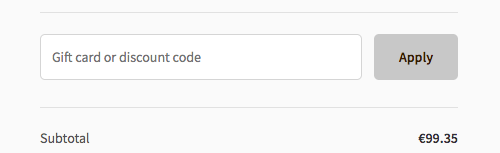
Here’s what happened when they stopped this practice:
Only 66% of customers actually bothered to copy and paste the 10% off discount code from their email to checkout.
Technology evolution has made us inherently lazy
So what was the outcome for the business considering that 33% or one-third of the 10% discount was left on the table i.e. 3.3% in revenue?
→ 3.3% meant that €264,000 was retained
The same ethos was applied as before— let the customer choose.
What I meant by “be careful what you wish for” above, is that this method enables an online business to identify a cohort of customers who are price-sensitive and those who are not.
A conversion focus can attract the wrong type of customer.
Don't get me wrong, I completely agree with the concept of “customer-first”, although I’d just rather know which customers I want to put first.
Just kidding.
In truth, this type of data is gold-dust for online retailers. Knowing the type of customers who are less price-sensitive means that you can find more of those highly profitable customers — In effect, defining a lookalike persona for your ideal customer.
Your conversion rate may dip, temporarily, but your Customer Lifetime Value will be better off in the long term.
Result
In 2019, the business realized new revenue totaling: €205,650 + €264,000
= €469,650
If the inverse were true, where non-price-sensitive customers represented 66% as opposed to 33%, the impact would this look like this:
→ 6.6% would equate to €528,000 being retained
The numbers don't lie folks!
3. Branded novelty product
What I’m about to explain is not entirely unique, but highly convertible if the price point is very low and highly discounted — less than a Euro or Dollar.
However, it’s worth pointing out that a unique dimension can add appeal due to scarcity mindest i.e. a product can only be bought from this website.
Let me share a story with you about the power of one such novelty. Back in the 1980s in Ireland Ulster Bank was trying to gain market share. They knew that Irish consumers rarely changed banks. So the strategy was aimed at capturing future customers, the next generation.
Enter Henri the Hippo!

To date, almost 40 years later, Henri the Hippo is considered to be one of the most successful marketing campaigns ever in Ireland.
A household without a Henri the Hippo was unheard of.
In fact, in 2008 the bank relaunched “Henri” to Irish consumers to dampen the impact of the financial downturn, relying “on nostalgia to sell the account to sentimental parents.” (The Irish Times, 2008)
So what’s my point I hear you say.
Well, online retailers can adopt a similar offering to their customers, a novelty product at checkout, and make money too. Here are three examples:
- Pack of 10 bookmarkers
- Fridge Magnet
- Shopping keyring
The list price for these items can retail at €4.99, but by offering customers a 50%-80% discount at final checkout converts (half price example below).
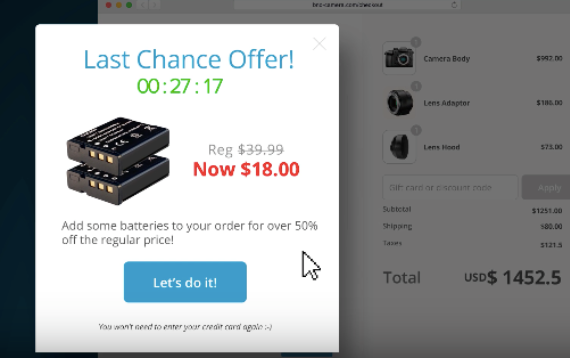
Why? At 50%, 80% off or better still, just €0.99 “Cognitive Dissonance” associated with consumer spending, or overspend rather is removed. We rarely give a second thought when something costs cents, a fraction of our total basket (Mcleod, 2018).
The same client discussed above sold 10,000 novelty items in their busiest month in 2019, generating €9,900 new revenue at a 50% margin (€4,950).
The magic
The real magic occurs during aftersale. The reason for this is that by placing a branded, physical and functional product in the consumer's hands and home is hugely powerful. The ultimate product placement (Johnson, 2018).
Free lifetime marketing!
Functional products like fridge magnets are non-perishable, as such can be used for a lifetime, potentially.
Let’s consider the impact of this strategy. Take a family of four household, 2 adults and 2 children:
- Each uses the fridge once a day — 365*4 = 1,460 impressions
- Each uses a bookmark once a week — 52*4 = 208 impressions
- The shopping keyring is used once a week — 52*1 = 52 impressions
So in a single year, a family of four could potentially interact with your brand up to 1,716 times — for free!
That’s strategic marketing.
Final thoughts
This evidence-based observation has certainly influenced my thinking. So here’s a recap on the three takeaways recommended above:
- Monetize your shipping — This is an untapped revenue stream, all to often sacrificed by online retailers. I’d urge you to reconsider or review.
- Embrace friction —A frictionless journey is an admirable objective unless you're leaving money on the table as a result. So think like a business before overthinking the consumer's journey.
- Novelty marketing — Free marketing is … priceless! Literally. Brainstorm ways to place your brand in the home of your consumer, offline. It will pay back tenfold.
In 2020 the case study client example above is anticipating a 20% increase in sales. Let me remind you what this means in numbers:
- 2019 → (€205,650 + €264,000 + €9,900) = €479,550
- 2020 → (€479,550)*1.2 = €575,460
Would you like an additional half a million in Sales and do so with your customer's permission?
References
- Johnson, D., 2018. Council Post: How To Determine The Right Marketing Mix For Your App. [online] Forbes. Available at:
- Mcleod, S., 2018. Cognitive Dissonance Theory | Simply Psychology. [online] Simplypsychology.org. Available at:
- The Irish Times. 2008. Big Push To Challenge Henri Hippo. [online] Available at: