DATA ANALYTICS FOR ECOMMERCE STARTUPS
How to Improve Your Online Business in 2020
If You Sell Online It’s Important To Utilise Your Data To Retain Customers And Future Proof Your Business
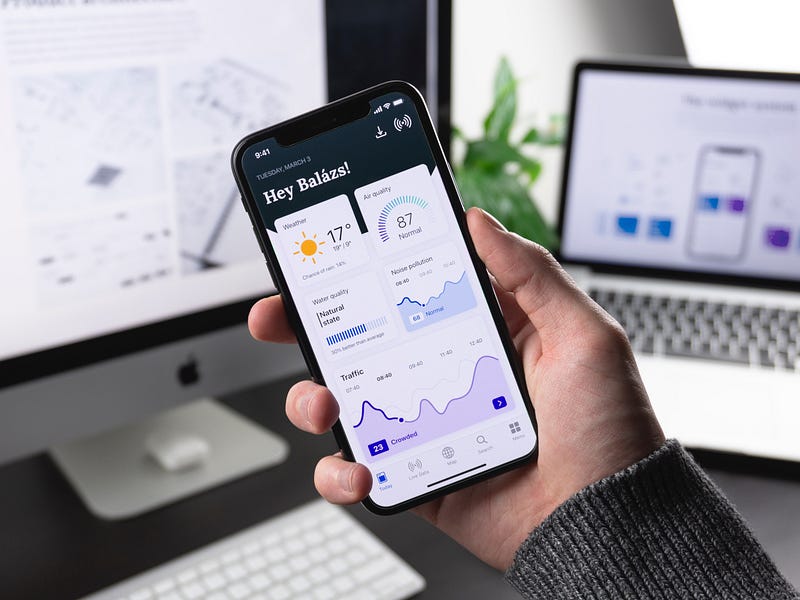
Not to state the obvious but it’s well known that eCommerce is an extremely competitive environment. Online Retailers certainly know this; they also know that modern-day consumers expect more, a personalized experience, easy to access information about products and exceptional service. Those who fall short of this expectation risk being bogged down in customer service issues or buried with weak ratings.
To better manage consumer expectations Online Retailers need to leverage off data by actively integrating data sources to gain insights in order to make data-led decisions. This is true for any retailer.
Using analytics to better understand your customer, their journey, their preferences means that, if done right, you can deliver the right product offering at the right time — the ultimate goal.
To do so Online retailers must aim to extract value from their data beyond just basic information gathering and monitoring.
Realtime data Insight harvesting from multiple sources should not be considered a cost, rather an investment in becoming a more profitable Online retailing business, a consumer-centric business.
Let’s take a look at 9 Benefits of Data Analytics for Online Retailers.
1. Personalization
According to Eagle Eye “75 percent of consumers are “unhappy” with generic offers, and prefer products and services to be directly aimed at them”, in doing so Online Retailers not only match consumer expectations but also increase conversion rates (www.em360tech.com).
“Personalisation is no longer a bonus but a marketing “necessity” in the retail sector because 81 per cent of consumers consider relevance to be the most influential factor in whether they redeem promotions.”
— www.em360tech.com
This is a Win / Win scenario not only increases Sales but reduces costs by improving conversion rates while reducing Cost Per Acquisition (CPA).
Punching Above Your Weight
I read somewhere that “the importance of Personalisation cannot be underestimated”. On that note, it’s worth looking at a real-world case study to appreciate the impact of Personalisation.
So let’s dig a little bit deeper.
A Company that’s boxing clever in this arena is Boxever.com. Last year Boxever.com announced a 3-year contract with a leading Irish bank to “help drive enhanced personalized experiences for its customers” (Boxever.com).
“Goodbye disjointed interactions, hello seamless experiences.” — Boxever
Saying goodbye to “disjointed interactions” is an attractive proposition, another compelling statement on the same webpage however is really powerful:
“Maximise every moment.” — Boxever
Random moment’s pass-by unnoticed, if not measured. To maximize every moment with each customer is a huge statement, a customer-promise beyond parallel — Whether Boxever.com delivers or not remains to be seen, the sentiment and intent, however, is appealing.
2. Demand Supply Insights
Three little words that frustrate customers and prospective buyers more than anything are:
“Out of Stock!”
An Online Retailer that develops a good understanding of their consumer profile and their buying behavior can accurately predict demand using Data analytics.
Data enables retailers to better manage supply chain forecasting, automate purchasing, planning, kitting, warehousing, fulfillment (pick and pack) and shipping more effectively. Large retailers like Tesco or Asda depend on analytics for the day-to-day supply chain management.
Deploying Data insights can improve your inventory space, throughput, and cash flow while avoiding the dreaded words … out-of-stock … that can result in abandoned carts, or worse, losing a sale to a competitor.
3. Marketing Mix
The marketing Mix principle applies to Online Retailers as it does to brick-and-mortar retailers. As such, there has to be an on-going investment in the right set of marketing attributes. The 4P rules apply — always.
The 4P’s: Price — Product — Placement — Promotion
While the Marketing process differs somewhat for online retailers compared to a traditional business, the 4P’s can be adopted to all channels. The right price, product, placement or promotion (bundle) increases the likelihood of purchase when executed with Data insights.
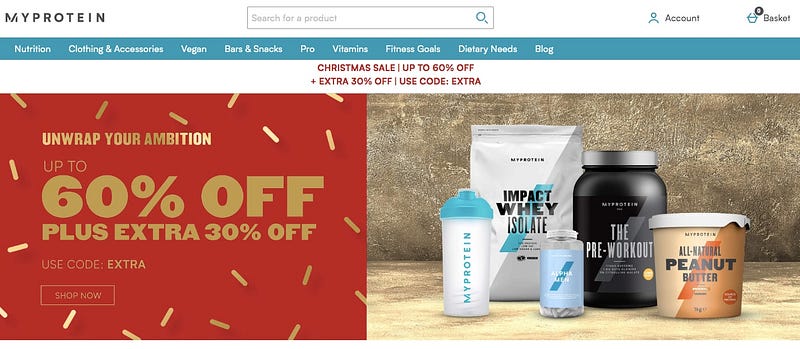
Using predictive analytics enables Online Retailers to determine the factors that drive more consumer acquisitions i.e. conversions or sales by channel and by segment.
Personalization enables Online Retailers to tailor their landing page to match their customer's preferences. Likewise, Outbound marketing campaigns such as Email Marketing or Google Display means that Online retailers can push the right proposition to an audience that matches customer persona.
Furthermore, by analyzing Data models Online Retailers can deploy marketing to spend more efficiently by allocating budget to higher performing media channels to maximize returns.
That said, it’s not a one size fits all process as consumer behavior will dictate incremental iterations. As such changes should be measured and actioned to reflect the ever-changing consumer media preferences.
4. Segmentation
Segmentation underpins personalization. By using predetermined segment attractiveness criteria such as market growth, competitive intensity, market-access, persona, gender, recency, frequency, and monetary value, etc. any Business can determine the overall attractiveness of each segment on a more granular level.
So what does this mean?
In a nutshell, Data can reveal the most valuable customer segment for your Business, those consumers worthy of your investment — Marketing spend or new Product Development.
What’s more, Data will also reveal the Lifetime Value of your Customers (CLV), the profile of consumers that delivers against your objectives now and in the future.
“A segmentation basis is defined as a set of variables or characteristics used to assign potential customers to homogeneous groups” — Wedel & Kamakura, 2000
Bottom line is that Data unveils and refines your ideal customer persona, your segment sweet-spot, better than any human can.
5. What’s the Score?
The ultimate score is Net Promoter Score or NPS. So what is Net Promoter Score (NPS)? What does it mean? Can it have an impact on my business?
NPS is a metric. An output captured when you seek feedback from your customers. We’ve all seen this in some form:
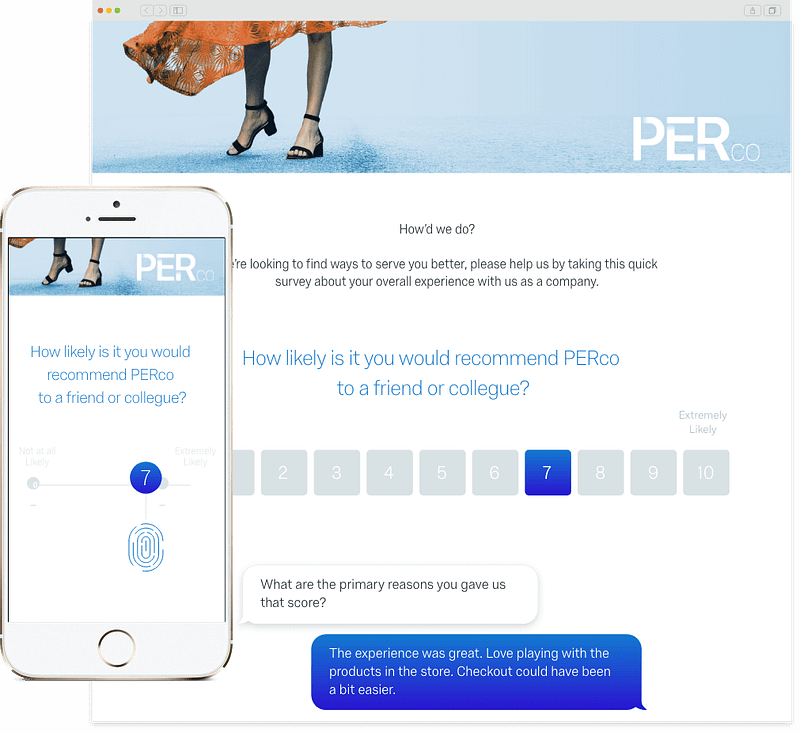
- Promoters — Customers who respond with a score of 9 or 10 are considered advocates, loyal and enthusiastic customers.
- Passives — customers who respond with a score of 7 or 8 are satisfied with a service but not motivated enough to be considered promoters. These Customers are vulnerable to competitor offerings.
- Detractors — Customers who respond with a score between 0 to 6. They’re unhappy customers and unlikely to buy from you again or worse as they may discourage others from buying from you.

Knowing your NPS allows you to respond to feedback on-demand or over time depending on what your customers are saying.
NPS can impact your Business as it can influence Sales to increase or decrease. It’s also a way to improve Conversion, more on this below.
6. Average Order Value And Conversion
Conversion is the holy grail of all eCommerce metrics, this is the minimum you should be able to see, understand and strive to improve. Your NPS can improve your Conversion as more customers make decisions on what others say about your products and service.
Conversion is measured as a percentage of the total number of visitors as a ratio versus those who complete a purchase.
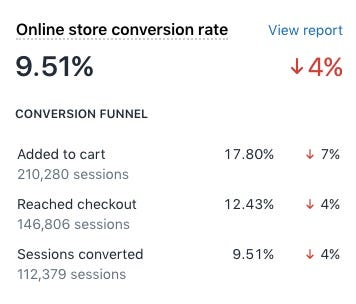
Improving your conversion will increase your revenue — it's as simple as that.
The average conversion can range from 1% to as high as 8–9%, depending on the sector, although 2–3% is common. It can be much higher for niches such as Motor tax, Medical or back to School products. Also, it's likely to be higher during sale periods when consumer visits take you up on your promotion.
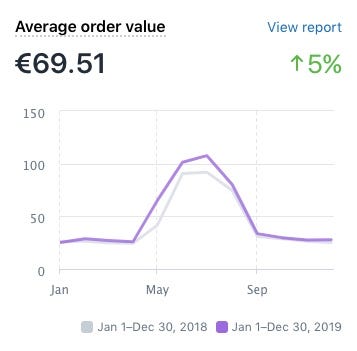
Once converted your Average Order Value (AOV), the average customer-spend at your store, by transaction, is visible. With this information, you can compare segments by product or promotion for deeper insights. From there you can strategize ways to improve and refine your Campaigns and Channel engagement.
AOV is an important metric in relation to the Conversion rate (CR). For instance, if you’re improving your CR and your AOV is falling then your hard work on CR could result in a drop in your overall Revenue. So it’s vital to monitor both.
In contrast, the higher your AOV the more valuable your transactions. Online Retailers use several tactics to increase their AOV. Classic examples are cross or upselling customers, those who bought Product X also bought Y.
Basket Analysis Data will give you deeper insights on this, enabling you to invest in high performing campaigns to persuade customers to choose an incentive, like a bundle or free delivery on orders over a certain value.
7. Customer Acquisition Cost
Taking care of your existing customers is important, but to scale you need to find new ones and lots of them. CAC is an important marketing metric that tells you how much money it costs to acquire a new customer so you can see your Return on Investment (ROI). Data analytics provides valuable channel performance to ensure that your budget is invested wisely.
Employing influencer channels, SEO optimization, Offline advertising, guest blogging, content marketing, social media, display, video, and viral advertising are all strategic channels that can strengthen your Brand’s proposition and position in the market. Each will have varying CAC.
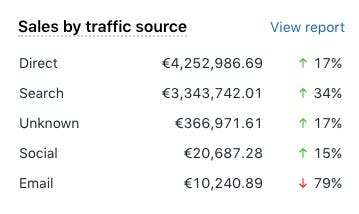
If your CAC value increases to convert a sale or attract new visitors to convert into customers then you need to think outside the box and hone in on channels that work for you.
Ideally, you want your sales, or a significant portion of your Sales, to come Direct or via Search, as illustrated above (51%). While not entirely free they are more cost-effective compared to Email or PPC.
8. Customer Lifetime Value
Customer lifetime value (CLV) is a complicated metric because it’s a prediction based on multiple variables. So the more eCommerce data that you have on your customers, the better your CLV accuracy will be.
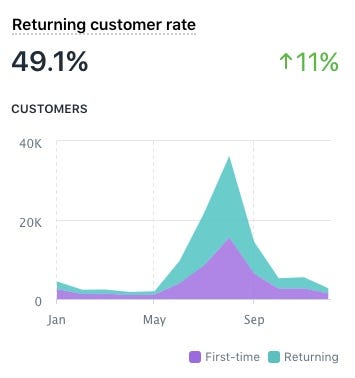
There are a number of ways to calculate how much a customer will spend across their lifetime with your brand, ranging from the simple to the complex. The complex version involves customer profile enrichment, which can include channel engagement, satisfaction scores, frequency, recency, retention and much more.
Online retailing businesses deploy a combination of calculations to predict CLV and target Persona lookalikes with respect to CAC. Identifying the behavior of what your most valuable customers look like enables Online Retailers to zone in on repeat purchases, similar audiences, increase customer spend and solidify loyalty — Promoters (NPS).
9. Data Sources
Data sources are the lifeblood of your eCommerce business, aggregated they can reveal unique customer insights if you harness their collective power in the one place — A single source of truth.
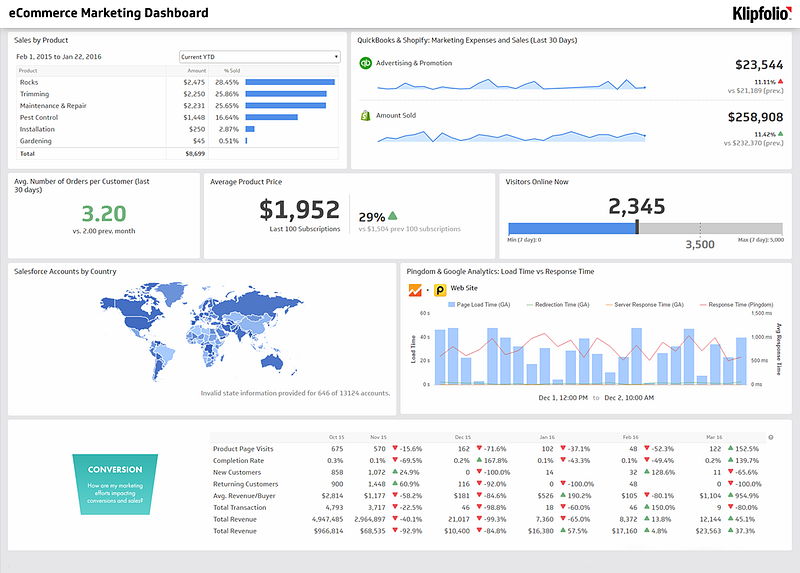
So what is a Data Source? Put simply, it’s any source of information that can shed light on your customer:
- On-Site — Owned Digital Assets: Web-store, Blog, Landing Pages
- Off-Site — Other Digital Assets: Social, PPC, CRM, Payment, ESP
By harnessing multiple sources of Data, Online Retailers can enrich a customer profile to make Data-led decisions for continuous improvement.
Final Thoughts
In conclusion, knowing your eCommerce data = knowing your customers. Who they are, what they like, what they do, why they do it, where they hang out and how this all might change in the future.
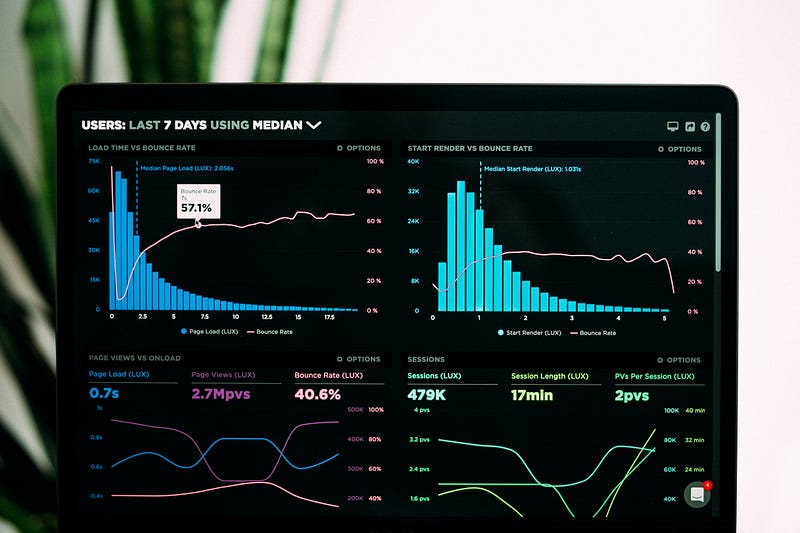
Building a data lake with a visualization dashboard to monitor real-time metrics as they happen means that Online Retailers no longer need to make educated guesses.
Leveraging off data mitigates the risk of getting things wrong.
Moreover, an enriched data lake offers unique insights into your customers, your business. Predictive Analytics can plot future trends on demand, empowering Online Retailers to make strategic decisions due to a deeper understanding of their digital assets and performance.
I must stress that building a Data Visualisation dashboard is of paramount importance — Its a window into your Business 24/7.
Remember, the numbers never lie!