avatarPaul Myers MBA

Free AI web copilot to create summaries, insights and extended knowledge, download it at here

5222

Abstract

ethnicity, and religion.</p><div id="ced6" class="link-block"> <a href="https://readmedium.com/what-is-ethical-leadership-and-can-it-survive-cdc15e4f9200"> <div> <div> <h2>What Is Ethical Leadership and Can It Survive?</h2> <div><h3>A discussion on ethical leadership</h3></div> <div><p>medium.com</p></div> </div> <div> <div style="background-image: url(https://miro.readmedium.com/v2/resize:fit:320/1*XMDHqi8CtuLwdfzWW0xXfA.jpeg)"></div> </div> </div> </a> </div><h2 id="fd7a">Evaluation of cross-cultural research</h2><p id="076a">Research can uncover important cross-cultural differences, relevant beliefs about effective leadership and behavior (Fiedler’s contingency theory) of leaders in certain situations (Flinsch-Rodriguez, 2010).</p><p id="0c35">The volume of research on this topic is increasing; however, conceptual and methodological weaknesses remain. Three examples of these weaknesses are:</p><ol><li><i>Sampling procedures are inadequate</i></li><li><i>Controls for contamination are unclear or missing</i></li><li><i>Nebulous interpretation of results, so validity is questionable</i></li></ol><h1 id="b89c">3. Gender Differences</h1><p id="0a0c">Two topical areas of interest in Gender are:</p><ol><li><i>Gender differences with respect to leadership behavior and effectiveness</i></li><li><i>Reasons for continued discrimination against women in leadership selection</i></li></ol><p id="9d59">Widespread discrimination is clearly evident given the low number of women who hold C-level leadership positions. While this has been increasing in recent years, a glass ceiling exists. Some explanations include biased beliefs about the skills and behaviors necessary for effective leadership.</p><figure id="57f1"><img src="https://cdn-images-1.readmedium.com/v2/resize:fit:800/1*lx7R3uX7rysWyPI-541tJg.jpeg"><figcaption>Image <a href="https://www.kornferry.com/insights/articles/women-in-leadership-2019-statistics">Source</a></figcaption></figure><p id="4e70">In relation to the research already conducted regarding leadership behavior, there is disagreement about the results of many of the comparison studies. However, there is no empirical support for the belief that one gender is more qualified than the other to be leaders.</p><p id="3e60">So there are limitations with research thus far.</p><p id="b8a1">One limitation is the lack of a clear definition of gender — characteristics often associated more with one gender than the other — which is not consistent across studies.</p><div id="e7c1" class="link-block"> <a href="https://readmedium.com/is-positive-discrimination-good-for-female-entrepreneurs-8e20afdfc7df"> <div> <div> <h2>Is Positive Discrimination Good for Female Entrepreneurs?</h2> <div><h3>A discussion about gender-typical products and Services for Female Entrepreneurs</h3></div> <div><p>medium.com</p></div> </div> <div> <div style="background-image: url(https://miro.readmedium.com/v2/resize:fit:320/1*fLE5VcQhFFsWZnfhQErbng.jpeg)"></div> </div> </div> </a> </div><p id="8639">Leadership positions require both a) strong task and b) interpersonal skills, so gender is unlikely to be a reliable predictor of leadership effectiveness.</p><p id="0dac">Obviously, gender should not be qualifying criteria for a position, so processes should be in place to ensure that it isn’t the case.</p><p id="c7c4">Gender stereotypes are changing, albeit slowly. Although it persists in some industry segments, strongest where it’s supported by cultural values.</p><p id="8212">The message is simple — hire the best person for the job regardless of gender.</p><h1 id="b874">4. Managing Diversity</h1><p id="1a1b">Diversity envelops multiple attributes, many were noted above: race, ethnic identity, age, gender, education, physical appearance, socioeconomic level, and sexual orientation.</p><p id="3386">Further to research in recent years, it’s clear that there are benefits of a diverse workforce, such as:</p><ol><li><i>A wider variety of perspectives improves creativity, and</i></li><li><i>A diverse workforce increases the available talent for important roles</i></li></ol><p id="9e75">One downside, however, is the cost from “distrust and conflict”, lower satisfaction and higher turnover, if mismanaged (Yukl, 2013).</p><p id="24e1">A workforce is less likely to share values with strong membership commitment when it has too many diverse members who identify primarily with their own subgroup (Syed, 2019).</p><p id="1a74">One solution is to foster appreciation through diversity training and incorporating this into the company culture. One mechanism is to adopt appraisal criteria and <a href="https://www2.deloitte.com/content/dam/Deloitte/nz/Documents/about-deloitte/DiversityAwardcriteria2016.pdf">recognition</a>.</p><p id="c82e">Efforts to change attitudes are more likely to succeed when:</p><ul><li><i>Diversity training is directe

Options

d at people who have not already formed strong prejudices, and</i></li><li><i>When it’s reflected in a culture that supports an appreciation for diversity</i></li></ul><blockquote id="9907"><p><i>‘Today there is a lot of talk about the importance of diversity, but the real benefits of engaging with varied perspectives and thinking differently about the world, aren’t widely understood.”</i><a href="https://www.matthewsyed.co.uk/resource/rebel-ideas-the-power-of-diverse-thinking/">Matthew Syed</a></p></blockquote><p id="d87a">Typically the HR department has primary responsibility for processes that impact diversity and equal opportunities in an organization. However, responsibility and strong leadership support is the only way to ensure its “widely understood” for successful implementation (Syed, 2019).</p><p id="c30c" type="7">Eliminate constraints that prevent qualified people from C-level role selection.</p><h1 id="b2b4">Final Thoughts</h1><p id="da23">To conclude, there are three points to take away for consideration.</p><h2 id="93f2">№ 1— Legislation is important, but we can all influence</h2><p id="2f76">Most countries have legislation covering all aspects of these areas. The importance of local legislation and its role cannot be underestimated.</p><p id="50f5">From an Irish legal setting, the relevant legislation is the <a href="http://www.irishstatutebook.ie/eli/1998/act/21/enacted/en/html">Employment Equality Act 1998</a> and the Equal Status Act 2000.</p><p id="3767">Company policies and procedures can set precedence. Most companies have policies and procedures encompassing gender, diversity and inclusion but don't provide training for employees and line managers.</p><ul><li><b>Tip </b>— Influence legislation by inventing and participating in new <a href="https://www.cio.com/article/3262704/diversity-and-inclusion-8-best-practices-for-changing-your-culture.html">initiatives</a> and roll-out training as standard policy — giving others permission to follow.</li></ul><h2 id="e511">№ 2— More emphasis on gender</h2><p id="e345">Having read Yukl (2013), just 2 of 20 pages in the chapter on Culture cover gender compared to 5 pages on other areas. This unequal spread almost diminishes gender.</p><p id="ab01">Given that both areas are equally important, each deserves equal coverage in the real world.</p><ul><li><b>Tip</b>—From my experience, company policies almost pay lip service to Gender. Don't do this, create something <a href="https://www.cio.com/article/3262704/diversity-and-inclusion-8-best-practices-for-changing-your-culture.html">unique</a> — Say it, mean it and follow-through.</li></ul><h2 id="3956">№ 3— Managing diversity (or not) costs money</h2><p id="a7af">Poor diversity indicates “more distrust and conflict, lower satisfaction and higher turnover”, resulting in higher costs (Yukl, 2013). Which is logical.</p><p id="fd8c">However, there is no real evidence for this argument i.e. costs are not quantified. The likelihood is that they’re hidden deliberately or unsaid, which impedes valid research.</p><ul><li><b>Tip </b>— An obvious failure is not managing diversity, which can have financial implications. So, estimate your potential costs and weed it out at a cultural level.</li></ul><div id="fca0" class="link-block"> <a href="https://readmedium.com/a-new-style-of-leadership-is-emerging-29e4e2b021bf"> <div> <div> <h2>A New Style of Leadership Is Emerging</h2> <div><h3>Startup Entrepreneurs are reinventing leadership.</h3></div> <div><p>medium.com</p></div> </div> <div> <div style="background-image: url(https://miro.readmedium.com/v2/resize:fit:320/1*F7C8tqZp-qe5VA0aVoYtOg.jpeg)"></div> </div> </div> </a> </div><h1 id="36d2">References</h1><ul><li>Flinsch-Rodriguez, P. (2010). <i>Contingency Management Theory — business.com</i>. [online] business.com. Available at: <a href="https://www.business.com/articles/contingency-management-theory/">https://www.business.com</a> [Accessed 10 Feb. 2020].</li><li>Globeproject.com. (2020). <i>GLOBE Project</i>. [online] Available at: <a href="https://globeproject.com">https://globeproject.com</a> [Accessed 10 Feb. 2020].</li><li>Yukl, G. (2013). <i>Leadership in organizations by Gary Yukl</i>. Boston: Pearson.</li><li>SHRM. (2020). <i>How to Develop a Diversity and Inclusion Initiative</i>. [online] Available at: <a href="https://www.shrm.org/resourcesandtools/tools-and-samples/how-to-guides/pages/how-to-develop-a-diversity-and-inclusion-initiative.aspx">https://www.shrm.org</a> [Accessed 10 Feb. 2020].</li><li>Syed, M. (2019). <i>Rebel ideas</i>. London: John Murray.</li></ul><figure id="83df"><img src="https://cdn-images-1.readmedium.com/v2/resize:fit:800/1*mlwY_sm_WPp5cr8vwCFJUg.jpeg"><figcaption>Photo by <a href="https://unsplash.com/@ayahya09?utm_source=unsplash&amp;utm_medium=referral&amp;utm_content=creditCopyText">Ali Yahya</a> on <a href="https://unsplash.com/s/photos/diversity?utm_source=unsplash&amp;utm_medium=referral&amp;utm_content=creditCopyText">Unsplash</a></figcaption></figure></article></body>

How to Improve Cross-Cultural Leadership at Work

A discussion about diversity and inclusion in the workplace

Photo by Alex Holyoake on Unsplash

Globalization, economic development, consumerism and changing demographic patterns means that Cross-Cultural Leadership is vital.

As such, its more important than ever for leaders to understand how to influence and manage people with different values, beliefs, and expectations.

There’s also a keen interest on this topic and whether the ability to provide effective leadership is related to a person’s gender, age, race, nationality, sexual orientation, ethnic background, religion or physical appearance.

This article explores Cross-Cultural Leadership in the following areas:

  1. Research
  2. Culture value dimensions
  3. Gender differences
  4. Managing diversity

So let’s jump in, shall we?

1. Research

Cross-cultural leadership research covers four pillars:

№ 1 — The Importance of cross-cultural research

Globalization has highlighted the importance of modern leadership to influence people from cultures other than their own and to do so requires an open-minded understanding of those cultures.

“If we are going to live with our deepest differences then we must learn about one another.”― Deborah J. Levine

This type of research enables leaders to understand how people from other cultures view them and how they interpret leadership actions from an array of cultural perspectives.

№ 2— Types of cross-cultural influences on leadership behavior

The main area covered by research to date relates to leader behavior, skills, and traits.

“Culture is the magic start-up ingredient.” – Colin Angle, Co-founder, iRobot

So far research has revealed that cross-cultural leadership is influenced by the cultural values and traditions of managers on the ground.

№ 3— Behavioural research

Much of this research examines differences between countries with regard to the typical pattern of leadership and the relationship of leader behavior to outcomes, such as subordinates’ job satisfaction and performance.

“If your actions inspire others to dream more, learn more, do more and become more, you are a leader.” — John Quincy Adams

№ 4— Global cultural study

GLOBE is a cultural study group of leadership in 60 different countries representing all major regions of the world and involving more than 150 researchers.

Below is a snapshot of insights being discovered.
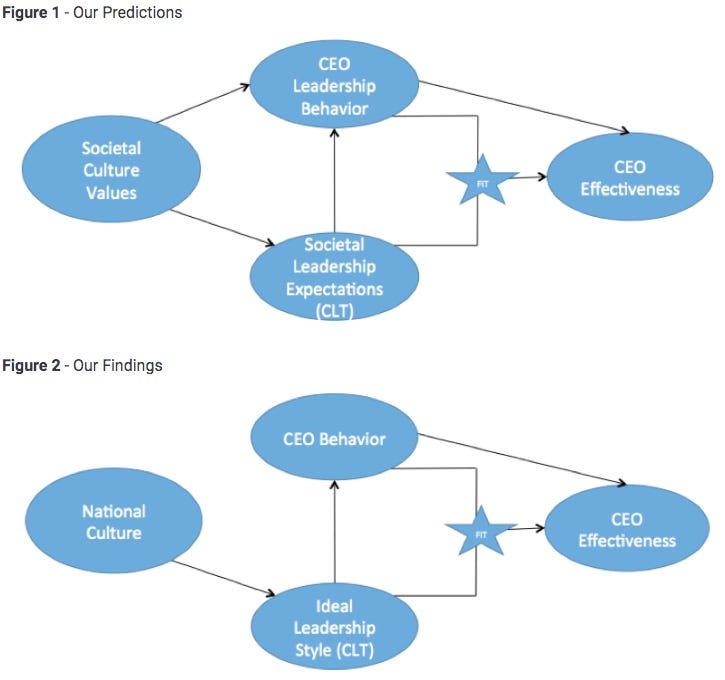
GLOBE CEO Study

GLOBE is a coordinated, long term initiative that aims to develop an empirically based theory to describe the relationships between national culture, leadership, and organizational processes.

2. Culture Value Dimensions

Major research findings on cultural values relate to leadership beliefs, behavior and development, summarised across 6 dimensions:

  1. Power Distance: The acceptance of an unequal distribution of power and status.
  2. Uncertainty Avoidance: Involves a high level of fear of the unknown and a desire for security, stability, and order — risk aversion.
  3. Individualism (versus Collectivism): Individualism is the extent that the needs of the individual are deemed more important than the collective needs of a group, company or society. Compare to collectivism, where the membership of an ‘in-group’ is an important aspect of a person’s self-identity and loyalty to the same important value.
  4. Gender Equality: How men and women are treated, with parity or not.
  5. Performance Orientation: The extent to which high performance and individual achievement are valued — results are valued more than people.
  6. Humane Orientation: Where a strong concern for the welfare of others exists and a willingness to sacrifice own self-interest to help others (not just within your family or other in-groups).

It is difficult to determine the independent effects of these pillars on leadership beliefs and behaviors. As such, researchers tend to group countries into clusters based on their regional proximity and similarities in language, ethnicity, and religion.

Evaluation of cross-cultural research

Research can uncover important cross-cultural differences, relevant beliefs about effective leadership and behavior (Fiedler’s contingency theory) of leaders in certain situations (Flinsch-Rodriguez, 2010).

The volume of research on this topic is increasing; however, conceptual and methodological weaknesses remain. Three examples of these weaknesses are:

  1. Sampling procedures are inadequate
  2. Controls for contamination are unclear or missing
  3. Nebulous interpretation of results, so validity is questionable

3. Gender Differences

Two topical areas of interest in Gender are:

  1. Gender differences with respect to leadership behavior and effectiveness
  2. Reasons for continued discrimination against women in leadership selection

Widespread discrimination is clearly evident given the low number of women who hold C-level leadership positions. While this has been increasing in recent years, a glass ceiling exists. Some explanations include biased beliefs about the skills and behaviors necessary for effective leadership.
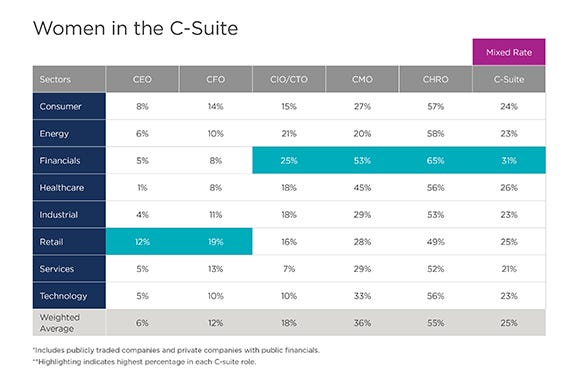
Image Source

In relation to the research already conducted regarding leadership behavior, there is disagreement about the results of many of the comparison studies. However, there is no empirical support for the belief that one gender is more qualified than the other to be leaders.

So there are limitations with research thus far.

One limitation is the lack of a clear definition of gender — characteristics often associated more with one gender than the other — which is not consistent across studies.

Leadership positions require both a) strong task and b) interpersonal skills, so gender is unlikely to be a reliable predictor of leadership effectiveness.

Obviously, gender should not be qualifying criteria for a position, so processes should be in place to ensure that it isn’t the case.

Gender stereotypes are changing, albeit slowly. Although it persists in some industry segments, strongest where it’s supported by cultural values.

The message is simple — hire the best person for the job regardless of gender.

4. Managing Diversity

Diversity envelops multiple attributes, many were noted above: race, ethnic identity, age, gender, education, physical appearance, socioeconomic level, and sexual orientation.

Further to research in recent years, it’s clear that there are benefits of a diverse workforce, such as:

  1. A wider variety of perspectives improves creativity, and
  2. A diverse workforce increases the available talent for important roles

One downside, however, is the cost from “distrust and conflict”, lower satisfaction and higher turnover, if mismanaged (Yukl, 2013).

A workforce is less likely to share values with strong membership commitment when it has too many diverse members who identify primarily with their own subgroup (Syed, 2019).

One solution is to foster appreciation through diversity training and incorporating this into the company culture. One mechanism is to adopt appraisal criteria and recognition.

Efforts to change attitudes are more likely to succeed when:

  • Diversity training is directed at people who have not already formed strong prejudices, and
  • When it’s reflected in a culture that supports an appreciation for diversity

‘Today there is a lot of talk about the importance of diversity, but the real benefits of engaging with varied perspectives and thinking differently about the world, aren’t widely understood.”Matthew Syed

Typically the HR department has primary responsibility for processes that impact diversity and equal opportunities in an organization. However, responsibility and strong leadership support is the only way to ensure its “widely understood” for successful implementation (Syed, 2019).

Eliminate constraints that prevent qualified people from C-level role selection.

Final Thoughts

To conclude, there are three points to take away for consideration.

№ 1— Legislation is important, but we can all influence

Most countries have legislation covering all aspects of these areas. The importance of local legislation and its role cannot be underestimated.

From an Irish legal setting, the relevant legislation is the Employment Equality Act 1998 and the Equal Status Act 2000.

Company policies and procedures can set precedence. Most companies have policies and procedures encompassing gender, diversity and inclusion but don't provide training for employees and line managers.

  • Tip — Influence legislation by inventing and participating in new initiatives and roll-out training as standard policy — giving others permission to follow.

№ 2— More emphasis on gender

Having read Yukl (2013), just 2 of 20 pages in the chapter on Culture cover gender compared to 5 pages on other areas. This unequal spread almost diminishes gender.

Given that both areas are equally important, each deserves equal coverage in the real world.

  • Tip—From my experience, company policies almost pay lip service to Gender. Don't do this, create something unique — Say it, mean it and follow-through.

№ 3— Managing diversity (or not) costs money

Poor diversity indicates “more distrust and conflict, lower satisfaction and higher turnover”, resulting in higher costs (Yukl, 2013). Which is logical.

However, there is no real evidence for this argument i.e. costs are not quantified. The likelihood is that they’re hidden deliberately or unsaid, which impedes valid research.

  • Tip — An obvious failure is not managing diversity, which can have financial implications. So, estimate your potential costs and weed it out at a cultural level.

References

  • Flinsch-Rodriguez, P. (2010). Contingency Management Theory — business.com. [online] business.com. Available at: https://www.business.com [Accessed 10 Feb. 2020].
  • Globeproject.com. (2020). GLOBE Project. [online] Available at: https://globeproject.com [Accessed 10 Feb. 2020].
  • Yukl, G. (2013). Leadership in organizations by Gary Yukl. Boston: Pearson.
  • SHRM. (2020). How to Develop a Diversity and Inclusion Initiative. [online] Available at: https://www.shrm.org [Accessed 10 Feb. 2020].
  • Syed, M. (2019). Rebel ideas. London: John Murray.

Photo by Ali Yahya on Unsplash
Business
Leadership
Work
Diversity
Women
Recommended from ReadMedium