What Is Ethical Leadership and Can It Survive?
A discussion on ethical leadership

“In a perfect world, it’s always clear what’s right or wrong. In the real world, things are often not so clear.
Someone’s wrong can be your right, which means your right will definitely, at some point, be someone else’s wrong. Most of the time the “right” choice can be subjective.
At some point in our careers, most of us will have to make tricky ethical decisions. How do you examine the issue and figure out what to do?” (Giang, 2015)
There’s a growing interest in ethical leadership, but there’s also considerable disagreement about the appropriate ways to define it and measure it.
“The primary issue is not whether leaders will use power, but whether they will use it wisely and well.” (Gini, 1998)
Heifetz stated that “there is no ethically neutral ground for theories of leadership because they always involve values and implicit assumptions about proper forms of influence” (Heifetz, 1994).
To understand and try to answer these questions, it’s important to examine ethical leadership as follows:
- Conceptions of ethical leadership
- Ethical dilemmas that leaders face
- Determinants and Consequences
- Theories
1. Conceptions of Ethical Leadership
The conceptions of ethical leadership include:
- Nurturing followers
- Empowering followers, and
- Promoting social justice
Personal integrity is considered the most important aspect of ethical leadership, demonstrated through honesty and consistency of values and behaviors.
It’s necessary to consider a leader’s intentions and values as well as behaviors when evaluating conceptions of ethical leadership.
2. Dilemmas in Assessing Ethical Leadership
Influencing follower commitment for a task is central in most leadership theories, but ‘influence’ is also the source of ethical concern.
Here’s why:
№ 1 — Influencing Expectations
It's easy to evaluate ethical leadership when the interests of the leader, followers, and the organization are congruent, especially when there’s no risk or cost involved. Like a football team, leading 3–0 in a game with a minute remaining.
That said, for an ethical leader to conform, they must inform followers of risk, and seek a conscious decision about whether their effort is worthwhile.
Which is rare.
So to be effective, a leader must emphasize what can be accomplished with a concerted, shared effort to influence ethically.
№ 2—Influencing Values and Beliefs
This is a controversial subject given that a leader may try to change the underlying values and beliefs of followers.
Stephens (1995), questioned the assumption that “a leader knows what’s best” for their followers and “the misuse of power to influence follower perception” (Yukl, 2013).
There’s also concern around the influence that a charismatic leader may have on insecure followers.
When leaders have a responsibility to transform an organization, success can be dependent on changing beliefs and perceptions of followers — an ethical dilemma.
№ 3—Multiple Stakeholders and Competing Values
The diverse consequence of a leader’s decisions and actions complicate the evaluation of ethical leadership.
Doing what’s best for shareholders (owners) may not be what’s best for other stakeholders like employees, customers, and the community.
Efforts to balance these competing interests involve subjective judgments about rights, accountability, due process, and social responsibility.
So it can be difficult to evaluate ethical leadership when stakeholders have incompatible preferences — competing values.
3. Determinants and Consequences
№ 1 — Individual Determinants of Ethical Leadership
Effective leadership traits relate to ethical leadership. Kohlberg (1984) proposed a model that described how people progress through six sequential stages of moral development as they grow from childhood to adulthood.
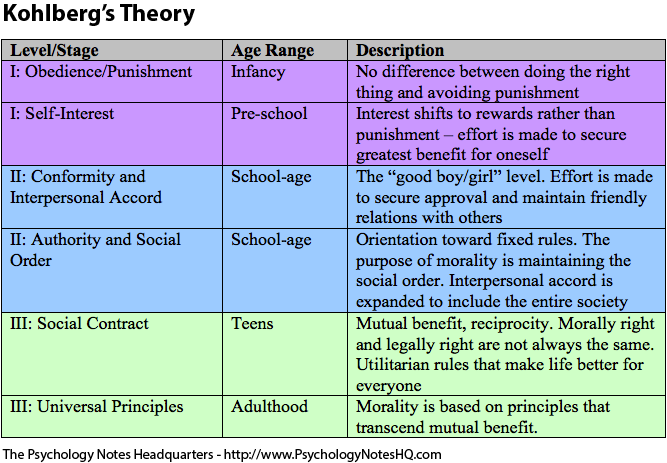
The lowest level indicates that the primary motivation is of self-interest (child) and the highest level of moral development (adult) is to fulfill personal values and moral principles.
№ 2 — Situational Influences on Ethical and Unethical Leadership
Ethical behavior is “strongly influenced” by situations (Brown et al, 2006).
Unethical behavior, on the other hand, is more likely to occur in an organization when unrealistic goals are set, with high pressure for increased productivity.
An example of this happened at Enron, a strong success-orientated culture led to employees exaggerating results to hide the truth, the company’s growing debt.
№ 3— Consequences of Ethical and Unethical Leadership.
The effects of ethical leadership can be found in a number of studies (Reave, 2005), with evidence of benefits for followers and leader-member relations.
As such, it can have a positive impact on an organization.
In contrast, research indicates that unethical leadership can result in negative consequences for followers and organizations.
Decisions that involve short-term organizational performance, for example, can have adverse consequences for employees and/or customers. That’s not to say that unethical leadership is toxic, but it can be.
One example of negative consequences is outsourcing employee jobs to low-cost vendors in other countries — but is this unethical? — that depends on the motivation to achieve this objective (Yukl, 2013).
Another is to include future sales revenue as current income to prop up the stock value — as Enron did.
4. Theories of Ethical Leadership
№ 1 — Transformation Leadership Theory
Burns (1978) described transforming leadership as a process in which “leaders and followers raise one another to higher levels of morality and motivation” (Yukl, 2013).
“In our transforming environments, we must keep asking how to deliver innovative and inventive experiences moment by moment continuously. This is a cultural shift that we all need to embrace collective success.” — Dr Mehmet Yildiz
Transformational leadership seeks to raise the consciousness of followers by appealing to ideals and moral values rather than negative emotions such as fear or greed.
In this instance, leaders and followers consider the benefit of the wider collective like their organization, community or the environment.
№ 2 — Servant Leadership Theory
Greenleaf (1977) proposed that service to followers is the primary responsibility of leaders and the essence of ethical leadership.
A servant leader must attend to the needs of their followers that includes nurturing, defending and empowering them.
Greenleaf believes that followers of such leaders are inspired to become servant leaders themselves, resulting in more people who serve as moral agents in society.
“A servant leader can foster happiness by helping their team to see the bright side of any incoming task” — Omar Rabbolini
An example of this type of leader today is “the conscious capitalist” John Mackey, CEO, and co-founder of Whole Foods Market (Kowitt, 2015)
Anderson (2009) noted that the negative consequence of this theory in an organization is when the welfare of followers is considered more important than financial performance (Yukl, 2013).
This can create conflict, but there is a solution (see below).
№ 3 — Spiritual Leadership Theory
Spiritual leadership theory explains how leaders can enhance the spiritual meaning of work experienced by followers.
One piece of research by Reave (2005) provided evidence that the opportunity to express spiritual values in one’s work is related to a person’s mental health, life satisfaction and intrinsic motivation (Yukl, 2013).
The limitations of this theory are similar to those of servant leadership. Both theories include lots of different values, so leadership behavior is dependent on how important these values are held.
№ 4 — Authentic Leadership
Authentic leadership describes an ideal leader whose behavior is guided by strong, positive values. The main emphasis of authentic leadership is the importance of consistency in a leader’s words, actions, and values.
The components of authentic leadership are:
- Positive psychological capital
- Positive moral perspective
- Self-awareness
- Self-regulation
- Leadership behaviors
- Impact on followers’ self-awareness
- Influence on the development of followers
Capabilities of confidence, optimism, hope, resiliency as a resource, plays a crucial role in developing individuals, teams, organizations, and communities to flourish and prosper under authentic leadership.
Although like other theories on ethical leadership, authentic leadership theories suffer from a lack of real clarity in terms of essential qualities.
Final Thoughts
Theories are still evolving, but somewhat confusing, making it difficult to confidently define ethical leadership.
The emphasis does, however, focus on leadership values and situational factors.
The efficiency of ethical leadership depends on the situation a leader or organization is in — a triage of leadership characteristics, follower characteristic and the business context (situational factors).
The belief is that values ground decision making, anchored in ethics.
How to Promote Ethical Behaviour
So how does a Leader promote ethical behavior in an organization? Well there are a number of ways to do this, such as (Yukl, 2013):
- Set clear standards of conduct
- Model ethical behavior by your actions
- Help others find a fair, ethical way to resolve problems and conflicts
- Oppose unethical practices
- Implement and support programs that promote ethical behavior
Consider America’s business and financial elite who echo the ethical leadership theme, coining terms like:
- “Compassionate capitalism” (Salesforce’s Marc Benioff)
- “Creative capitalism” (Bill Gates), and
- “Just capital” (investor Paul Tudor Jones)
Terms that frame “their philosophies” (Kowitt, 2015).
Steeped in these notions “is the fundamental precept that profits and purpose should go together — and that companies that marry the two faithfully will outperform the competition over the long term.” (Kowitt, 2015)
So the survival and evolution of ethical leadership are dependent on a marriage of profits and purpose, with equal endeavor.
References
- Brown, M. and Treviño, L. (2006). Ethical leadership: A review and future directions. The Leadership Quarterly, 17(6), pp.595–616.
- Giang, V. (2015). 7 Business Leaders Share How They Solved The Biggest Moral Dilemmas Of Their Careers. [online] Fast Company. Available at: https://www.fastcompany.com [Accessed 6 Feb. 2020].
- Heifetz, R. (1994). Leadership without easy answers. Cambridge, MA: Belknap Press of Harvard University Press.
- Kohlberg, L. (1984). The Psychology of Moral Development: The Nature and Validity of Moral Stages (Essays on Moral Development, Volume 2). Harper & Row
- Kowitt, B. (2015). Whole Foods’ John Mackey: The conscious capitalist. [online] Fortune. Available at: https://fortune.com [Accessed 6 Feb. 2020].
- Rabbolini, O. (2020). Servant Leadership In Times Of Trouble. [online] Medium. Available at: https://medium.com [Accessed 6 Feb. 2020].
- Yildiz, M. (2020). Innovative & Inventive Business Culture for Digital Transformation Leadership. [online] Medium. Available at: https://medium.com [Accessed 7 Feb. 2020].
- Yukl, G. (2013). Leadership in organizations by Gary Yukl. Boston: Pearson.