
How to Do Your Best with a Business Analyst Mindset
Twelve principles to take you from competency to excellence

What makes a business analyst exceptional? Is it proficiency in business process modeling and analysis techniques? Is it the knowledge of the latest technologies?
While these are important, another factor plays a crucial role in implementing successful business changes. I will call it the business analyst mindset.
Business analysis is a critical competency required to define, plan and implement business changes. Much has been written about business analysis tools and techniques, modeling notations and requirements capturing methodologies. There is a wide choice of business analysis training courses on the market. Formal certifications are offered to assess the level of knowledge and experience in the field.
Yet, despite all the training and resources, many organizations struggle with projects and cite requirements quality and requirements gaps as top reasons for project delays and failures.
Here are some business analysis challenges that represent key project risks:
- Alignment of the executive support of business changes (including funding) with business strategy
- Ability to consider the long-term impacts of a business change beyond the scope of a particular project
- Stakeholder and user engagement in the business analysis process
- The communication style of the business analyst and the ability to adapt to varying audiences
- The climate of acceptance of the difference in opinion; supporting analysis-based decision making vs. making decisions based on the authority
- Support for the role of business analyst in identifying and analyzing real business problem vs. a documentation role.
Successful mitigation of these key risks depends on the maturity and the mindset of the business analyst.
This brings us to the concept of a business analyst mindset. The mindset plays a vital role in making a business analyst successful. It drives motivation and behavior, especially in challenging professional situations.
Here are some recognizable scenarios where human factors play a critical role. Let’s review how the mindset can help a business analyst recover and find a resolution to the problem.
Problem scenario A
Stakeholders disagree on a vital point, and the side with higher authority is winning even though it does not have a solid argument.
Challenge:
Challenging authority is intimidating. Stepping in between two parties that are disagreeing and taking on a referee role can be emotionally taxing. A business analyst is unwilling to arbitrate or wants the sides to settle their differences themselves.
Constructive business analyst mindset:
The opposing sides may not be willing or ready to settle their differences on all points, but a business analyst should help facilitate consensus on the particular questions relevant to the project. The consensus should be based on facts and analysis, use real business data to validate assumptions and objective evaluation of the pros and cons to avoid subjective decisions. This will require diplomacy, assertiveness, and objectivity under pressure.
Problem scenario B
An executive request that does not make sense, is eating up too much time or takes business requirements in the wrong direction.
Challenge:
Managing stakeholder relationships is tricky, especially with the most powerful stakeholders. Sometimes a business analyst does not have access or a line of communication to these stakeholders, and may not even have an opportunity to challenge or question the requirements.
Constructive business analyst mindset:
Occasionally, such a request may turn out to be a misunderstanding, a case of a broken telephone, or a question that is misinterpreted as a request by an overzealous team member. Asking for clarification and rationale works most of the time if requested politely and respectfully. A request for clarification may need to be brokered or a line of communication created. This is a case where rational persistence pays off.
A business analyst needs to know the “why” behind the requirements so that she can facilitate a shared understanding of these requirements and support determining the best solution. This should be a sufficient justification for a conversation with the stakeholder who put forward the requirements in question.
Problem scenario C
Business stakeholders are making unreasonable or unjustified requests and the business analyst is intimidated into documenting what they are told without analyzing the information.
Challenge:
Part of the problem lies in the perception that the job of a business analyst is to “document requirements provided by business”. This is a dangerous perception. It creates an illusion that all that’s needed is to write down what the business users are unhappy about, what is not working today, and what they think will fix the problem based on their experience with other software. This substitutes real business requirements for solving a business problem with “premature solutioning”.
Constructive business analyst mindset:
Setting stakeholder expectations about the goals and process of business analysis is necessary at the beginning of every engagement. A business analyst cannot assume what the expectations of a new audience about the business analysis process are.
To forge a successful collaboration with requirements stakeholders, a business analyst must educate the group about the importance of gathering information, analyzing the current state and defining requirements as an outcome of the analysis activities. At the same time, the business analyst needs to take a strong stance and recognize that their job is not about “scribing” and “capturing”, but first and foremost about analysis.
These examples are just some of many where a strong professional mindset plays a key role in the success of business analysis.
To summarize, the business analyst mindset can be defined as way of seeing, thinking and reasoning that supports business analyst in doing the best possible job of analyzing and solving business problems.
Here are the twelve principles of the business analyst mindset outlined in my book “Business analyst: a profession and a mindset”:
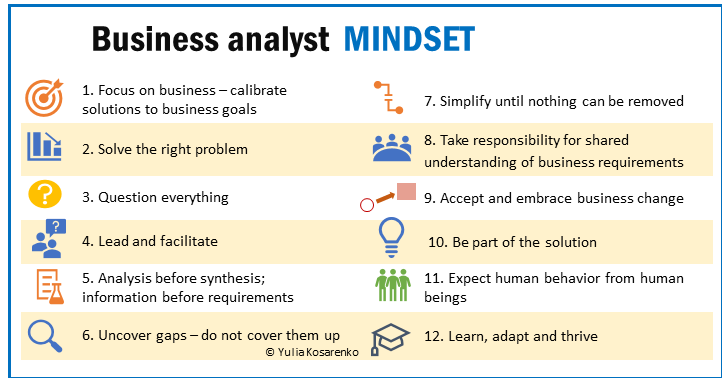
Beyond tools and techniques of the trade, principles of the business analyst mindset reinforce the importance of building successful relationships and communication patterns, taking accountability for facilitating consensus and addressing gaps, and guiding stakeholders to make analysis-based decisions.
Emphasis on the business analyst mindset and fostering its principles is an important foundation of a successful business analysis practice in any organization.
Originally published at http://why-change.com on February 24, 2020.
Yulia Kosarenko is the author of Business Analyst: a Profession and a Mindset. She is a speaker and the business analysis community activist, and offers online courses, personalized coaching and corporate training for business analysts and architects.
Website | Contact | Training | Mentorship | Courses | Job Interview Clinic | Books | Downloads | LinkedIn | YouTube | Instagram | Twitter


