
Business Analyst Mindset: Twelve Principles (Part A)
Start with the right problem

What do all successful business analysts have in common?
You may call out the knowledge of the techniques and proficiency with tools, a good grasp of technology or agile team experience. However, at the foundation of this success is the right mindset — the business analyst mindset.
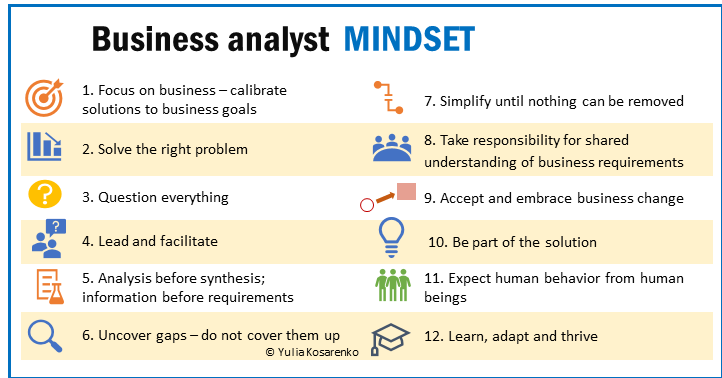
Explore the first four principles with me in this article — and if you prefer watching videos or listening, see the embedded videos in each section.
Principle #1: Focus on Business — Calibrate Solutions to Business Goals
To excel at what you do, you always need to start with the client and their needs. Who is your client when you are a business analyst? Is it the project manager, the developer, the test lead, or the architect? Perhaps, a business relationship manager, or your functional manager?
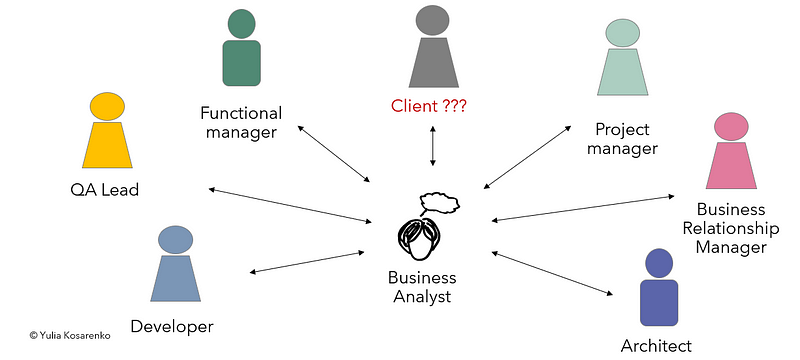
One of them may have influence over your schedule, another — over your compensation and promotion, and another — over the solution components. However, the reason you have a job is to solve business problems. The value you bring is what you do for your clients — business groups that have problems in need of a solution.
Your real clients are the business stakeholders who have a problem you are helping to resolve. Everything you do has to be done with business needs in mind.
Principle #2: Solve the Right Problem
If solving problems was easy, business analysts would have nothing to do. In reality, when you see an issue or your clients describe it to you, you are in fact observing the symptoms and hearing about pain points.
We cannot assume that the problem described to us is the real issue. It may be a symptom of a more complex problem or a pain point that has multiple causes. Before forging ahead to solve a problem set in front of you, make sure you understand it.
Discovering the real issue may turn out to be the hardest challenge you face when practicing business analysis.
So what can you do? Investigate, search for the root causes, analyze and break the problem down. Explore different factors to understand their relationships and correlation. Listen to all sides and ask “why?” as many times as needed to get to the real problem. This is the job of a business analyst, and the attitude that will help you solve the right problem.
Principle #3: Question everything
How do you discover the right problem? Understand why things don’t work the way they should work?
Discovery and analysis are built on the foundation of asking questions. Ask questions to learn, to get information, to investigate, and to understand. Ask questions instead of making assumptions. The questions you ask, and the questions you don’t ask, have the power to influence the success of the change.
Sometimes, a question you did not ask may turn out to be the most important one. The answer to that unasked question may have changed the course of the project.
Your most important role as a business analyst is not in finding answers. It’s in asking the right questions.
Principle #4: Lead and facilitate
As a business analyst, you have a special role. You may not be managing people in a traditional sense. But you are the link between the groups of people that don’t always understand each other. You are accountable for helping them communicate, reach that understanding, and work better together. You help manage the relationships, explain, clarify and navigate different opinions and agendas.
A business analyst is a classic example of a leader without authority, an influencer without seniority. During a project, they will take on a variety of leadership roles — planning and leading the requirements analysis process, organizing diverse groups, managing expectations, helping technical and business people communicate, training and preparing business groups for upcoming changes.
They may even need a special hat stand for all those hats they have to wear.

Why so many hats?
A business analyst’s role is to facilitate effective communication among people who need to achieve a common goal in the most efficient way.
Ensuring effective communication includes many aspects — asking questions, listening, explaining and writing articulately. It also requires managing groups of people that get together to achieve common goals — meeting facilitation.
For a business analyst, the ability to lead and facilitate is crucial. You may find this side of your job is the most challenging, but without it, you cannot be successful.
With a business analyst mindset you have the right foundation to become a true leader — a leader who strives to do the right thing, leads others to do the right thing, and knows what the right thing is.
Explore the BA mindset further in my books and courses, or subscribe to the Why Change Newsletter to stay in touch and hear about upcoming events and webinars.
Website | Contact | Training | Mentorship | Courses | Job Interview Clinic | Books | Downloads | LinkedIn | YouTube | Instagram | Twitter


