
How to Create the Best Employee Experience with Organisational Culture
Know the Difference between Culture and Ideology

Culture and Ideology
Best experiences do not just happen by chance. The best employee experience is the result of an organisational culture that engages and aligns their emotional commitment to the organization and its goals because they are emboldened and empowered to use exceptional discretionary effort.
Culture is the fusion of beliefs, values, norms, and behaviors that provide the organisational cultural character. The degree of cohesiveness of organisational culture is the extent to which its members have internalised the beliefs, attitudes, and values within the organisation, as manifested in their individual and collective behaviors. It is important to understand that culture is what the organisation “is”, and not something that the organisation “has”. The implications of such a perspective are that organisations would behave and act as a consequence of how it interprets their world. It is this enactment and interpretation process that constitutes the essential dynamics of organisational culture.
An earlier article “Organisational Culture Made Simple” explained that: “Organisations evolve as they make sense of themselves and their environment. As a social organism, the organizational survival instinct seeks to reduce uncertainty through information flows, and the organization is enacted through the interpreted meaning of individual actions”.
Organisational culture is therefore both an adaptive regulatory mechanism, uniting individuals into the organizational social structures, as well as a necessary means to create adaptive organisms operating within their environment.
When left alone, culture should naturally evolve towards greater congruency and consensus in a steady fashion. This is only possible when situations encountered by organisations are not radically different from the past, and when the environment is changing in an orderly and understandable fashion. That is when the future is viewed as an extension of the past. The “culture” of an organisation as a “loosely-coupled” system cannot deal effectively with the radical change needed when the organisation finds itself in an environment with a dynamic, chaotic character as in the new management realities we are now facing.
The new management realities of business excellence threaten organisations as they systematically dissolve hitherto accepted motivations and purpose, when they are not amenable to the usual interpretations, when the usual means to adapt and deal with change usually backfire and are often rendered ineffectual. The following depicts the key differences between culture and ideology.
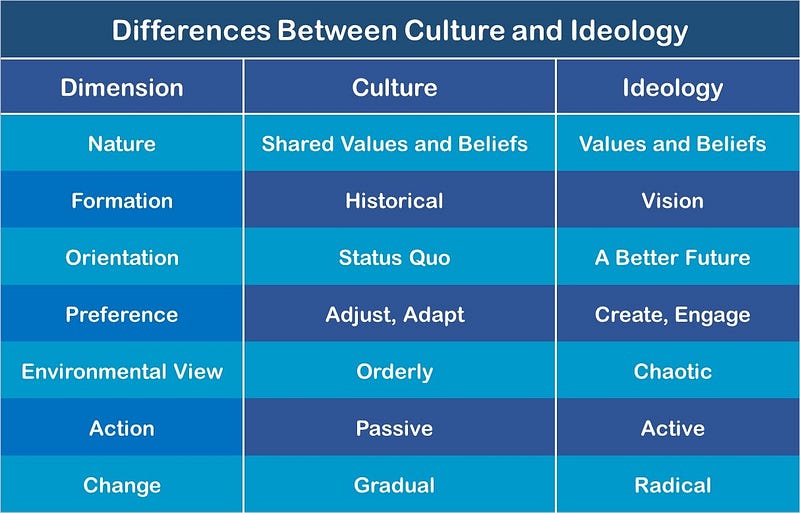
It is wrong to regard culture and ideology as synonymous or merely mirror images of the same phenomenon. It matters that they are fundamentally and conceptually different, and a careful understanding of their differences is critical to the determination of an organisation’s success and survival, or failure and oblivion.
An appropriate ideological cultural system, by definition a conscious, cohesive, and consensual culture in its own right, could pose a welcome challenge to a “loosely coupled organisation” and could capture the hearts and minds of organisational members by merits of its logic, relevancy, and beneficial consequences.
Enter the Ideology of Business Excellence. The ideology of Business Excellence by itself is an adequate and ordered system of cultural symbols. It presents itself as a complete, patterned reaction or response to the management and business issues of business excellence as well as the socio-psychological stress and disequilibria engendered by the new management realities. The ideology of employee engagement is embedded in the ideology of business excellence.
The Formation of Employee Engagement Culture
Open system perspectives in organisation theories see organizations both as hierarchical systems and as loosely coupled systems. In open systems, there is some semblance of clustering and levels where multiple subsystems exist to specialize in certain system activities. Interdependencies and connections within a subsystem also appear to be tighter than between subsystems. And these “stable sub-assemblies” give a distinct survival advantage to the entire system.
Organizations however do not function as mechanistic cybernetic systems. The normative structures are often loosely connected to actual behavior at both the individual and collective levels. The organization is, in effect, a coalition of groups and interests, with each attempting to obtain something from the collectivity by interacting with others, and each with its own preferences and objectives. The resulting culture, as the constructed organizational reality, is dependent on the degree to which a group of people share many beliefs, values, and assumptions that encourage them to make mutually-reinforcing interpretations of their own acts and the acts of others. This loose coupling nature of organisation is a key ingredient in enhancing the quality of adaptability in the organisational culture.
Adaptability presumes learning. In this respect, culture refers to what is learnt. Therefore, if culture is learned, its ultimate locus must be in individuals rather than in groups. A satisfactory cultural theory must therefore explain the sense in which one can speak of culture as being shared or as the collective property of a group of individuals, and it would have to identify and describe the processes by which “sharing” emerges.
To become the organisational culture, employee engagement is therefore learnt and not taught. The desired exceptional employee experience is the outcome of a learning organisation that transforms the employee engagement ideology into its organisational culture.
There is no single clear definition of employee engagement. The different expectations of each organisation have spawned various indicators and quasi-measures purportedly measuring their respective culture of employee engagement.
The organizational culture is created from the social construction process where shared meaning, shared understanding, and shared realities are all different ways of describing cultural formation. A deeper understanding of the ideology-to-culture creation process is needed to enlighten and inform a more effective transformational effort to create a conducive employee engagement culture for a great employee experience.

Please enjoy my recent Articles.
You can also subscribe to my stories and social media posts via your email. Enjoy more interesting Articles by signing up to Medium here: https://thefuturistoracle.medium.com/membership