What’s Wrong with Current Business Management?
Transform your Organisation to Work For You

Increasing globalisation and rapid technological innovations create an ever-smaller world constantly in a state of revolutionary flux. As a result, organisations nowadays operate in highly complex and dynamic environments.
Management today has to move beyond its focus on a strategy that merely seeks to define a rational product-market position, towards a sense of purpose that envelops its employees’ passion and commitment. It must look deep beneath organisations as simple structures and apply a process-based perspective that integrates and links the individual competencies and capabilities that exist within the organisation.
When an organisation is viewed in terms of processes, it acquires a flexibility characteristic and enhances confidence in the management of change. The effective management of change is undisputedly the single greatest challenge for management as it enters the new millennium. A better world beckons, making it imperative for management to adapt by transforming itself into relevance or face the prospects of oblivion.
Various prescriptions in the recent past decade seeking to reengineer, delayer, downsize, rightsize, redesign and reform the organisation are symptomatic of desperate management attempts to come to terms with the emergent and unforgiving business environment. Business no longer begins and ends with profitability. Likewise, business management ceases to be defined just by market share and sales growth.
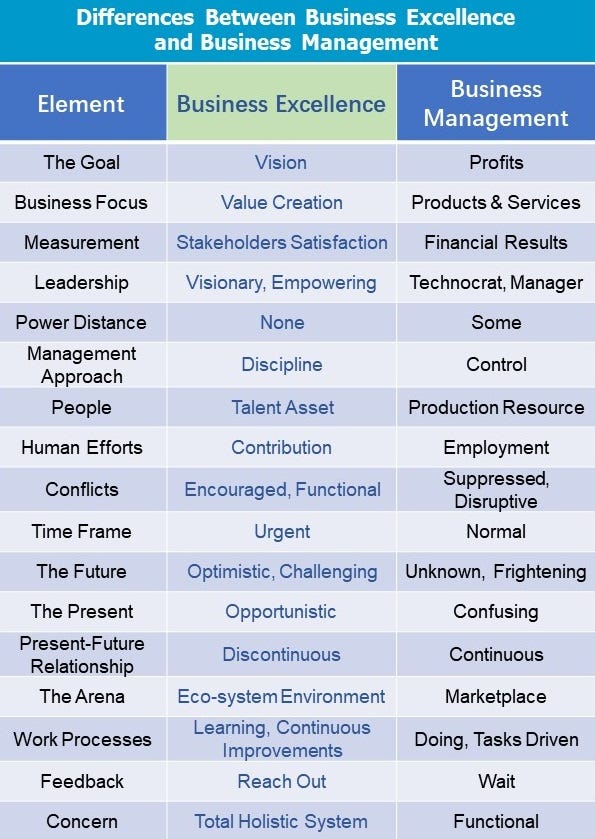
The business of management has become the management of business excellence.
While business management would require the alignment of product and services with customers’ expectations of quality in the marketplace, the management of business excellence involves the alignment of business strategy, organisation behavior and the global environment.
To use the organisation itself as a strategy for business excellence is not a new idea. Lawrence and Lorsch have highlighted the need for organisations operating in dynamic environments to be able to assume various flexible, differentiated and structural patterns, each of which is in fact a multiplicity of interconnected, mutually supporting sub-organisations. Flexibility is the only plausible winning strategy to deal with uncertainties in the business environment. Peter Drucker has also emphasised strategy and organisational culture as the two fundamentals of a business organisation that have to be managed particularly well in any successful management of change. The importance of people, purpose and processes in the management of business excellence is further reiterated by Kanter who believes that when people choose actively to manage the turbulence in the environment, they “do more than predict the future, they invent it”.
Establishing a conscious, unifying sense of purpose is the first crucial step in organisational transformation. It binds people to their organisation. The resulting passion which permeates organisational efforts and activities in all functional areas, and driven by a visionary leadership, has in a few organisations become their most powerful competitive factor in securing a sustainable and enduring business excellence. These organisations are the forerunners of a total quality organisation whose peculiar management approach sets them apart from other organisations. Their unique management style used to be known as total quality management (TQM).
Today, TQM has outgrown its earlier bounded mindset to embrace a more holistic Business Excellence management (BizXMgt) approach.
A BizX organisation departs from conventional organisations by their systematic social engineering of a corporate culture based on an ideology of BizX which is totally and completely motivated by an entirely different set of management pre-requisites.
What’s Wrong with Current Business Management?
Current management refers to an extremely broad and fragmented pantheon of management theories, models and practices. Although the vast majority of them were developed or evolved only over the recent 70 years, they have generally not changed radically in terms of their basic ideological and philosophical assumptions and behaviors. It is however recognised that there are indeed a number of conflicting and competing management theories, models and practices. This generalised critique shall only highlight the key and major premises.
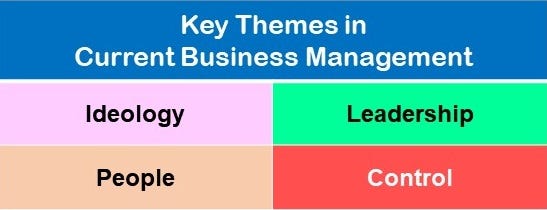
There are at least 4 themes in the ideological and philosophical assumptions and behaviors of current business management, namely: ideology, leadership, people and control.
Ideology
The Protestant Ethics of the middle ages is a major shaper of current business management thinking and practices. It legitimises the accumulation of wealth as an indication of divine grace and blessings, confers upon profits a high moral value and thereby sets the stage for a commercial revolution.
The laissez faire theory of Adam Smith in the late 18th century promotes unrestricted free trade as the best approach for the optimal allocation of resources for the benefits of society by individuals who are pursuing their own best interests, with the presumption that these are not in conflict with society’s best interests. A hundred years later, Social Darwinism extended the struggle for biological survival to the broader parameters of society, and argued that the existence of rich and poor classes are a natural order and that the most capable and resourceful people in the population will rise to become the most wealthy in society. The combination of the Protestant Ethics, the doctrine of laissez faire and Social Darwinism provides the essential boosters for the tremendous industrial and commercial expansion in the past 180 years.
They also influence the development of today’s rational, hierarchically-structured organisation-type and its corresponding business management approach which is based on logical functions designed to pursue the rational goal of profit maximisation, and cost reduction, through a management control system of rules and procedures.
These “sacred cows” of profits and costs as the sole determinants of current business management actions are increasingly being invalidated, to be replaced by the discovery of higher-order visions guided by specific moral values in the commercial pursuit of the greater good for mankind beyond purely materialistic goals.
The future is no longer a simple, logical extension of the past. Given the almost weekly profusion and proliferation of management perspectives and models nowadays, it appears that the time-line of management thinking is no longer a smooth continuous, evolutionary function. Rather, it is a discontinuous one. There is an urgent need to free us from this “prison” of historical shackles, and embrace a new ideological foundation for growing fresh paradigms that are unencumbered by history.
Leadership
Current management practices and training encourage managers to see leadership as simply the final act of gaining co-operation for the implementation of decisions. The artificial distinction of leaders and managers has not contributed to a more convergent understanding of management leadership. Few managers have escaped from the self-imposed organisational “prison” system of corporate structures and rules, becoming a mere tender of the machinery of that part of the larger organisation to which he belongs, and which rewards him for submission, acquiescence and compliance.
New management realities demand that the manager becomes a shaper of what can be, instead of mere servants of what is. He must accept responsibility for change, for doing things in new and unusually ways. He is able to see his environment in a fresh and different context, questioning hitherto hallowed assumptions and developing fresh approaches to emergent and longstanding issues. It is imperative to develop managers for leadership. The essential tasks of the new managerial leadership are to deal with business strategy amidst change and to build change-responsive organisations.
BizX leadership is more than just about methods, styles and tools. BizX leaders possess compelling visions, which provide the crucial task and mission directions, beyond purely financial goals, and have the capabilities to translate these through their people into reality. The accompanying BizX ideology infuses work with meaning that goes beyond just profits maximisation or a job. Over a sustained period of time, the BizX ideology became rooted into an emergent set of shared values and beliefs, and when stabilised, constitutes the corporate culture. Vision, within a BizX ideology, is the sine qua non of corporate leadership for business excellence.
People
Despite the human relations thinking over the past 60 years, current management practices continue to regard people as less than the strategic capital resource that they truly are, and which should be treated and developed as such. Management accounting practices do not accord recognition to people as assets, or treat expenditures on human resource development as investments in the conventional sense. Current management treats its people essentially as a cost and expense item on their balance sheet, and therefore the only logical management actions are to constantly reduce and eliminate its share of the commercial profit pie. People experiences of work and management controls are important socialising influences. It is from their subjective orientation within the organisation that they perceive an understanding of the “worthiness” placed upon them by the organisation.
The essential prerequisite condition for business excellence is the complete elimination of specific organisational practices that interfere with the conscious efforts of its members to focus work so as to derive a greater sense of mission accomplishment. A climate of partnership is needed to instil a collective commitment to business excellence and to encourage people to develop self-discipline for the achievement of mission goals and the ultimate corporate vision.
In the face of global competition and constantly shifting economic and market conditions, the human talent appears to be the only asset capable of producing the desperately needed competitive edge. People are the ultimate high technology. They are the main actors in business strategy, creating a future for the company instead of just letting it happen.
The successful management of business excellence involves a system of corporate values, planning capabilities and organisational responsibilities that drive strategic thinking and actions with operational decision-making at all levels and across all functional lines of authority in the company. The totality nature of an organisational strategic response to the dynamic business environment assures an enduring and sustainable competitive edge.
Control
Only financial measures and indicators guide current business management controls. The economic rationality of efficiency also dismisses the notion that a business organisation should provide its members ample opportunities for the exercise of political democracy. Tight controls are therefore embedded in the social and organisational structure of the organisation. Such bureaucratic controls remain externalised rather than becoming internalised. They merely evoke the appearance of individuals acting as if the company is their source of meaning and commitment, which in reality is actually not the case.
Humanistic controls, popularised by the human relations school of management have also failed to promote a cohesive sense of the broader community as it too does not possess the capabilities to generate passionate sentiment or emotion. The hierarchical organisational structure also prevents any connections with the personal values and goals of management other than the profit motive. Control by corporate culture regards culture as a variable to be manipulated and managed to strategic ends. It seeks to improve organisational performance by securing greater employee commitment and identification with corporate values. The notion of shared beliefs and values is conveniently, and simplistically, regarded as unproblematic.
An alternative obsession with management control is motivated mostly by Marxist perspectives, which assume an inherent, irreconcilable conflict between management and workers. This assumption is naive and self-defeating by extension of its own argument of the futility of effective management control, which would never ever have been possible if it were true.
There are as yet no persuasive evidence that motivational and ideational management controls have been effective in obtaining an enduring and sustaining business excellence in organisations which are devoted purely to the pursuit of commercial profits.
A mindshift to the BizX ideology is needed to discard the notion of “control” in favour of the concept of “discipline” so as to discover the ideologies that could provide stable disciplined orientations to the world and produce the level of organisational self-discipline for sustained performance, instead of the current efforts in search of liberation from the illusions of management domination.
The key differences between Business Excellence (BizX) and current business management are shown below: