How I Engage the 3 Core Drivers of Organisational Transformation
Creating the Business Excellence Organisation (BizXO)

A Business Excellence (BizX) ideology provides the “sense” in a Transformed Organisation through its structure of values, beliefs and associated practices. The BizX Organisation is an organisational paradigm that combines social psychology with complex organisation theories to describe organisations in which the envisioned purpose is anchored on the dynamic demands of customers, and its ability to engage in rapid and relentless continuous change defines its crucial capability for sustaining growth and survival.
There are 3 contingency factors which drive the shape of organizational transformation into a BizX Organisation (BizXO): (1) Commitment to Customers, (2) Problem Situation and (3) Business Environment.
(1) Commitment to Customers
The customer experience is the critical paramount factor for a sustainable market leadership advantage. An organisational commitment to its customers can only be subjectively measured to a matter of degree rather than by the scientific determination of absolute. There are two dimensions in an organisational commitment to customer; namely, (a) understanding the expectations of customers, and (b) responsiveness to meet these expectations.
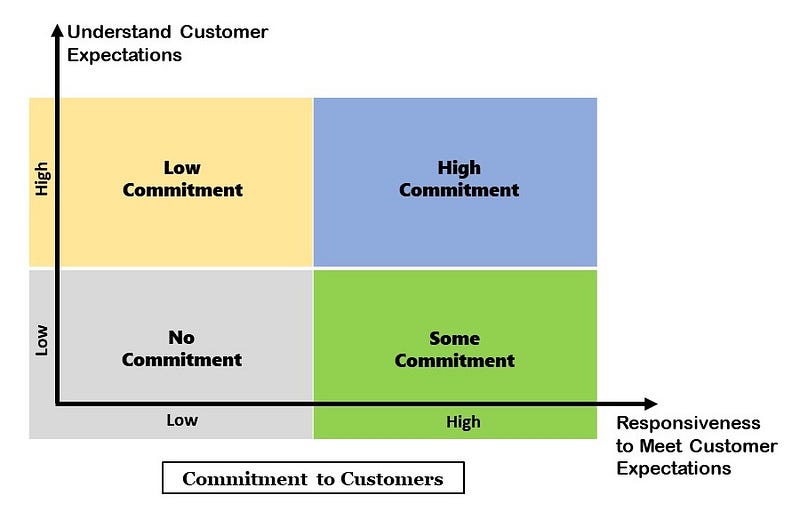
The above illustration shows the understanding of organizational commitment to its customers.
A high understanding of customer expectations coupled with fast and timely organisational response to meet them indicates a high customer commitment. A high commitment to customer is a necessary condition towards obtaining a superior and outstanding customers experience, deserving of the legendary “wow” effect. It is not however a sufficient condition for total customers satisfaction, which depends upon a combination of other factors such as durability, reliability, service and functionality, total buying experience, for examples.
A low understanding of customer expectations and slow organisational response to meet them clearly indicate indifference and apathy; that is, no commitment to its customers. Similarly, a slow response to presumed understanding of customer expectations does not support logical alignment between cognition (high understanding) and action (slow response), thereby making such commitment suspect, and renders the best possible verdict of having only a low customer commitment.
On the other hand, a fast organisational response to meet the expectations of customers which it has low or little understanding is an example of over zealousness and ever eagerness to please the customer. Its low understanding of customer expectations would eventually backfire and such “deliver first-ask later” approach to customers is misguided and detrimental to organisational success. It does however indicate some commitment to its customers, when contrasted with low commitment, by a matter of degree.
The organisational commitment to its customers is driven more by its responsiveness to meet customer expectations than by its understanding of the expectations.
(2) Problem Situation
A problem situation is a gap between actual and expected performance. An organisation evaluates its performance based on stakeholders’ feedback and continuously assesses its situational urgency according to results obtained from the use of its resources and their impact on the marketplace of its products and services. There are two dimensions of the problem situation, namely, (a) returns on net assets or RONA, and (b) market growth.
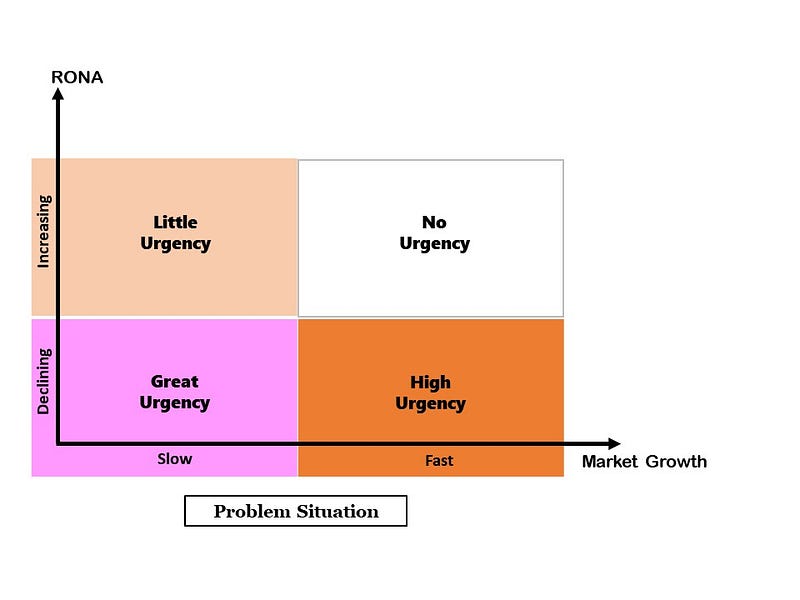
From the above illustration, a situation of increasing RONA in a fast growth market imposes no immediate threat to organisational survival and therefore has no desperate need for any quick problem solutions — this is a situation of no urgency. In the other extreme situation, declining (or stagnating) RONA in a slow (or stagnating) growth market would constitute a situation of great urgency as they signal the impending death of the organisation unless some appropriate solutions to clearly identified problems are drastically implemented immediately to reverse the trend. Know that survival is not compulsory and therefore optional by choice.
Increasing RONA is a measure of productivity growth insofar as they indicate better results from resource deployment and management. A situation where there is increasing RONA in a slow (or stagnating) market will inject a little urgency to the problem situation, but there is no need yet for desperate measures since the organisational performance as measured by its RONA continues to be favourable. However, a declining (or stagnating) RONA in a fast growth market would signal a growing failure to deploy resources in an appropriate manner to harvest the growing market opportunities, and this attaches a sense of high urgency.
The urgency of the problem situation encountered by an organisation is determined more by its returns on net assets (RONA) when compared in conjunction with the growth of its market.
(3) Business Environment
The business environment of an organisation refers to the conjunctive state of its external macro environment (M-Env) and its immediate competitive environment (C-Env). The state of dynamism and stability of the business environment is the confluence of the rate of change in the interaction between the M-Env and the C-Env.
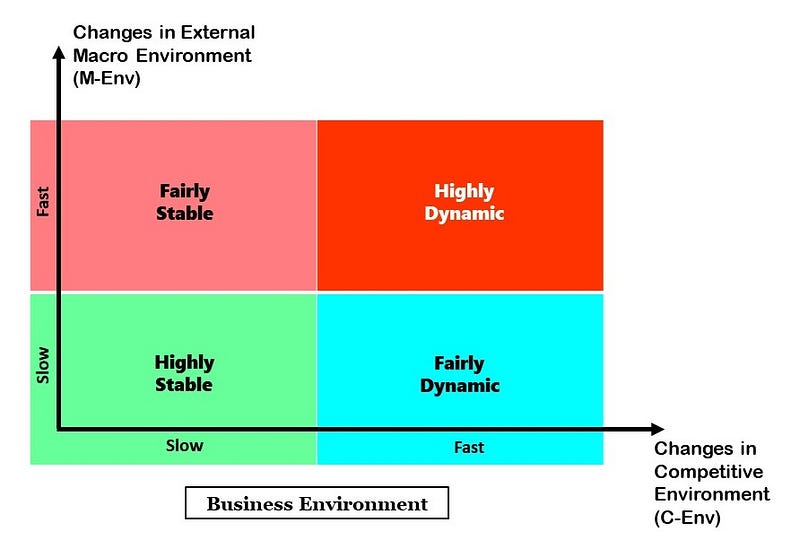
The stability and dynamism of the business environment could be visualized and evaluated as shown in the above illustration.
The organisation’s M-Env refers to the external environment that is common to all its competitors, and consists of elements in the technological, demographic, sociocultural, political/legal, macroeconomic, and global segments. Its C-Env is characterized by the competitive behaviors of its competitors, suppliers and customers, and which are further moderated by the influence of substitute product/services and the extent of entry barriers for new competitors to the marketplace.
Where there are fast changes in both the M-Env and the C-Env, the business environment is regarded to be highly dynamic. In a dynamic business environment, the predictability of outcomes as to future environmental states is uncertain. Where changes in both of these environments are slow, a highly stable business environment exists, and management takes comfort in the predictability of future environmental states with a greater measure of certainty.
When changes in the M-Env is fast when compared to a much slower C-Env, the business environment may be considered as fairly stable since the slow response to the M-Env by the C-Env could mean that the changes in the common environment do not yet have significant material and strategic impact to the organisation and its fellow competitors. It could however also indicate a lack of competency, capacity and capability on the part of the C-Env to respond in any meaningful manner to challenges resulting from the changes in the M-Env. In any case, the business environment would remain fairly stable.
Active competitive activities could drive fast changes in the C-Env in a relatively much slower M-Env. The business environment becomes fairly dynamic as the organisation do battles with its competitors in order to secure, sustain and advance competitive positions as well as market share.
The dynamism of the business environment relates more to fast changes in its competitive environment (C-Env) than to changes in its external macro environment (M-Env).
Organisational transformation is focused at the confluence and interaction of the three contingency factors of (1) commitment to customers, (2) problem situation and (3) business environment in their respective engagement with the Business Excellence (BizX) ideology. They influence the organisational transformation process and determine the shape of new organisational forms.
The goal in any organizational transformation is to create the BizXO as an agile organization. An agile organization remains flexible and adaptive, and constantly changes in response to emergent, predictive and anticipative trends in the organization people and business eco-system.