Organisational Culture Made Simple
Why your Organisational Culture can Be Changed and Transformed

The understanding of culture is central in any transformation of organisations. There is as yet any consensus as to what the concept of culture really mean. The definitions of “culture” ranged from the simplistic “…the way we do things round here” to the profound “…the set of habitual and traditional ways of thinking, feeling and reacting that are characteristic of the ways a particular (organisation) meets its problems at a particular point in time” These are in addition to more than 164 other different definitions of culture.
The concept of culture has its roots in anthropology, where even anthropologists have not agreed to a common acceptable definition for it. It is understandable therefore to see “organisational culture” as just a polemical concept since it has no clear, unambiguous definition.
What is Organisational Culture?
Generally, culture refers to a system of attitudes, values and knowledge that is widely shared, consciously and unconsciously, within a society and propagated through learning from generation to generation. There is some degree of convergence of the view that culture refers to “a set of shared values and beliefs” and acting the “normative glue” that holds an organisation or society together.
Many definitions agree that culture comprises some interrelated psychological qualities indicating group agreement, implicitly or explicitly, on how problems are identified, solved and decisions made. Ordinarily, these psychological tendencies translate into “the way things are done around here” or “what people believe does or does not work in their workplace”. They eventually become taken for granted and move beyond awareness. The human need for consistency and order further drive their assumptions to form a mental pattern or mindmap that is implicit, taken for granted, and unconscious. It is only through a process of inquiry that they are brought to the surface.
Consistent to this perspective, the popular conception of culture is a pattern of basic assumptions and beliefs that are shared by members of an organisation, that operate unconsciously, and that define in a basic taken-for-granted fashion, an organisation’s view of itself and its environment. These assumptions are invented, discovered or developed by a given group as it learns to cope with its problems of external adaptation and internal integration. These “solutions eventually come to be assumptions about the nature of reality, time, truth, space, human nature, human activity, and human relationships…”.
Organisational culture is therefore functional in the organisation by:
(1) Specifying what is of primary importance to the organisation, the standards against which its success and failure should be measured;
(2) Dictating how the organisation’s resources are to be used, and to what ends;
(3) Establishing what the organisation and its members can expect from each other;
(4) Making some methods of controlling behaviour within the organisation legitimate and makes others illegitimate — that is, it defines where power lies within the organisation and how it is to be used;
(5) Selecting the behaviours in which members should or should not engage, and prescribes how these are to be rewarded and punished;
(6) Setting the tone for how members should treat each other and how they should treat non-members: competitively, collaboratively, honestly, distantly or hostilely; and
(7) Instructing its members about how to deal with the external environment: aggressively, exploitatively, responsibly or proactively.
Specifically, organizational culture impacts organisational life through 5 key functions. The organizational culture is embedded within:
(1) Mission and Strategy:
The extent to which activity and thinking reflect common understanding is the vision or core mission of the organisation.
(2) Goals:
Developing common understanding on goals that are derived from the vision and what must be done to achieve that vision.
(3) Means:
Developing common understanding on the means to be used to attain the goals, such as the organisational structure, division of labour, work processes..etc.
(4) Measurement:
Developing common understanding on the criteria to be used in measuring how well the group is doing in fulfilling its goals, such as the information and control system.
(5) Correction:
Developing common understanding on the appropriate remedial or repair strategies to be used if goals are not being met.
Organisational culture manifests itself beyond its behavioral norms, hidden assumptions and human nature, and also occurs at different levels and degrees of depth. Norms are just below the surface of experience and have an “ought to” quality to them. As a maintenance rule, they are transmitted from one person to another by stories, rites, rituals, and sanctions that are applied when a norm is violated. This explains the relative stability, or rigidity, of organization culture which also becomes an obstacle to organizational transformation.
This important element of “sharing” in the nature of organisational culture can be better understood in the following 4 statements:
· shared patterns of behavior constitute the bottom line of culture;
· shared assumptions and beliefs are the foundation of culture;
· shared values provide the criteria for making decisions; and
· shared norms are the immediate drivers of the patterns of behavior that constitute culture.
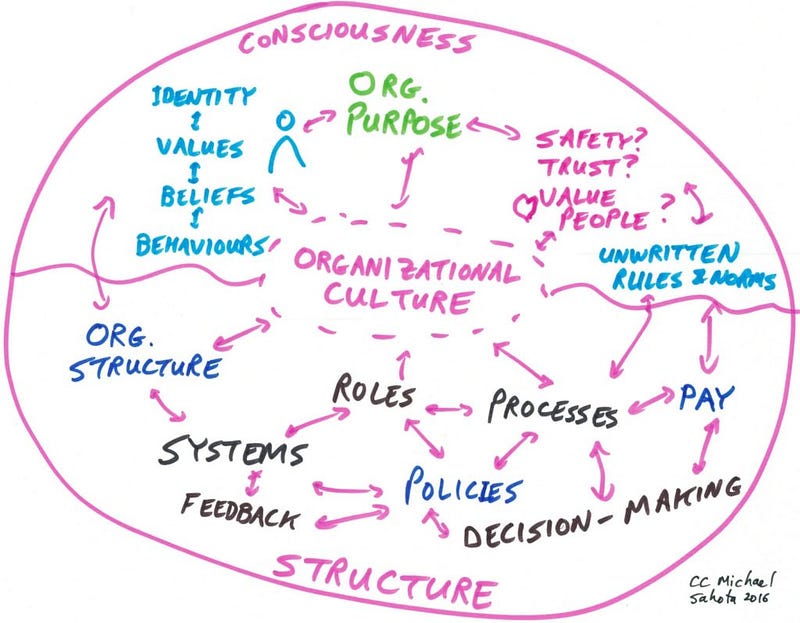
In a nutshell, culture is the “organization’s system of shared values and beliefs, which interacts with people, structures, and control systems to produce behavioral norms”.
It is the fusion of beliefs, values, norms and behaviors that provide the character of organisational culture. The degree of cohesiveness of organisational culture is the extent to which its members have internalised the beliefs, attitudes and values within the organisation, as manifested in their individual and collective behaviors.
Culture is what the organisation “is”, and not something that the organisation “has”.
Organisations would behave and act as a consequence of how it interprets its world. It is this enactment and interpretation process that constitutes the essential dynamics of organisational culture. For organizational transformation to be successful, it must target the needed fundamental change at this core.
Successful Organisational Transformation
Differences in organisational cultures would pre-supposes that its respective members are in fact living in different organiational worlds. Truth is, culture is dynamic and is not a static ‘thing’ but within which, everyone is constantly creating, affirming and expressing. Through their admonitions, excuses, and moral judgments, organisational members mutually “coerce” one another into conformity.
Organisational culture is not imposed from outside but exposed from within; and any organisational transformation efforts which attempts to change culture would have to factor in this internal “culture making” or “sense-making” process.
An alternative perspective of organisational culture see it as an extension of the wider social culture that is connected in a Parsonian-like social system comprising of the political, economic, social and cultural subsystems. It considers the creation of (new) organisational culture as actively negotiated. The crucial implication here is that culture is created actively, rather than just passively inherited, by its members.
Culture is therefore a learnt phenomenon. It is what one gradually recognises and internalised. It is both an input and an output. Culture is partly unconscious, often one has to think hard to recognise the cultural behaviour patterns. Culture is historically based. Culture is also heterogeneous, as there are certain to be sub-cultures within the organisation, given the different degrees of congruency in cultural assimilation at any given time.
Organisational transformation experts must understand the profound influence of culture, given the existence of multiple occupational cultures and the effect they have on organisational coherence and cohesiveness.
The organisation should not be conceived of as the carrier of a single, unique, and monolithic culture. Organisational members also bring into the organisation the various sets of assumptions that they acquire outside the organisation. And these could interfere with their development of a shared set of assumptions within the organisational setting. Organisations thus contain many different cultures rather than a single, pervasive culture.
Effective organisational transformation sees organizations as “loosely coupled” systems in which individual members have great latitude in interpreting and implementing actions.
Two coupling elements often discussed are technical couplings (between technology, task, role) that are task-induced and authority couplings (positions, offices, rewards, sanctions) that somehow hold the organization together. It recognises the autonomy of individuals and the looseness of the relations linking individuals in an organization. It also views the purpose of information processing in organisations as being aimed at reducing the equivocality of information about the organization’s external environment. Managers as information processors receive information about the external environment and then create or enact the environment to which they will attend. In creating the enacted environment, managers consciously separate out for closer attention selected portions of the environment based on their experience.
Organisations evolve or transform as they make sense of themselves and their environment.
As a social organism, the organizational survival instinct seeks to reduce uncertainty through information flows, and the organization is enacted through the interpreted meaning of individual actions. The organisational culture is both an adaptive regulatory mechanism, uniting individuals into social structures, as well as a necessary means to create adaptive organisms operating within their environment.