
How to cope with over-stimulation when you are a Highly Sensitive Person
When the attention span shortens and we notice our mind drifting away, we can say these are the first signs of over-stimulation.

Living in the digital world of 2019, we see more and more marketers changing their strategies from optimizing for search to optimizing for people.
What does optimization for people mean?
It means we notice what are the different types of people according to how their brain works and how we could optimize our reach to them. However, this article is not about marketing strategies. This is for the real people targeted by more and more stimuli, not just from advertising and from our economical systems, but from all environments.
Our brains are wired from a very young age to cope with different sources of stimuli. As we grow into adulthood, the complexity of stimuli is more diverse and the brain faces longer cues of comprehension and detection of these stimuli. As a result, sometimes, the reaction to over-stimulation might have a delayed effect. This is especially true for highly sensitive people.
How does high sensitivity occur and where does it start?
It starts of course in our childhood. We are born with the ability to interpret a number of situations and as we go from one to another without properly processing the information ( for example, kids who’s families have moved or traveled a lot might have this problem as they were in an unstable environment and constantly had to adapt rather than process information on a slower pace), we will feel overwhelmed by the amount of data we need to process from a young age.
In the long term, if there are periods of buffer time when the baby can start processing that information, this will also contribute to resilience and easier adaptation of the baby to any environment. There’s no magic bullet to pinpoint the best way to deal with this. However, the psychology of child development allows us to see which sensors are developed at each stage of the development and what will be the „impairments” formed in the brain of the child if we don’t take care of the stability of the environment we provide to the child. For example, at a very young age, the first few weeks and months are essential for forming a bond based on smells because the baby doesn’t see properly and can’t distinguish very well the faces. As a result, his bond with the mother is based on smell. Another important stimulus in this stage is touch and skin to skin contact for the sensation of safety and connection. This calms the limbic brain which is the most reactive in this stage because the cognition is not formed yet and the limbic brain is the first „interface” we have with the world. If this stage was in any way disrupted, as adults we will face problems in calming ourselves down and soothing our pains.
Being able to calm our limbic brain is the first strategy in coping with over-stimulation
This is especially true for a Highly Sensitive Person but it applies to any person who’s level of arousal and stimulation has reached capacity. If you can activate your Parasympathetic System, then you’re halfway there in soothing and calming your limbic brain. If you are not sure what it means to be a Highly Sensitive Person, I recommend using the test from the famous book of Elaine Aron who writes about this topic with an authority of over 30 years in the field of psychology of sensitive people.
We read a lot of articles and strategies on how to deal with anxiety, stress, and depression which are the result of over-stimulation. However, each person has its own personal formula that can apply to solve the alert created in the brain from stimuli. I call this the personal alchemy of the brain. I like coining such terms as it helps people understand that there’s nothing fixed about the brain. Psychology, psychiatry, and neuroscience are all subjective fields of study and such, no formula fits all.
How can we determine our personal formula to calm down?
First of all, let me reinforce that being able to calculate your own formula is not something easy to be done if you are not helped. So if you’re able to notice on your own what are the triggers and coping schemas you activate when you need to calm down, you’re already further along the way than many who get specialized help for this. After almost 3 years of therapy and many different styles of therapy used to calculate my own formula, I came up with some targeted strategies, no-bullshit advice, to help others facing the same issue.
Here’s what came out of my therapy journey and 100+ psychology books read in the midst of depression last year:
- You’ll need to learn a new vocabulary of emotions in order to interpret what comes from the environment as stimuli.
Hopefully, if you’re reading this you’re a person who is interested in developing new soft skills as a human to improve your own performance in the world but also in dealing with different environments. Learning emotions is something we start doing as babies, but while the development of our brain into adulthood allows us to process and connect triggers from different stages of our lives and process that in our limbic brain, only by naming processes we are fully able to document the schemas we go into. For that, we need to learn new vocabulary and explore more emotions from a spectrum and name feelings and sensations in our bodies.
2. Once you can “label” emotions, you can start noticing when they occur.
This is the common practice of mindfulness. I really prefer saying that we label emotions for the purpose of being able to categorize them rather than say in a general way that we practice mindfulness. I see many people struggling to adhere to the concept because they find it too spiritual. There is, of course, a more rational way to look at it and I think being able to label things is the primary experience we learn as kids once our empirical knowledge is developed. We are all able to do this and in western society, we are even more hard-wired to think in these patterns or rationalization of all inputs from the environment. Noticing when is the key moment when they occur is another crucial step in developing your own formula to calm down.
We master coping mechanisms from a very young age. Noticing when you feel a certain emotion is the first step of my 3rd step about observing your coping patterns to that emotion.
3. Observing your coping mechanisms for the labeled emotion.
This is, of course, very contextual information and it might be hard to notice all coping mechanisms you have even for only one emotion. However, one thing I learned from my own process of therapy and the journaling I did for every session for 2 years on a constant base was that once you start practicing this bit by bit every day you start developing a skill of clustering types of emotions with types of coping mechanisms. Pairing them allows you to see a very important equation. The relationship between Trigger and Effect. The book of Peter Hollins, a psychologist who wrote about the hidden influences behind actions, thoughts, and behaviors and categorized them into types of psychological triggers, allows us to recreate the cause and effect schema and learn something from it.
4. Make a list of how you used to handle a specific trigger in the past as a child and your coping mechanism and reframe that as an adult
Often the over-stimulation is a combination of multiple factors and processes from which more than 85% ( according to Freud’s Ego study of the subconscious processes that happen in our mind) are on auto-pilot because we’ve already come across similar situations in our past and we’ve learned behavior of coping with those emotions. As such, making a list of how we used to deal with this at different times of our development helps us see how more nuanced and subtle we became in soft skills to handle them.

5. Find suitable coping mechanisms that allow you to grow and contribute to your holistic well being.
You might get some inspiration about healthy coping mechanisms by looking into Dialectical Behavioral Therapy which is pointing out some of the most powerful strategies to deal with regulating emotions developed specifically for people who have to face very intense emotions. Feeling overwhelmed as a highly sensitive qualifies as having intense hyperactivity of the brain in the attempt to regulate emotions. As such, I find the advice of Masha Linehan, the creator of this type of therapy that combines behavioral sciences with Buddhist concepts like acceptance and mindfulness to be extremely useful. One of the basic concepts of this type of therapy that you can also start doing today is the planning with specific details on how you will implement change in your life.
My personal formula for this is to use Zoom-In& Zoom-Out techniques.
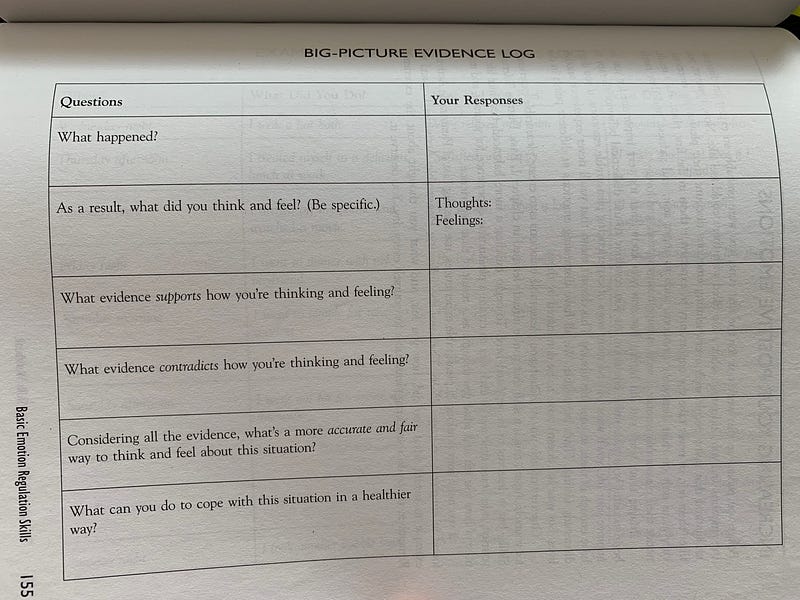
I became a master of seeing big picture events and then being able to take action in the detail and change the small situations that help me in getting my big picture plan done. It starts with an evidence log like the one below from a book I personally take great pride in following every time I need to handle my emotions and I lose sight of my options to deal with it.
6. Make the list of things you will turn to as a soothing/ calming strategy for your own triggers of over-stimulation
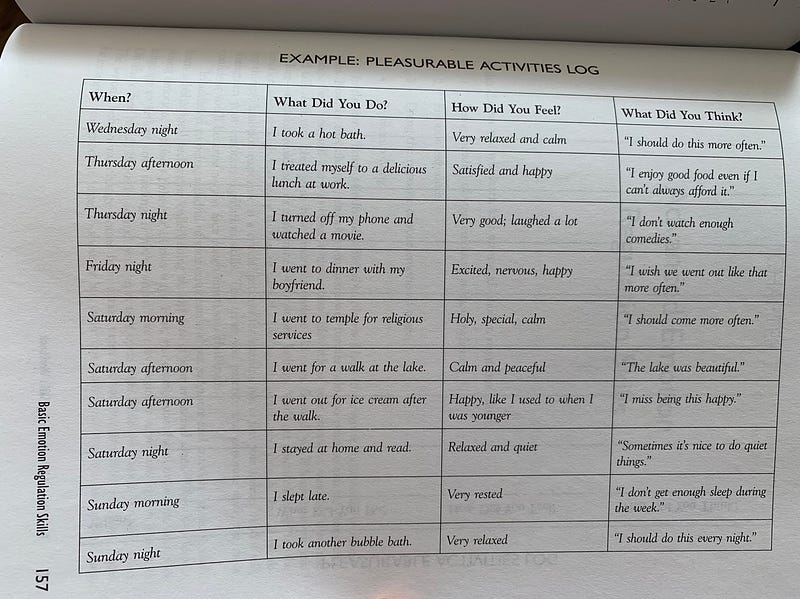
A very good way to follow the last step of the personalized formula is to look for inspiration for types of soothing actions that will allow you to change your current patterns of behavior in coping with over-stimulation. Here is another example from the same book about DBT ( Dialectical Behavior Therapy):
Hope you enjoyed this article. The 2nd part of this article about activating your parasympathetic system as a way to calm down your brain.