
Why experience economy is intrinsically connected to our emotional regulation practices
Economies change because of people’s behaviors evolving, and that’s something that Joe Pine has talked about in his book The Experience Economy with his analogy with the birthday cake.
So if we know that people’s behaviors generates consumption in a specific way, then we can also say that people’s dramas, traumas, and emotional fluctuations can generate new economic trends. As such, can we also say that studying the human brain evolution and its susceptibility to stimuli of the environment can generate new economic trends? Richard Thaler believes it can!
Richard Thaler organizes how economic decisions are influenced by human psychology in 3 categories:
- cognitive limitations (or bounded rationality)
- Self-control problems
- Social preferences
However, my view on this topic after studying marketing and psychology and neuroscience is organizing the decision-making process according to 2 main aspects which have subcategories as follows:
- Our hardwiring of the brain generated by our initial experiences in the world ( until the age of 11–16 years old when abstract thinking is developed in children)
2. Our soft wiring of the brain where we develop cognitive abilities to make abstract models of the world and reflect on our choices and regulate our emotions
The first category has 3 main premises:
1. The upbringing environment will generate the basic consumption style which is either abundant, moderate or frugal. There is no such thing as scarce. People don’t choose scarcity, they fall into it. Frugality, however, is a choice. Abundance can be developed later in adulthood as a result of scarcity in the childhood environment because this is ( maybe) a coping mechanism for the limitations faced.
2. The types of psychological traumas will generate a personality that copes in specific ways to triggers which replicate childhood trauma ( unless those behaviors are analyzed and corrected through therapy which brings extra cognitive abilities to regulate emotions and update the hardwiring of the brain)
3. The permanence of instability experienced in the family. This will generate a style of attachment to material things or people. In environments where people experienced rapid changes and consumerist behavior of the parents, the attachment style to some objects will be more avoidant of the permanence of things whereas in combination with the trauma of abandonment the same person might become anxiously attached to people and therefore have a long term commitment towards certain products/ objects to compensate for the lack of permanence or stability of the environment and people. The compensation though is limited to only a few items whereas the most important purchases will still be less committed. An example of that might be a person who will keep a certain perfume for more than a decade but change apartments every few months.
The second category is a very complex one because it is prone to take into consideration new ethics and morals of the adult person who is engaged with its behavior in intimate ways and has developed enough self-awareness around this topic to discipline its consumption behavior according to the new context of its life.
Soft wiring can be anticipated by knowing these coordinates:
1. What is the potential of the investment in the short term/ long term? ( this is more the econ model described by Thaler)
2. What is the ratio of the investment? What do I aim to do with it?
3. What is the main benefit it brings me?
4. It this something I identify with as a person? Do the values of the company producing it matches my values?
5. Do I need this product/ service?
6. Can I replace this product/ service with another doing somewhat similar things?
7. Do I have to decide all the above every time I buy routine products or can I automate the buying decision making process for a certain category of products/services by outlining once the rules and then following a discipline?
I don’t think this is an exhaustive list, however, I do believe that most rational people will follow most of these questions to decide what they buy and how they prioritize their budgets.
Coming back to the premise that emotional regulation strategies and styles influence the economy, we can analyze whether this is a valid assumption by flipping the analysis lenses and looking at triangulation of big data.
Let’s look at the example of the publishing industry, the entertainment industry, and the travel industry. What do they have in common?
A chart of the publishing industry in the US in 2018 shows that the most sold genre of books is fiction ( which comprises the best scoring genres in sales from the chart). The way fiction is intrinsically connected to human psychology is according to this article the need to escape reality. The same goes for the travel industry which is more logically connected to the action of escaping and entertainment industry which is an immersive experience into a new reality.
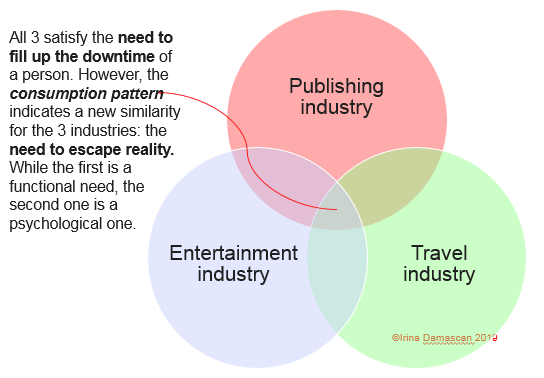
From the experience economy perspective, these industries have managed to leverage the experience of escapism into products that satisfy this need for consumption.
But how might we anticipate what are the experiences we can sell in other industries following this formula?
We can only answer this question is we link deeper the patterns of psychological evolution of the human brain to experiences that help regulate our emotions.
Let’s look at another example. What do emotions like anxiety, stress and high sensitivity have in common?
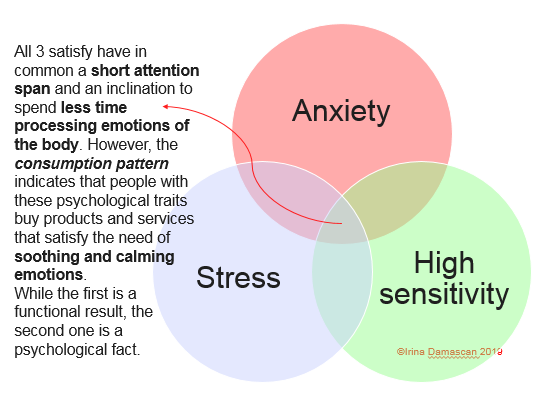
If we extrapolate these conclusions in 2 types of products/services, we would be able to generate solutions for experiences for very different industries:
- The sustainable/good category of products which will help solve these psychological needs and that would lead to products/services that calm emotions such as: yoga classes, self-help books, therapy sessions, calming/ powerful smells in body products ( an example of a very good branding following this aspect is Rituals founded by a dutch entrepreneur who previously worked for the FCGM brand Unilever).
- The less sustainable that manipulates consumption and leverages the short attention span are companies like Netflix that are now introducing episodes of 3–5 minutes to be able to capture the high demand of the teenage segment who is still not able to conceptualize and use abstract thinking in order to regulate emotions and simply binge on coping mechanisms for their psychological traits by consuming easy media that brings instant gratification. Other industries like gaming and travel sell experiences based on the same concept of soothing rather than calming. Of course, we can also look at food consumption and binging of different products that cause addiction.
All the above examples have much deeper routes in the neuroscience of chemicals in our brains and can use much more complex formulas to determine the consumption patterns of certain products compared to others. Yet, the level of neuromarketing ( or neuroeconomics )we have today in these industries has not reached the level of understanding of the human brain that they can manipulate enough critical mass to destroy humankind, but for sure books like the one of Nir Eyal ( Hooked) will help more companies tap into the destructive potential of creating addictive products if we don’t step up about human rights in this matter. However, I am a real firm believer that these companies using the model presented by Nir will learn how to design for the good. There’s a really good set of values designed in this sense for the future of digital cities promoted in Amsterdam under the name of TADA movement. Some of these values are very relevant for what design for good is (other books like Design for Good Society are also taking up these values in the field of design).
My current research is on expanding these values from the city level to the business level so more corporates can embrace these new values for a better world and social innovation. The research will be published in a book dedicated to C level executives who yearn to lead this transformation. Meanwhile, I am available for service design consulting projects for companies that want to be at the forefront of innovation while also contributing to a better world.


