
How to Be Kind to Our Fears

With COVID-19, we started experiencing collective anxiety. Concern for our survival. Both in a physical and economic sense.
This disease is changing the world in so many ways.
“COVID-19” and “coronavirus” are just two of the new words I’ve started using these days. “Pandemic” and “lockdown” are two more. I might have encountered the latter two previously, but I wouldn’t have paid much attention to them. Probably because I was never that interested in films, books, or games (for example, the board game with the telling title Pandemic) in the apocalyptic or dystopian genre.
I am still not interested in these genres. But I am interested in COVID-19, as we all are. It is threatening the survival of humanity; of course, I am interested.
I realized that it suddenly became a topic that everyone can talk about. Before the coronavirus, finding someone to talk to at a social gathering, who shared our interests, wasn’t always straightforward. Now everyone is interested in the same one topic.
Even the Danish tradition of discussing (and complaining about) the weather, can’t match what coronavirus has achieved. Being on everyone’s mind, right from the moment we wake up.
Here is how I became aware of that.
Several months ago, before the pandemic broke out, I woke up from a strange and unsettling dream. Since practicing an anthropological approach to being here and living in the moment, which started when I read Being Here by Ariel and Shya Kane in 2011, I knew that such unsettling dreams were simply my internal alarm signaling I either needed to go to the bathroom (in most cases), drink water, or massage my cramped leg. The dream itself is not what I remember. I remember the thought I had as soon as I became fully awake. I thought, “Phew, what a dream! Thank goodness reality is much better.”
A day or two after the lockdown started in Denmark, I had another dream and a different thought after waking up. The thought was one word: “Coronavirus.” That was scary. Now reality was more frightening than the dreams that day, which probably weren’t bad at all because waking up in itself was pleasant that day. But this unknown and invisible enemy roaming the world was scary. “How vulnerable are we? What might become of my family? What should I do? What can I do?”
When the fear grips me, the Self-Gamification tools become a big blessing.
I remember acknowledging quietly that I was afraid of the future. So I summoned myself, as kindly as I could, to come back to the present and asked myself what I could do next.
This question, formulated over several years practicing Self-Gamification, took the following shape:
“If this [challenge, project, activity] was a game, how would I approach it as its designer or player?”
After asking myself this question, another appeared all by itself, “Is there a game that could help me?” I immediately thought of the countdown element present in so many games, both sports and video games.
I was inspired to use a countdown in real-life situations by the life-changing #5SecondRule used by Mel Robbins to overcome her procrastination and stop pressing the snooze button when the alarm clock went off in the morning. This rule (A reminder: rules are one of the main game components) was inspired by a commercial showing a rocket launch with
“the famous final five-second countdown, 5- 4- 3- 2- 1.” — Mel Robbins, The 5 Second Rule

In fact, the countdown “5- 4- 3- 2- 1-GO” is a game in itself. The goal would be the next step that intuition, your gut, or something outside yourself, draws your attention to; the rule is to start doing that within the 5 second period; and the feedback system is a quick assessment of whether you went ahead or not. And if you didn’t, then the winner would be the snooze button.
So, on that day, when I woke up and became aware of my fear of the coronavirus pandemic, I stood up, counted to three (my version of the countdown game at that moment), and started my day.
Acknowledging my fears and being compassionate toward myself helped me be empathetic and compassionate toward the members of my family, who had their own fears in various degrees and shown in different ways.
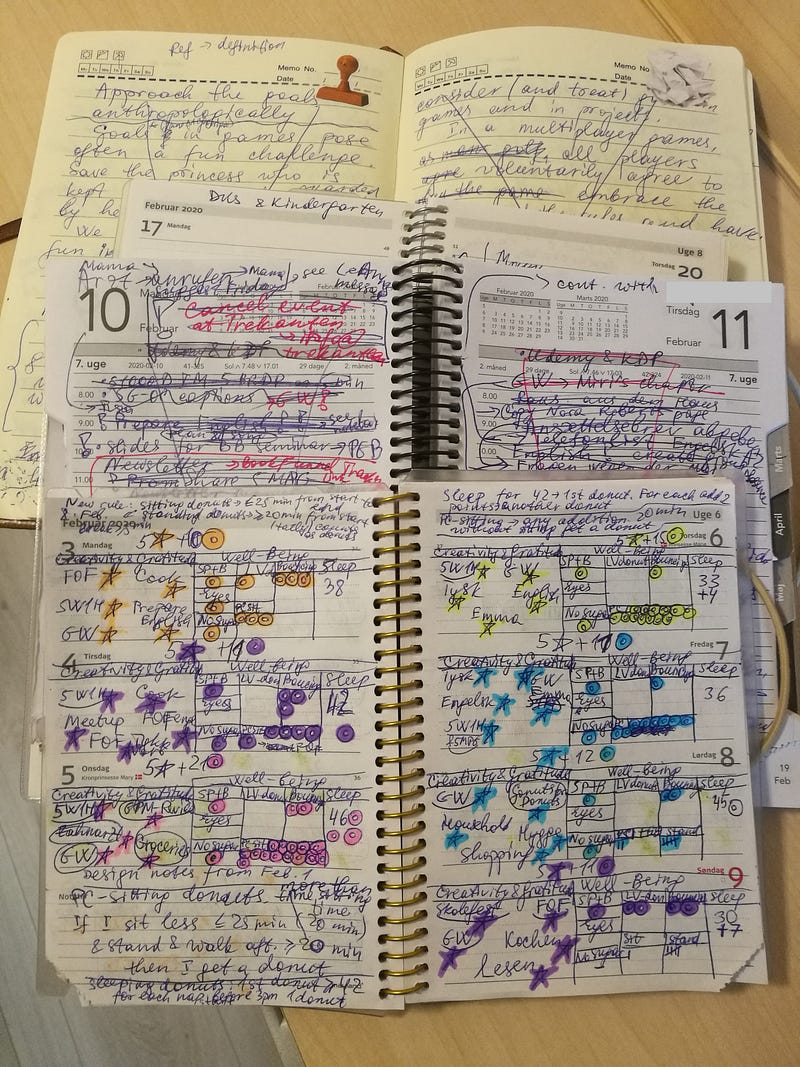
Identifying small steps and what I could do right there, right at that moment with what I had available, was a blessing. Recording each small step I had done, and crossing it out, then giving myself points, stars, and donuts in my feedback systems, as well as adjusting them and the rules of my self-motivational games, made the whole process more fun. This self-motivational game design process engaged me and gave me the possibility of engagement whenever fear gripped me again.
Perceiving whatever is on my to-do list, which I also call a “gamebook,” as a game has been a great trick too. Because at any time that I felt stuck or saw my children were stuck, and there was something we had to do, I would ask, “So what project game will we play next?”
From Robert Maurer’s book Mastering Fear I learned about the results of anthropological studies that showed that the healthiest response to fear, which contributed to our survival as a species, is to ask for help.
That’s great to know, but what if we are too upset (= “unhappy, disappointed, or worried.” — Oxford Dictionaries) to ask for help? Ariel and Shya Kane, whom I quote often, said something brilliant on social media, which I quote from memory here. They said that
we can’t avoid becoming upset, but we can choose what to do in the next moment. Staying upset is one possibility, but there are other choices too.
Could it help to understand where the upsets come from?
Do all upsets come from fear? We don’t know for sure. However, based on the research, I suggest that this is the most useful way of looking at them. — Robert Maurer, Mastering Fear
To become aware of that was terrific. In addition, while practicing seeing myself non-judgmentally and learning more about kaizen and how our brains function, I learned that upsets were not wrong. They were simply indicators — a little red light-emitting diode, or a blue light and a loud siren — pointing at a conflict, a war inside myself.
A well-known American brain researcher, Jill Bolte Taylor, who experienced a stroke and shared her experiences shortly before, during and afterward in her acclaimed book My Stroke of Insight, wrote the following intriguing words in this respect:
Many of us speak about how our head (left hemisphere) is telling us to do one thing while our heart (right hemisphere) is telling us to do the exact opposite. Some of us distinguish between what we think (left hemisphere) and what we feel (right hemisphere). — Jill Bolte Taylor, My Stroke of Insight
That means that everything produced inside me, either thoughts or feelings, whether they appear in my head or my heart or anywhere else in my body, either creative and uplifting or depressive and dragging, are all produced by my brain. By different parts of it, but still by the same physical entity of my human body.

So, it is my brain that is doing all the struggling, and waging all the wars in my head!
As I became aware of that, I had an idea. That idea is another of so many examples of the effortless resourcefulness I address often.
We all learned about the ancient Olympic Games at school and the idea behind them. We’ve heard that all wars and conflicts were stopped so that the opponents could step into peaceful competition within the framework of the Olympic Games. They got points, scores, and laurels.
So, I thought, if creativity was fighting a battle with fear in my head, why not let them put their war aside and organize games for them instead. Why not give each of them points as they progress, as well as laurels and awards for the winner of each round, and praise for the other half who gave her best but lost?
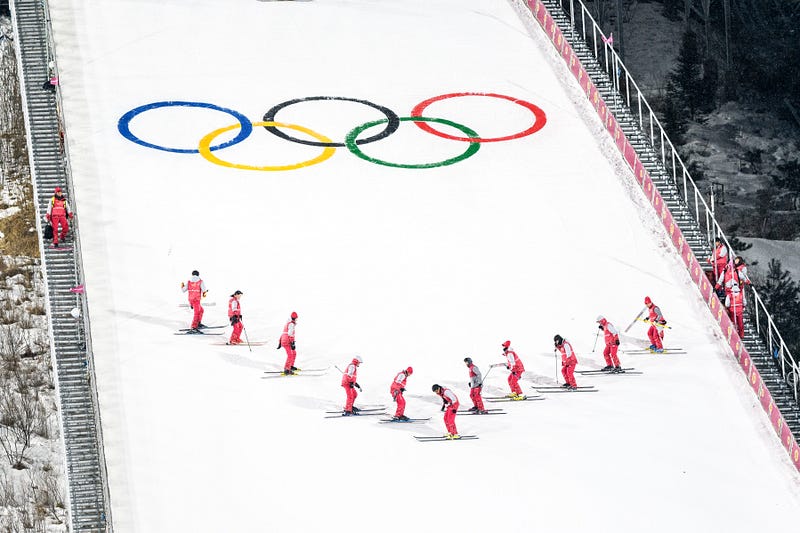
Yes, why not? In doing so, I showed respect to both opponents in my head, the one driving forward and the one hitting the breaks. I showed them this regard by organizing “Olympic” games for them. And not only for a short time, but again and again. Beyond that, I varied the types of games to keep them going and having fun, and me along with them.
The results of these “brainy Olympic Games” were brilliant. If war erupted again between the competitors in my head for any reason, then it didn’t last long, because these wars were not fun at all, while playing games was.
The combination of awareness (that is non-judgmental seeing), kaizen, and gamification, which make up Self-Gamification, can help us to master fear in a light and enjoyable way — in a gameful way.
A quick reminder. This gameful way doesn’t mean that you need to be in denial and overly cheerful.
We’ve all got upset or even angry at least once in our lives if we didn’t win a game or didn’t reach a level we wanted, or bumped into a wall in a car racing game. The difference between real-life projects and games is that, in games, we don’t stay upset for too long. If we observe that we are, then we stop playing the game. To continue playing, we need to put the upset aside and focus our attention on the next move in the game. Or on another game. In a real-life situation, we can do the same: acknowledge the upset and move on.
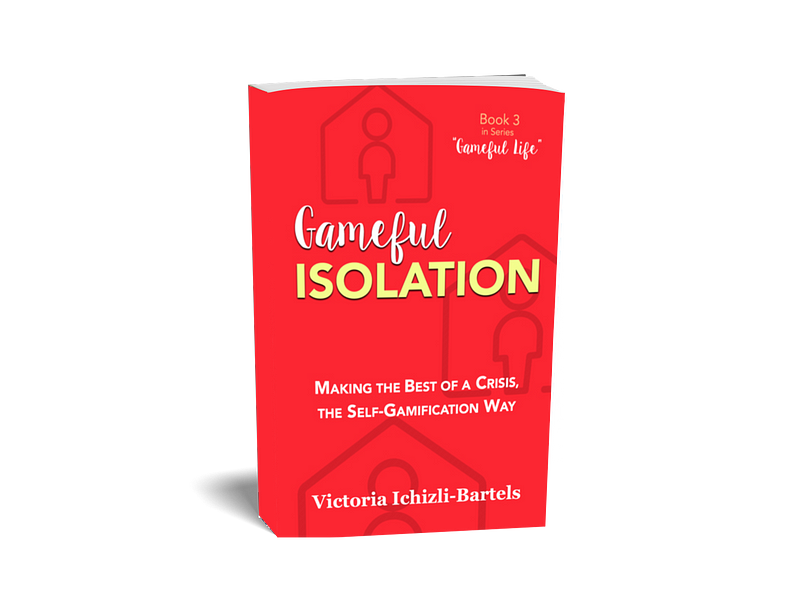
This was an excerpt from my book Gameful Isolation: Making the Best of a Crisis, the Self-Gamification Way. I hope you enjoyed reading it. If you would like to get access to the vlog accompanying the book then check out this page: Gameful Isolation.
And here is the video to the excerpt above:
P.S. To keep in touch, subscribe to my newsletter, Optimist Writer.
About the author:
Victoria is a writer, instructor, and consultant with a background in semiconductor physics, electronic engineering (with a Ph.D.), information technology, and business development. While being a non-gamer, Victoria came up with the term Self-Gamification, a gameful and playful self-help approach bringing anthropology, kaizen, and gamification-based methods together to increase the quality of life. She approaches all areas of her life this way. Due to the fun she has, while turning everything in her life into games, she intends never to stop designing and playing them.


