avatarBill Myers

Free AI web copilot to create summaries, insights and extended knowledge, download it at here

3732

Abstract

e by 3 dots.</p><p id="6cfa">The reader can quickly scan through them to see if they want to follow up on the main points or other references. This story has 4 reference links.</p><h1 id="3367">References</h1><p id="0894"><b>Position: </b>Links in the middle of a story can be distracting. Do I stop reading and go to the link, or try to remember to follow it later? If I do click it, does it replace my story or go to another tab?</p><p id="63d2">I prefer references at the end of the story in a “<b>References</b>” section, as shown in the picture.</p><p id="3c3e">They may be my related stories, other medium stories, or external links, either in order of importance or as they are referenced in the story.</p><p id="571d">I really hate underlined text as a link. I always copy the URL onto a separate line. Usually, it shows the title and lead picture.</p><p id="f602"><b>Information: </b>In addition, I usually state why the link is there. Readers shouldn’t have to guess. The reader then has the option to follow it if the points are interesting. It’s much harder to do that in the middle of the story.</p><p id="0b22">I never include links that have nothing to do with the story in this section.</p><figure id="7158"><img src="https://cdn-images-1.readmedium.com/v2/resize:fit:800/1*yK87VfifC5eX_PWL6ohlYQ.png"><figcaption>Photo by the author, William Myers, October, 2021</figcaption></figure><h1 id="400f">Table-of-Contents (TOC)</h1><p id="25f4">If you have more than 3 or 4 pages on your profile, it is a good idea to have a Table-of-Contents (TOC). I have one master and 11 sub-categories.</p><p id="ffe2">I always include the sub-category TOC in the <b><i>Other Articles in the Same Category</i></b> section. That section usually contains one link. On rare occasions, the story fits in two categories. Then both will be there, in order of importance.</p><h1 id="61f2">Author’s Message</h1><p id="1d83">I usually don’t include this section, but this is the place if you want to include something that has nothing to do with the story. Here are some things that might be included:</p><ul><li><b>About Me</b> story.</li><li><b>Critical Information. </b>You may have published a story that may save a life, one that everyone should read. It’s highly unlikely, but if so, one story only.</li><li><b>Historical article of interest.</b> This is truly to attract readers to an old story that might still be relevant, and will not become outdated in the next year. There should be only one such story in this section, and it should not appear in the 1st or 2nd page of your profile.</li></ul><p id="5fda">The author may have something else to include. Remember that these links, titles, and subtitles will be included in the word count and the projected read time. Also, the more links you have, the less likely they will be clicked.</p><h1 id="944f">At the Very Bottom</h1><p id="4f69"><b><i>Optional links in comments message: </i></b>If you do not want links included in comments, explicitly state so here and add that any comments containing links will be blocked.</p><h1 id="b0b6">Conclusion</h1><p id="d1d1">My general story structure:</p><ul><li><b>Synopsis</b><i> (not included for 1-minute reads)</i></li><li><b>Story Text</b></li><li><b>Conclusion</b></li><li><b>References</b> (<i>may not be any</i>)</li><li><b>Other Articles in the Same Category (TOC)</b></li><li><b>Author’s Message</b> (<i>optional/rare</i>)</li><li><b>Optional “<i>links in comments”</i> message</b> (<i>never in mine, but maybe for other authors</i>)</li></ul><p id="bfcf">Giving readers a general format sets expectations and lets them skim a story if they wish. Hopefully, this makes life easier for my readers.</p><h1 id="e6a9">References</h

Options

1><div id="f1f8" class="link-block"> <a href="https://readmedium.com/how-many-links-to-other-medium-posts-should-you-post-at-the-end-of-each-medium-story-9421b534e3"> <div> <div> <h2>How Many Links to Other Medium Posts Should You Post at the End of Each Medium Story?</h2> <div><h3>One? Two? Twelve?</h3></div> <div><p>medium.com</p></div> </div> <div> <div style="background-image: url(https://miro.readmedium.com/v2/resize:fit:320/0*EAM0RsV4zG87puqA)"></div> </div> </div> </a> </div><ul><li><a href="undefined">Roz Warren</a>: <i>What number becomes counterproductive?</i></li><li><i>Inspiration for this article</i></li></ul><div id="059c" class="link-block"> <a href="https://en.wikipedia.org/wiki/Main_Page"> <div> <div> <h2>Wikipedia, the free encyclopedia</h2> <div><h3>From Wikipedia, the free encyclopedia Jump to navigation Jump to search Hurricane Rosa brought widespread flooding to…</h3></div> <div><p>en.wikipedia.org</p></div> </div> <div> <div style="background-image: url(https://miro.readmedium.com/v2/resize:fit:320/0*Mdt6iXM40EM6Ppk8)"></div> </div> </div> </a> </div><ul><li><i>An independent source of definitions, history, and other information</i></li></ul><div id="0e44" class="link-block"> <a href="https://readmedium.com/leadership-project-management-table-of-contents-toc-e95b9b0e25be"> <div> <div> <h2>Leadership & Project Management — Table of Contents (TOC)</h2> <div><h3>A brief synopsis & links to my stories about blunders, successes, and overlooked tasks</h3></div> <div><p>medium.com</p></div> </div> <div> <div style="background-image: url(https://miro.readmedium.com/v2/resize:fit:320/1*5LrkmFY0mA_-HyLO4x1mmw.jpeg)"></div> </div> </div> </a> </div><ul><li><i>Example of showing 14 other stories in a category mentioned in the text</i></li></ul><div id="7b9e" class="link-block"> <a href="https://readmedium.com/prostate-improved-using-chocolate-7ae546640115"> <div> <div> <h2>Prostate Improved Using Chocolate</h2> <div><h3>Easy, readily available & no major risks, unlike most home remedies</h3></div> <div><p>medium.com</p></div> </div> <div> <div style="background-image: url(https://miro.readmedium.com/v2/resize:fit:320/1*OMzRHP2gUj5bQbgNOx_MQw.jpeg)"></div> </div> </div> </a> </div><ul><li><i>Story providing the <b>References</b> picture</i></li></ul><h1 id="9000">Other Articles in the Same Category</h1><div id="f403" class="link-block"> <a href="https://readmedium.com/writing-table-of-contents-toc-95074309a128"> <div> <div> <h2>Writing — Table of Contents (TOC)</h2> <div><h3>A brief synopsis & links to my stories about my methods of writing, publishing, and content on Medium and other…</h3></div> <div><p>medium.com</p></div> </div> <div> <div style="background-image: url(https://miro.readmedium.com/v2/resize:fit:320/1*eqp5IcJciFcBWIExa3jaEg.jpeg)"></div> </div> </div> </a> </div></article></body>

Story Structure

How to Add Links to Stories Without Irritating Your Readers

Links must be obvious, relevant, easy to scan, and as few as possible
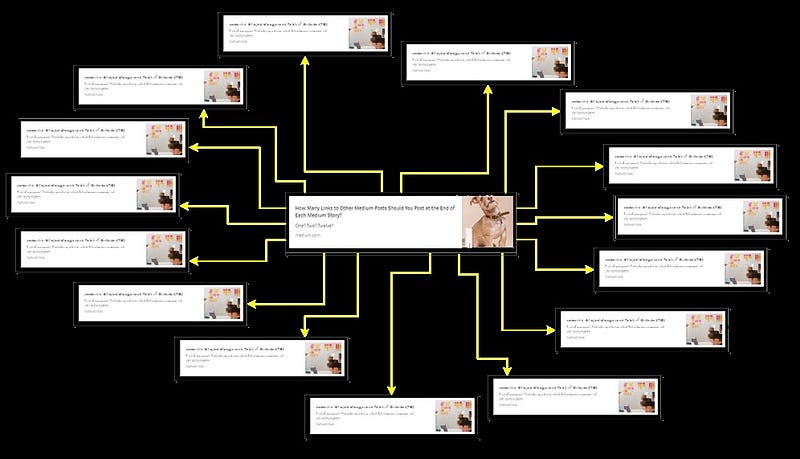
Photo by Author, William Myers, October, 2021

Synopsis

Links are important for online stories. However, they can be irritating and sometimes counterproductive.

Readers react better if the story is well structured, consistent, and everything is relevant. I’ll provide a simple structure to meet those expectations.

Too Many Links

Roz Warren’s story about how posting links at the end to draw readers to your other stories may backfire. Her main point is that if you have too many, all will be ignored, even if it is important.

The right number of links can draw readers

If drawing readers is the sole reason for including the link, you must be very careful.

Reasons for the Link

Links become important when they support points in the story or keep the story to a reasonable length. For example, one link may cut the read time by 5 minutes.

Which are you more likely to read, a 4-minute story or a 9-minute story?

The link’s points can be summarized in one paragraph while stating the link is in the References section. However, links can serve many purposes, such as:

  • External: supporting the story, Medium: another author supporting the story, Medium: your article supporting the story. These either support points mentioned in the story or provide another source of information. The points may be other opinions, definitions from sources like Wikipedia, or scientific studies.
  • Medium: link solely to draw readers. This smacks of an advertisement and probably should not be included. Readers may never look at your links again and it could cost you followers.
  • Medium: link to old, non-related stories. The link may be permissible if the story is somehow related to the projected audience of readers. There should never be more than one. — The only exception is if you have a timeless story that is so important that it could impact the life of anyone who reads it. I have one, but it is the lead story in the Health Table-of-Contents. I have not put it in any unrelated articles. It is doubtful that someone reading a politics story would follow that link.
  • Medium: “About Me” link. If it is pinned near the top of your profile, it would be redundant unless you are trying to establish your credentials for the article.
  • Table-of-Contents. I always include the one that will list the article. If the article is about Leadership, the reader may be interested in the author’s other 14 stories on Leadership. — Per Roz Warren’s article, adding 14 links at the bottom, like in the lead picture for this article, would guarantee that no one would ever click those links.

If it is one of my Medium articles, I always use the Friend Link in case a non-member reader came from Google or Facebook. That way, they will not use one of their free reads if they click it.

Link Position & Appearance in the Article

I put all links in pre-defined sections, always in the same order, at the bottom. Each section is separated from the others and the main article by 3 dots.

The reader can quickly scan through them to see if they want to follow up on the main points or other references. This story has 4 reference links.

References

Position: Links in the middle of a story can be distracting. Do I stop reading and go to the link, or try to remember to follow it later? If I do click it, does it replace my story or go to another tab?

I prefer references at the end of the story in a “References” section, as shown in the picture.

They may be my related stories, other medium stories, or external links, either in order of importance or as they are referenced in the story.

I really hate underlined text as a link. I always copy the URL onto a separate line. Usually, it shows the title and lead picture.

Information: In addition, I usually state why the link is there. Readers shouldn’t have to guess. The reader then has the option to follow it if the points are interesting. It’s much harder to do that in the middle of the story.

I never include links that have nothing to do with the story in this section.
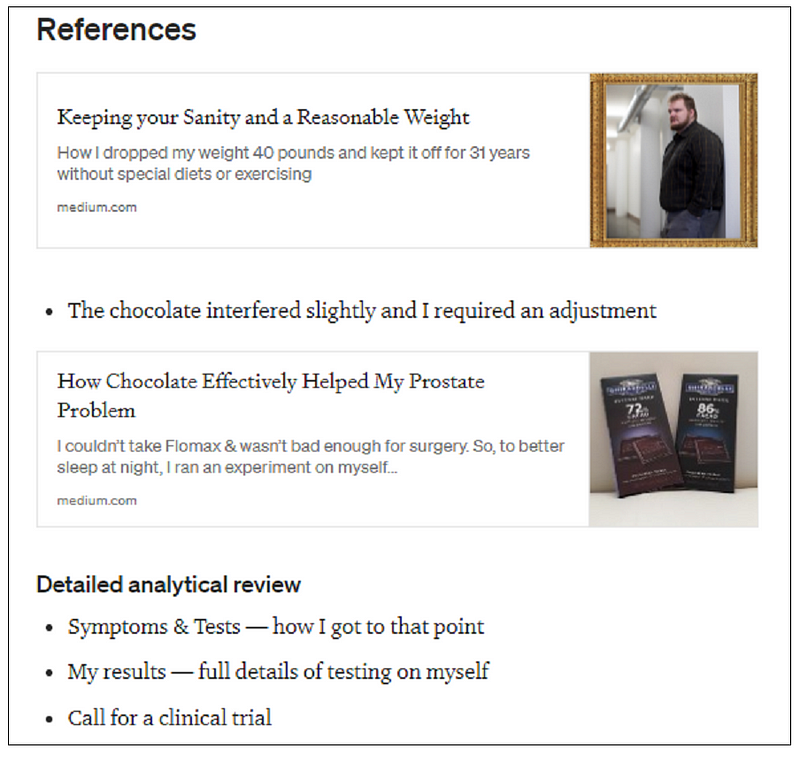
Photo by the author, William Myers, October, 2021

Table-of-Contents (TOC)

If you have more than 3 or 4 pages on your profile, it is a good idea to have a Table-of-Contents (TOC). I have one master and 11 sub-categories.

I always include the sub-category TOC in the Other Articles in the Same Category section. That section usually contains one link. On rare occasions, the story fits in two categories. Then both will be there, in order of importance.

Author’s Message

I usually don’t include this section, but this is the place if you want to include something that has nothing to do with the story. Here are some things that might be included:

  • About Me story.
  • Critical Information. You may have published a story that may save a life, one that everyone should read. It’s highly unlikely, but if so, one story only.
  • Historical article of interest. This is truly to attract readers to an old story that might still be relevant, and will not become outdated in the next year. There should be only one such story in this section, and it should not appear in the 1st or 2nd page of your profile.

The author may have something else to include. Remember that these links, titles, and subtitles will be included in the word count and the projected read time. Also, the more links you have, the less likely they will be clicked.

At the Very Bottom

Optional links in comments message: If you do not want links included in comments, explicitly state so here and add that any comments containing links will be blocked.

Conclusion

My general story structure:

  • Synopsis (not included for 1-minute reads)
  • Story Text
  • Conclusion
  • References (may not be any)
  • Other Articles in the Same Category (TOC)
  • Author’s Message (optional/rare)
  • Optional “links in comments” message (never in mine, but maybe for other authors)

Giving readers a general format sets expectations and lets them skim a story if they wish. Hopefully, this makes life easier for my readers.

References

  • Roz Warren: What number becomes counterproductive?
  • Inspiration for this article
  • An independent source of definitions, history, and other information
  • Example of showing 14 other stories in a category mentioned in the text
  • Story providing the References picture

Other Articles in the Same Category

Writing
Structure
Medium
Links
Life Lessons
Recommended from ReadMedium