
How The Planet of the Apes Created the Original Surprise Ending
…and no other film has done as good of a job since
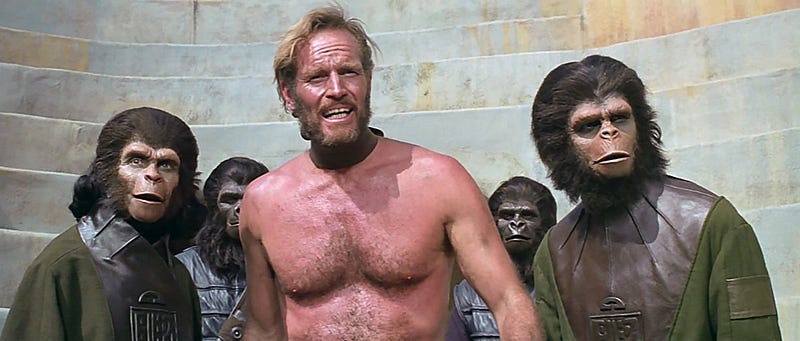
SPOILER ALERT — If you haven’t seen the original flick, don’t read this story.
*This story is about the original 1968 film, not the 2000 reboot**
An Otherworldly Plot
I can remember, clear as day, the stunning finale of what is largely seen as one of the cheesiest-yet-engaging sci-fi flick of the 60s. As a child of eight or so watching with my older brother, I was rapt. This was, after all, the early 1970s and the entertainment that is commonplace today was hard to come by then. No instant gratification streaming via Netflix or YouTube existed. You actually had to wait for some interesting flicks to show up on your black and white television sets. So when this otherworldly (literally) plot about apes being in control and humans being subservient appeared on the screen, how could I look away?
“The Planet of the Apes” was not only groundbreaking because of its special effects costumes and makeup; the concept in and of itself — that apes were ruling this strange kingdom, and that humans had devolved to a lower life form — was startling.
“The Planet of the Apes” was not only groundbreaking because of its special effects costumes and makeup; the concept in and of itself — that apes were ruling this strange kingdom, and that humans had devolved to a lower life form — was startling.
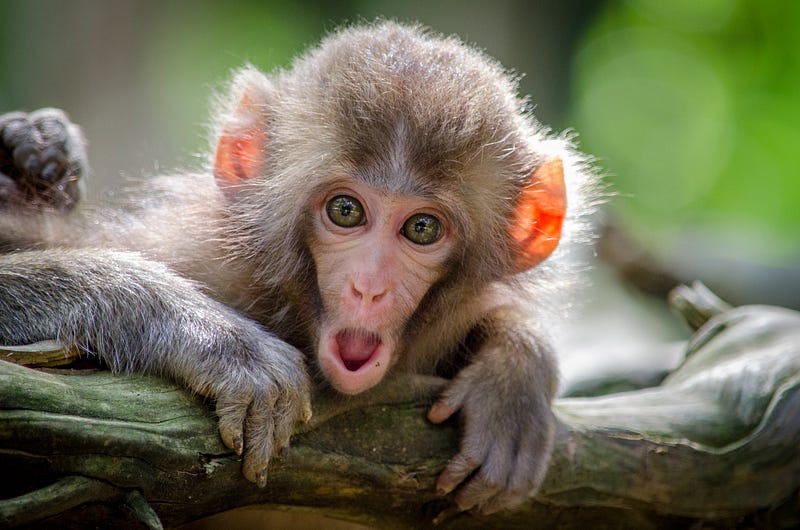
Based on the novel “Monkey Planet” by Pierre Boulle (the same author who wrote “Bridge on the River Kwai), the story is particularly disturbing as it taps into one of humankind’s primal fears: of being displaced, overtaken, deemed lesser than, becoming the “other” and, by extension, losing one’s freedom. In the film, the human-like creatures are mute and are enslaved, working for the ruling species: apes. The movie’s popularity can largely be attributed to its ability to convey the horror of losing our dominance in the world, wherever that world may be. Our position in this kingdom — earth, or any other planet that had Homo Sapien-type creatures roaming the land — is no longer on of dominance and not surprisingly, this premise is beyond frightening indeed.
The movie’s popularity can largely be attributed to its ability to convey the horror of losing our dominance in the world, wherever that world may be.
The story of Taylor, the chief protagonist and space traveller, is played by Charleton Heston. It’s one that follows his journey through this nightmare planet that he crash-landed on with his two astronaut colleagues.
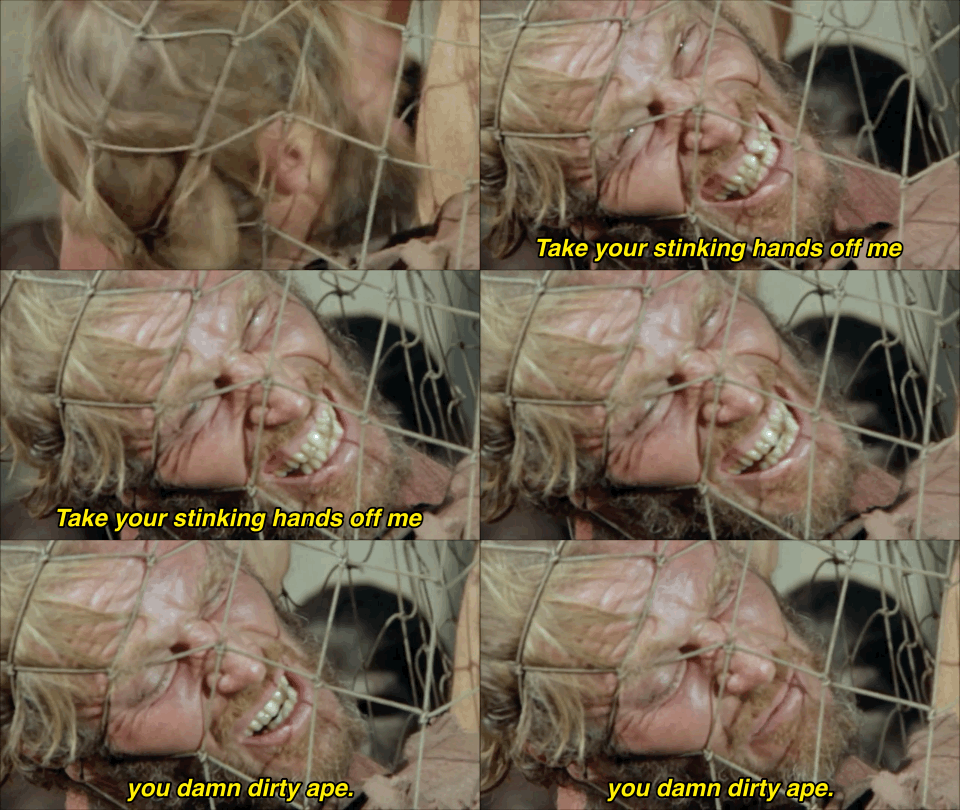
The film follows the evolution of a relationship between the main character and two ape professors-in-training who take a liking to him. Suffice it to say that the plot thickens, and then some. As expected, there are twists and turns but perhaps none so startling than the final scene of the film. And of course, there’s that classic line: “Get your stinking paws off of me you damn, dirty ape!”
“Get your stinking paws off of me you damn, dirty ape!”
What is it about apes and humans that make us uncomfortable? Is it that we are clearly related, the result of a common ancestor far back but obviously not as far back as we thought?
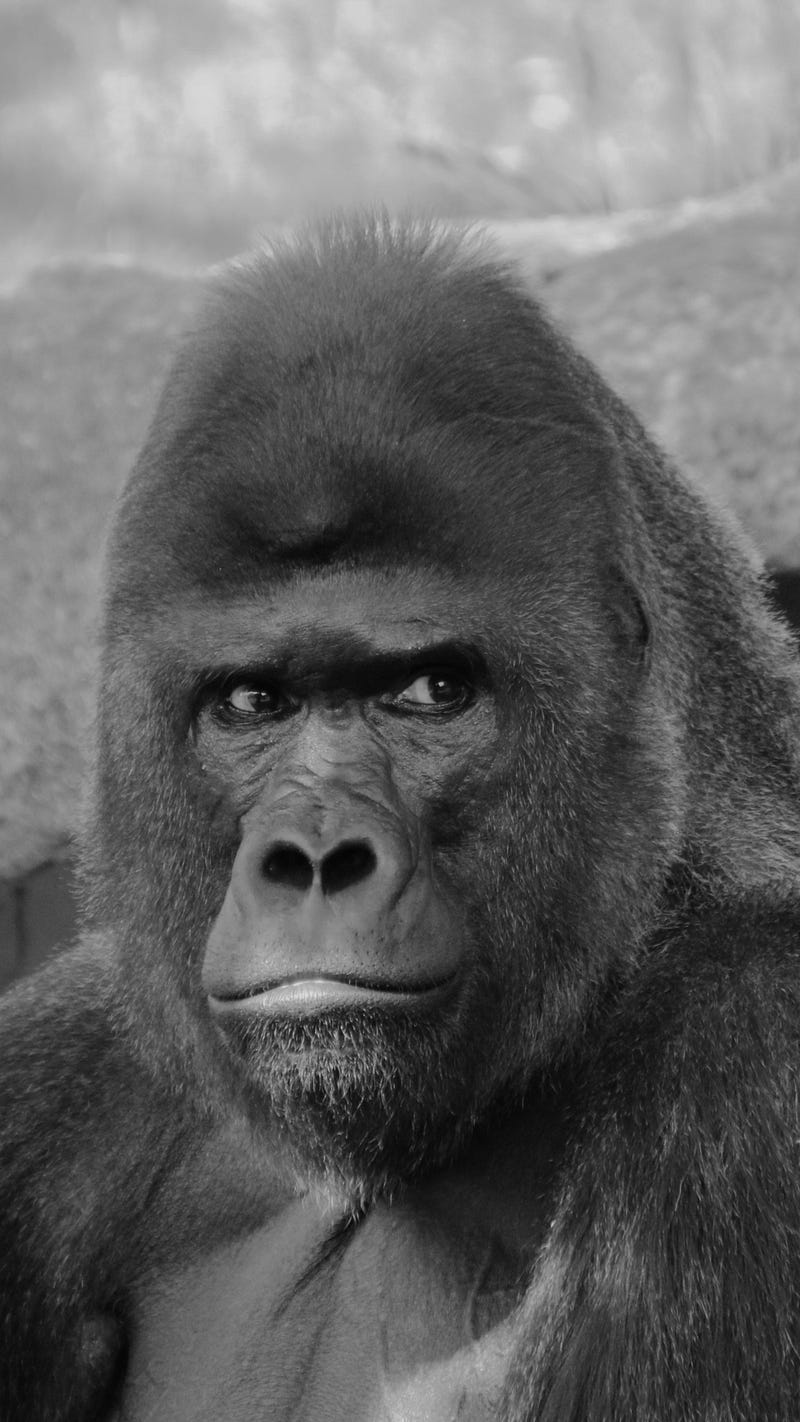
Is it the fact that the idea of devolution — that we cannot just advance in our abilities as a species, but that we can just as easily regress into a shell of our former selves, while another species supersedes us in both abilities and power?
One shudders to think.
Is it the fact that the idea of devolution — that we cannot just advance in our abilities as a species, but that we can just as easily regress into a shell of our former selves, while another species supersedes us in both abilities and power?
*Spoiler Alert! This is your last chance to stop reading!*
The Big Reveal
The beauty of the film (in addition to its 1960s-era cheesiness) is the audience really doesn’t know where the plot is going. Yes, Taylor finally gets the upper hand and shows his chief antagonist — Dr. Zaius — who’s the boss. Yes, the reality about the existence of humans prior to the rise of the apes is revealed through something as simple as a talking doll.
Plot twist: Taylor was revealed to not have been that much of an anomaly after all.
It is, however, the final scene that makes this film memorable.

Seared into my childhood mind was the stunning revelation at the end of this sci-fi tale. Here, the viewer is shown a slow pan of the seaside where Taylor and his mute human-like partner, Nova, have ridden on horseback in their quest for freedom and answers. As they slowly come upon a structure before them, the horror of their reality becomes apparent. There — or partially there, as the structure has been largely destroyed — is the remainder of an iconic symbol. Before them are the remnants of what had forever been seen as the symbol of freedom and liberty, now shown in a destroyed and diminished capacity.
The Statue of Liberty is revealed to be a shell of her former self.
As a kid, it at once crystallized what had been happening in this strange tale to that point. The realization that Taylor had been on earth all along was mind-blowing, and the implications of this fact were not lost on me nor on anyone who hadn’t suspected the finale. Who could have imagined? This was the surprise ending of all surprise endings.
The Ugly Truth Revealed
Surprise endings and plot twists are certainly not new, and Planet of the Apes wasn’t the first use this device. Movie-lovers will remember the final scenes of Citizen Kane and Psycho, both of which preceded the 1968 science fiction favourite. In more recent times, some of us are still stunned by the ending of The Sixth Sense, a 1999 flick starring Bruce Willis with a big reveal that not many of us saw coming.
And yet it is the low-tech, decidedly corny and overacted (Heston) film that continues to be seen as one of the best of its kind in terms of the “surprise” factor.
Why?
One might argue that it’s the realization that we’re not really who we think we are and that at any given time, our reality may mutate, and not in a good way.
“It’s the realization that we’re not really who we think we are and that at any given time, our reality may mutate, and not in a good way.”
Others may say that at any given time, the ugly truth about our perceptions about reality may be revealed, at our peril.
Still others may feel the very real weight of our collective and often selfish choices; that our behaviour today may have an adverse or worse, apocalyptic effect on tomorrow. Climate change anyone?
The question remains how human civilization went backwards in the world where apes were running the show and humans were mere “animals,” or worse, “beasts.”
As one of Taylors’ supporters, Cornelius, read from the Sacred Scrolls not long before the unexpected revelation at the end of the film:
“Beware the beast Man, for he is the Devil’s pawn. Alone among God’s primates, he kills for sport, or lust or greed. Yea, he will murder his brother to possess his brother’s land. Let him not breed in great numbers, for he will make a desert of his home and yours. Shun him. Drive him back into his jungle liar, for he is the harbinger of death.”
Perhaps the wisdom of the Sacred Scrolls was firmly grounded in truth. Indeed, killing for sport, lust or greed are everyday occurrences in today’s world. Being considered a “harbinger of death” is sadly not surprising if you look at the experiences of those living in places where unnecessary suffering and killing is commonplace. In spite of the shock that the ending provides to those who have never seen the film, maybe we need to be honest with ourselves in admitting that the surprise ending of this film is not that much of a surprise after all.