
How the joyful sounds and colorful flowers of spring will make you happy

Springtime has arrived in Ottawa. Many readers stwill already have noticed that nature is waking up from winter. Some of you live in the tropics and experience monsoon seasons, and I know that for some of you, autumn has just started. But in Ottawa, spring is only beginning now. There are still piles of snow in the garden, but all the roads are snow-free.
I love spring; the rebirth of nature makes it a season of hope. I enjoy the smells and colors, but the most noticeable change is the sounds of birds singing. I woke up this morning with the recognizable tune of the black-capped chickadee, a two-note fee-bee song. The chickadees are the heralds of spring, reminding us that the cold and isolation of winter will soon be over.
Spring is my favorite season
In the past two years, I experienced the harsh winter conditions combined with the pandemic measures as isolation, and I don’t think that I have ever spent so many hours per day at home. Of course, I enjoy the pristine snow-covered nature areas under the frequent blue skies in Ontario and Quebec. Still, after two Canadian winters, I concluded that spring is my favorite season.
Spring arrives for me in two steps: the birds singing and the flowers blooming. Motivated by the black-capped chickadee’s enthusiastic calls, I decided to see if I could find my first flowers of the year. But after a walk of several hours, I hadn’t found a single one. But then, just before I got home, I did see some first flower bulbs breaking through the surface. I don’t think any reader will be excited about this photo, least of all my Dutch subscribers who are enjoying the colorful tulip fields, but I’m sharing it with you anyway since I cherish this small sign of new life.
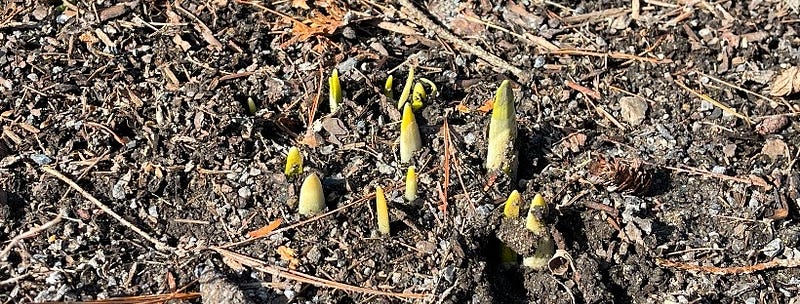
On the plus side, we’ll get our share of tulips in Ottawa; we just have to wait longer. Next month, I will share some pictures; the tulips in Ottawa are a unique sight to see and remind me of the strong historical ties between Canada and my country, the Netherlands.
The black-capped chickadee
Instead of photographing my first flower of the year, I tried to take a picture of a black-capped chickadee. I found one, and just when I wanted to take the picture, it flew up and landed on my hand. Many chickadees in Ottawa are accustomed to humans and accept seeds from your hand. This kind little one just gave it a try and then flew off.
I should bring some birdseed next time that I’m out. The birds must be hungry after the cold Ottawa winter. On cold winter nights, the chickadees can reduce their body temperature from 42 degrees Celsius to just 12 to conserve energy. It’s a rare example of torpor in birds, a state of decreased physiological activity, including a reduced metabolic rate. Some species of hummingbirds also use it to survive the winter.
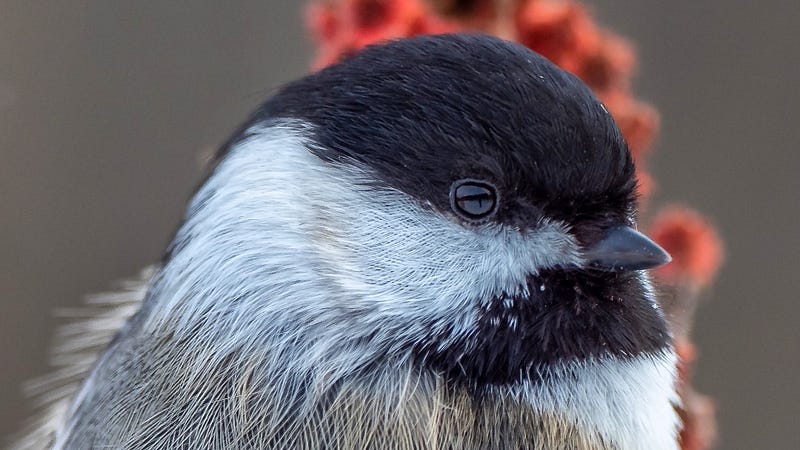
I found this photo of a Chickadee on the internet, but I am not sure if it is a black-capped chickadee or the Carolina chickadee. Their range is the easiest way to distinguish them, but I don’t know where this picture was taken. On average, the black-capped is larger, but this cannot be used to confidently identify the species. Compared to the black-capped, the southern twin Carolina seems lighter in color and has a more smooth-edged bib, whereas the black-capped has a more “ragged” looking black bib. These minor differences are often even more difficult to find in populations where the black-capped and Carolina overlap in range. There may even be a form of hybrids.
Birds singing each other’s songs
Another possibility to distinguish them would be by their call. However, to make life even more complicated for the experts studying these two species, they frequently learn each other’s vocalizations where their ranges intersect, which happens in a narrow band in the east-central United States. So a chickadee singing both songs or “odd-sounding” songs near the zone of overlap cannot be positively identified purely by voice in the field. Nor do the two species just speak two languages (and the hybrid varieties in the overlap zone).
Scientists have identified thirteen separate vocalizations that communicate different information, such as food or danger. It is believed that their communication skills have evolved to this high level because of their habitat: they live and feed in dense vegetation, and even when the flock is close together, individual birds tend to be out of each other’s visual range. It is a habitat-induced language development not unlike the inhabitants of the island La Gomera. They use a whistling language, Silbo Gomero, to communicate in the rugged landscape of distances of up to five kilometers.
Both the black-capped chickadee vocalization and the Gomerian whistling are a geographer’s dream of the impact of habitat on language development. Although UNESCO recognized Silbo Gomero as a Masterpiece of the Oral and Intangible Heritage of Humanity in 2009, the chickadees still wait for such recognition.
If you find articles like this valuable and want to support my work, consider signing up to Medium. It’s $5 a month, giving you unlimited access to all my articles AND all stories on Medium.
If you sign up using my link, I’ll earn a small commission, at no additional cost to you.