avatarAlexander Verbeek

Free AI web copilot to create summaries, insights and extended knowledge, download it at here

3899

Abstract

ps some think of their children and expand their vision by a few decades. The end of the century is about as far in the future as we are prepared to talk about. Flip those 78 years back into history, and you will find yourself in 1943. That doesn’t sound that far. We still deal with the horrors of that time. Some people that survived the war have still memories of what happened in that year, just like some of today’s young people will still remember this year’s conflict in Ukraine at the start of the next century.</p><p id="073a">A critical discovery that contributed to the industrial revolution was the steam machine. It was based on the principle that water expands when you heat it, and then you can use that energy for all kinds of processes. From the earliest days after this discovery, a favorite steam energy use was pumping water out of the coal mines. The coal was then burned to heat even more steam machines or facilitate other production processes. In the last century, we enthusiastically added other fossils fuels to burn, like oil and gas.</p><p id="f309">We burned so much that we finally heated the atmosphere, not directly like you heat the steam machine’s kettle, but because of the emitted greenhouse gasses. More than 90 percent of the energy that is thus trapped is absorbed into the oceans. And that brings me back to where we just started: the same principle that got us into this mess, the expansion of water, is now coming after us with an act of revenge. Because the oceans expand once they get heated, we have to deal with a double-whammy of melting land ice and the expansion of warmer oceans.</p><p id="448f">These worries of climate scientists (and anyone else who pays attention to the Planet) are not shared by all politicians. I remember, for instance, last year’s <a href="https://www.nytimes.com/2021/03/21/us/politics/ron-johnson-wisconsin-misinformation.html">remarks</a> of Ron Johnson, a Republican Senator from Wisconsin. He blamed “sun-spots” for climate change instead of the proven man-made causes. Nor was he worried because CO2 is good for trees. He also claimed that Greenland has a good reason to be called green because it was green at one point in time.</p><h1 id="84cb">Greenland</h1><p id="21d2">Ice-core studies have revealed that there was a tundra landscape in northern Greenland that existed a million years ago, or perhaps 400,000 years ago. But that was long before the emergence of us, the Homo sapiens sapiens, on the Planet, some 200,000 years ago.</p><figure id="cdd0"><img src="https://cdn-images-1.readmedium.com/v2/resize:fit:800/1*RNV9nHOg0fgGxWgOljaDDA.jpeg"><figcaption>A monument for Erik de Red in Narsarsuaq, Greenland (photo: Rüdiger Wenzel, CC BY-SA 3.0 DE)</figcaption></figure><p id="62c6">Greenland got its name in an early example of a clever marketing campaign. Erik the Red was, by all accounts, not a very pleasant man. About a thousand years ago, the Viking was exiled from Norway for killing people. Later he was expelled from Iceland for killing more people. The land he then sailed to had no people to kill (at least not in that southern part of Greenland, the Inuit were probably around this time, making their entry much farther to the north). He promoted the green valleys he found between the icy fjords and massive ice shields as ‘the green land’ to lure settlers.</p><p id="34c7">Some 400 years later, the community he had founded still lived there but then suddenly disappeared from history. The last things anyone heard from them are in a few early 15th century letters about a wedding and the burning at the stake of someone accused (and found guilty, I suppose) of witchcraft.</p><p id="449f"><a href="https://www.smithsonianmag.com/history/why-greenland-vikings-vanished-180962119/">Here</a> is some fascinating reading about what may have happened to them.</p><p id="443c">We can easily relate to

Options

three main elements of the theory of the existential challenges they had to cope with:</p><ul><li>changing trade relations</li><li>climate change</li><li>a major pandemic</li></ul><p id="1801">I’m sure you will recognize these elements when following the news these days. Lessons of history are fascinating, and I would love to know what has happened to the last settlers of Greenland. Because it would perhaps give some indication of what will happen to us. But maybe I rather don’t know.</p><p id="d6b3">If you would like to hear more about the collapse of the Conger ice shelf, listen to this week’s <a href="https://www.callin.com/user/alex_verbeek">podcast</a> that I host every Thursday at 3 p.m. ET with Alister Doyle.</p><p id="45de"><b>If you find articles like this valuable and want to support my work, consider <a href="/@Alex_Verbeek/membership">signing up to Medium</a>. It’s $5 a month, giving you unlimited access to all my articles AND all stories on Medium.</b></p><p id="46d5"><b>If you sign up using <a href="/@Alex_Verbeek/membership">my link</a>, I’ll earn a small commission, at no additional cost to you.</b></p><div id="fd46" class="link-block"> <a href="https://medium.com/@Alex_Verbeek/membership"> <div> <div> <h2>Join Medium with my referral link - Alexander Verbeek</h2> <div><h3>As a Medium member, a portion of your membership fee goes to writers you read, and you get full access to every story…</h3></div> <div><p>medium.com</p></div> </div> <div> <div style="background-image: url(https://miro.readmedium.com/v2/resize:fit:320/0*4ktXF9jV_x8obi7J)"></div> </div> </div> </a> </div><div id="3994" class="link-block"> <a href="https://readmedium.com/ukraines-music-fuels-hope-and-resistance-ddac9a5a8e0b"> <div> <div> <h2>Ukraine’s music fuels hope and resistance</h2> <div><h3>Ukrainians use music to unite around a shared cultural past and project their hopes into the future; it strengthens…</h3></div> <div><p>medium.com</p></div> </div> <div> <div style="background-image: url(https://miro.readmedium.com/v2/resize:fit:320/1*fBdmf0DWrlbuOg4UQxpi7A.jpeg)"></div> </div> </div> </a> </div><div id="9da5" class="link-block"> <a href="https://readmedium.com/if-you-fear-for-the-future-you-are-not-alone-b466ddfd60e0"> <div> <div> <h2>If you fear for the future, you are not alone</h2> <div><h3>United, we can respond effectively to crises like Ukraine, the pandemic, or climate change.</h3></div> <div><p>medium.com</p></div> </div> <div> <div style="background-image: url(https://miro.readmedium.com/v2/resize:fit:320/1*z4PXZYk3EiL-V57jlyKEHA.jpeg)"></div> </div> </div> </a> </div><div id="2d93" class="link-block"> <a href="https://readmedium.com/the-wartime-leadership-of-churchill-fdr-and-ukraines-president-zelenskyy-d18972d9ec20"> <div> <div> <h2>The wartime leadership of Churchill, FDR, and Ukraine’s President Zelenskyy</h2> <div><h3>I had never imagined we would ever need a leader like Churchill again to fight off a brutal invasion of an independent…</h3></div> <div><p>medium.com</p></div> </div> <div> <div style="background-image: url(https://miro.readmedium.com/v2/resize:fit:320/1*VK1A6rKM_Y1W86HatS0o1Q.jpeg)"></div> </div> </div> </a> </div></article></body>

Why you should be worried about a collapsing ice shelf in Antarctica
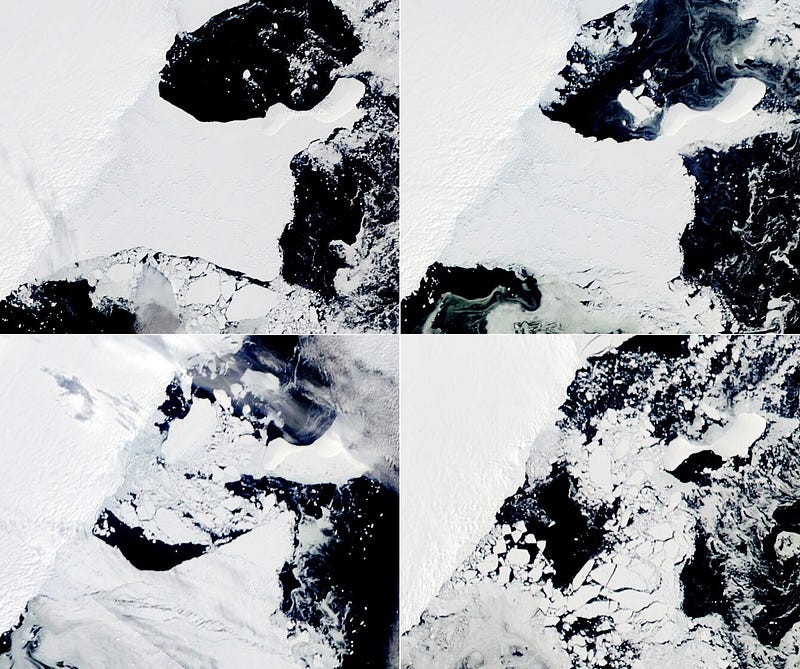
The progression of the collapse is visible in the image series above. Images were acquired with NASA’s Terra and Aqua satellites.

The breaking of ice shelves is a natural process, but glaciologists have noted that some large ice shelves have completely disintegrated in the past decades. The latest example is the Conger ice shelf, which collapsed last month.

Antarctic ice shelves often function like a cork on a bottle of champagne. They withstand the pressure of the vast quantities of ice higher up. So when an ice shelf collapses, it’s like a slow-motion popping of champagne with a faster flow of the grounded ice towards the ocean.

These events have become more likely because of climate change, and they contribute to sea-level rise. Events in the Antarctic sound like something far away and therefore irrelevant. However, the world that we know will be dramatically different by the end of this century because of sea-level rise. Predictions for the end of this century are difficult since we don’t know what climate policies our leaders will pursue. But a meter (or more if we keep ignoring the urgency) is well possible, and the predictions for the next century are much worse.

It’s a sign of our times that I only learned about the Conger ice shelf because it was gone. Like the last male Northern White Rhino, I would never have heard about this subspecies if it wouldn’t be extinct soon.
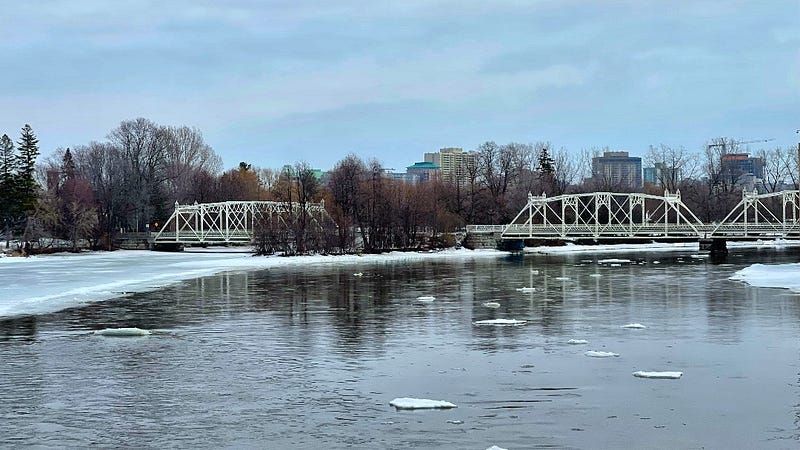
The Minto Bridges, Ottawa, Canada (photo: Alexander Verbeek)

Today, I thought about the Conger ice shelf when I passed the set of three Minto bridges in Ottawa. I enjoyed their reflections in the water and watched the vast pieces of ice passing on the river. After all these months of winter conditions, it is nice to see Ottawa without the snow and ice. Watching ice disappear is even more fascinating than seeing all that snow come down a couple of months ago.

In early 1902 the fourth earl of Minto, the eighth governor-general of Canada, described his crossing of the Ottawa river to Quebec.

“The ice-bridge jam gave way last night, and the river was passable only in canoes; the banks were piled with rough ice, and fields of icebergs were floating down the river… It was a most thrilling experience.”

I was delighted to find that the Library of Congress has a two-minute video of this event, where the Earl was joined by his wife, the Countess of Minto. You can watch it here. I noted the amount of ice. My Canadian friends seem to be correct; this was a mild winter.

Lord Minto actively promoted heritage preservation, and his efforts led to the creation of the National Archives of Canada. Therefore, I suppose that he would be pleased to know that the modern bridge built around that time in Ottawa and named after him is now a well-known heritage bridge.

Climate Change

While the climate change drama has astounding speed in geological terms, its pace is far too slow to worry policymakers. We live our lives in less than a century, and therefore our imagination is incapable of seeing any further than that period. Perhaps some think of their children and expand their vision by a few decades. The end of the century is about as far in the future as we are prepared to talk about. Flip those 78 years back into history, and you will find yourself in 1943. That doesn’t sound that far. We still deal with the horrors of that time. Some people that survived the war have still memories of what happened in that year, just like some of today’s young people will still remember this year’s conflict in Ukraine at the start of the next century.

A critical discovery that contributed to the industrial revolution was the steam machine. It was based on the principle that water expands when you heat it, and then you can use that energy for all kinds of processes. From the earliest days after this discovery, a favorite steam energy use was pumping water out of the coal mines. The coal was then burned to heat even more steam machines or facilitate other production processes. In the last century, we enthusiastically added other fossils fuels to burn, like oil and gas.

We burned so much that we finally heated the atmosphere, not directly like you heat the steam machine’s kettle, but because of the emitted greenhouse gasses. More than 90 percent of the energy that is thus trapped is absorbed into the oceans. And that brings me back to where we just started: the same principle that got us into this mess, the expansion of water, is now coming after us with an act of revenge. Because the oceans expand once they get heated, we have to deal with a double-whammy of melting land ice and the expansion of warmer oceans.

These worries of climate scientists (and anyone else who pays attention to the Planet) are not shared by all politicians. I remember, for instance, last year’s remarks of Ron Johnson, a Republican Senator from Wisconsin. He blamed “sun-spots” for climate change instead of the proven man-made causes. Nor was he worried because CO2 is good for trees. He also claimed that Greenland has a good reason to be called green because it was green at one point in time.

Greenland

Ice-core studies have revealed that there was a tundra landscape in northern Greenland that existed a million years ago, or perhaps 400,000 years ago. But that was long before the emergence of us, the Homo sapiens sapiens, on the Planet, some 200,000 years ago.
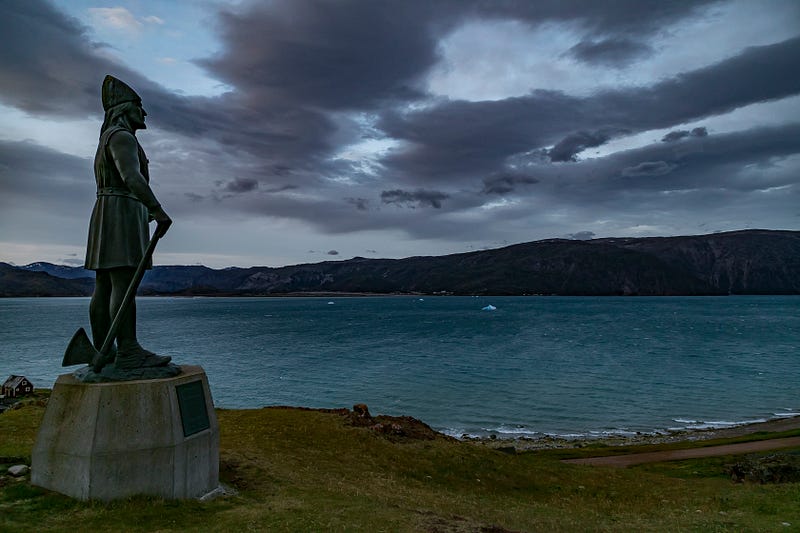
A monument for Erik de Red in Narsarsuaq, Greenland (photo: Rüdiger Wenzel, CC BY-SA 3.0 DE)

Greenland got its name in an early example of a clever marketing campaign. Erik the Red was, by all accounts, not a very pleasant man. About a thousand years ago, the Viking was exiled from Norway for killing people. Later he was expelled from Iceland for killing more people. The land he then sailed to had no people to kill (at least not in that southern part of Greenland, the Inuit were probably around this time, making their entry much farther to the north). He promoted the green valleys he found between the icy fjords and massive ice shields as ‘the green land’ to lure settlers.

Some 400 years later, the community he had founded still lived there but then suddenly disappeared from history. The last things anyone heard from them are in a few early 15th century letters about a wedding and the burning at the stake of someone accused (and found guilty, I suppose) of witchcraft.

Here is some fascinating reading about what may have happened to them.

We can easily relate to three main elements of the theory of the existential challenges they had to cope with:

  • changing trade relations
  • climate change
  • a major pandemic

I’m sure you will recognize these elements when following the news these days. Lessons of history are fascinating, and I would love to know what has happened to the last settlers of Greenland. Because it would perhaps give some indication of what will happen to us. But maybe I rather don’t know.

If you would like to hear more about the collapse of the Conger ice shelf, listen to this week’s podcast that I host every Thursday at 3 p.m. ET with Alister Doyle.

If you find articles like this valuable and want to support my work, consider signing up to Medium. It’s $5 a month, giving you unlimited access to all my articles AND all stories on Medium.

If you sign up using my link, I’ll earn a small commission, at no additional cost to you.

Climate Change
News
History
Politics
Environment
Recommended from ReadMedium