
Ukraine’s music fuels hope and resistance
More than half a century ago, John Lennon knew he was not the only one dreaming of a world that would live as one. But as every headline in the news reminds you, his ideals still require imagination. Putin’s indiscriminate targeting of civilians created hell on earth, one that is still burning when you read these lines.
When President Biden called Putin “a butcher,” it received more comments than his predecessor’s qualification of the same man as a genius on the day of his unprovoked and unjustified invasion of Ukraine. Biden didn’t call the Russians butchers, but the Russian dictator Putin.
We should not forget the brave Russians who dare to speak up against the regime and protest in Russian cities; they must be aware of the dire consequences of their bravery and are willing to accept those. Would you have joined them?
Imagine
Music can be a powerful tool to unite people. John Lennon’s “Imagine,” or Sting’s 1985 ballad “Russians” may have changed the world view of millions. I remember how both songs influenced my thinking when I was growing up. I wonder if Putin ever paid attention to the line “there’s no such thing as a winnable war, it’s a lie we don’t believe anymore.”
But Russians love their children too, which is an excellent reminder to differentiate between Putin, Russia, and Russians. President Biden spoke about the first, not the latter. Anyone who loves children does not order or allow an airstrike of a theater filled with refugees, well marked with warnings in giant letters: “children.”
This war is “madness”
I wonder if Lennon and Sting are still played in Russia these days; if there is nothing to kill or die for, our children will be safe from Oppenheimer’s deadly toy. Russians can no longer enjoy listening to the legendary rock group Aquarium on the programs of RMG, one of Russia’s largest media companies. RMG took this decision after the group’s lead singer had called the war against Ukraine “madness.” Aquarium is not alone; RMG announced that other Russian acts and Ukrainian musicians are also banned because of harsh statements made “in the context of the difficult situation between Russia and Ukraine.”
Difficult indeed. Censors will never be songwriters; unlike Lennon and Sting, they want to obscure the truth and avoid raising awareness. Censors know the power of music and prefer silence.
The power of music
Meanwhile, in Ukraine, music proves a powerful force of comfort, hope, and identity. Like in so many wars before this one, suppression and brutality by a foreign invader unite the people against a common enemy. That is visible on the battlefield, in the streets and cellars of Ukrainian cities, and in democratic countries worldwide.
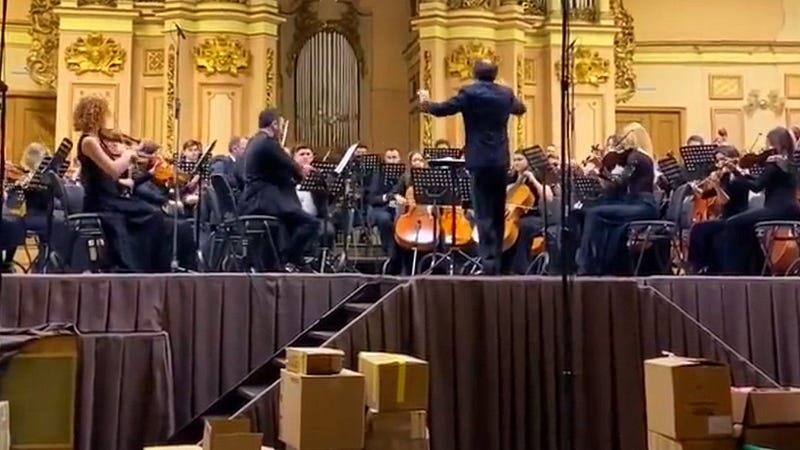
Ukrainians use music to unite around a shared cultural past and project their hopes into the future. While Russian artillery pounds the cities to rubble, musicians boost the people’s spirits and strengthen their defiance against the aggressor.
“Let it go”
Bravery knows many forms, as seven-year-old Amelia has shown in her viral videos that millions have seen worldwide. You will likely remember her singing in an air raid shelter in Kyiv “Let It Go” from the Disney movie “Frozen.” Initially, she sings while you still hear the talk of others, but then everyone falls silent and listens to beauty amid the destruction. A voice of hope, a reminder of innocence, and the next generation that will rebuild Ukraine
Amelia is now one of the millions of refugees in Poland. She escaped with her grandmother and her 15-year-old brother Misha. Her parents stayed behind in Kyiv to defend their country. But, unknown to Amelia, she was not only fleeing for bombs; according to the Polish Deputy Senate Speaker Małgorzata Gosiewska, she had to run from vengeance and had become a target.
Amelia loves to draw ponies and sing. The world witnessed this when she took the stage in a vast stadium in Poland to sing the Ukraine national anthem.
Meanwhile, the Ukrainian anthem is still sung in the bunkers, as you can see in this video filmed in the metro of Kharkiv, where the youth is taking refuge.
The world gets to know the Ukrainian anthem, and you will still know it long after the war has ended (yes, every war ends, although during any war, it is tough to remember this lesson of history). Listen to this moment, in the barracks:
And another example of a powerful protest against the senseless destruction of people’s homes and lives is the woman who plays her piano for the very last time before leaving Kyiv.
And this is the cultural achievement that the population of Odessa is trying to preserve:
Social media is filled with dozens of examples of Ukrainian musicians giving the people hope and strengthening their solidarity. I could go on with many more examples, but I will show only a few more.
These two clips should be seen together. First, this one of Hans Zimmer’s “Time” being played outside by the Lviv-based pianist Alex Pian, who’s trying to make people forget the air raid alarms for a moment.
And then, on March 25, Hans Zimmer interrupted his own concert in London
This war is not just fought with weapons. Showing the national identity of Ukraine, one that is separate from Russia, is an effective tool in the resistance. Celebrating the beauty of music while the enemy destroys the country’s cultural and historic buildings shows the brutality of this war. Combining music with a national identity, like singing the national anthem, is central in the Ukrainian message to each other, to Russia, and to the world.
Listen to Vera Lytovchenko, playing each night in the basement of an apartment block in Kharkiv. She’s dressed like performing in the Kharkiv Opera, where she usually plays as a soloist. Her renditions of Vivaldi and Ukrainian melodies have become a social media sensation. She says that it helps her to briefly forget the war. When contacted by AFP over WhatsApp, she replied: “I’m not a doctor, a soldier, or a politician. I just play the violin.”
All these musicians and all Ukrainians were ordinary people who lived their everyday lives until a month ago. They could have been you or me, and suddenly they find themselves in extraordinary circumstances. I wonder what I would do. Would I be so brave?
Little Amelia is one of them. After the concert in Poland, she was asked about her parents in Kyiv. Her mother had voluntarily stayed behind with her husband. “I do not know where they are right now. They simply stayed in Kyiv,” the girl said, “I miss them… but I will see them again. After all, they are my parents.”
If you find articles like this valuable and want to support my work, consider signing up to Medium. It’s $5 a month, giving you unlimited access to all my articles AND all stories on Medium.
If you sign up using my link, I’ll earn a small commission, at no additional cost to you.


