
ILLUMINATION | Psychology | Science
How Self-Affirmations Ignite Your Brain So You Can Be Your Best
Get great with these techniques

Self-affirmations uplift us, enrich us, and ignite our confidence. But in my twenties, I arrogantly thought they were stupid and fluffy.
Until they struck me like lightning, and I later learned how self-affirmations change the brain. My experience is now etched deep into the crevices of my mind. Despite the overwhelming emotion and tears, I couldn’t be more grateful.
My First Self-Affirmation Experience
While ‘under’ I hear the words,
“Repeat after me — I believe in myself.”
Despite being hypnotised, I have to force the words out of my mouth,
“I believe in myself.”
Luckily, I‘m laying down because as I finish the sentence my whole body shudders. I feel intense emotion. Still hypnotised, a tear rolls down my face.
I hear it again.
“Repeat after me — I believe in myself.”
With a river of tears down my face, I oblige and say,
“I believe in myself.”
The voice repeats with,
“Say it — I believe in myself.”
My emotions bubble and I became more audible,
“I believe in myself.”
“Keep repeating the words,” I hear. I become energised with conviction and shout,
“I BELIEVE IN MYSELF! I BELIEVE IN MYSELF!! I BELIEVE IN MYSELF!!!”
The minutes pass, and I rise from my hypnotic slumber with yet more tears. I cry like a wrongly convicted prisoner that, after a decade trapped, has been released from his shackles.
My mind races, “What just happened? I don’t understand why I’m crying. I… I feel… unburdened.”
I’m overwhelmed. I soon realise my tears are of relief and gratitude. Streams of gratitude run down my face and fall to my lap.
My internal questions persist, but they are not for a hypnotist. I had no courage to see one. I was listening to a hypnosis recording, alone, in bed — and shouting, “I believe in myself,” — to no one but me, no one but my brain.
On reflection, it’s important to note that hypnosis is controversial, with poor quality research in many health and psychology areas. Perhaps, according to a scientific review, better studies could prove that hypnosis alone helps with stress. So, if anything, hypnosis can be a helpful relaxation technique — and that’s what I was using it for, but thankfully I stumbled into self-affirmations.
Your ‘Self’ and Self-Affirmation
Considering our sense of self can help us appreciate the power of self-affirmations. Our self-image, made up of our roles, values and belief systems, can be positive or negative, depending on our experiences in the moment.
But a long-term negative self-image can lead to low-self esteem, anxiety and depression.
So, an overall positive self-image is essential for health and wellbeing.
A fractured self-image does its best to protect against psychological threats. But defensiveness can go into overdrive and escalate to aggression. Aggression in the form of abuse — physical, social, and verbal — can cause psychological damage. They go beyond threats.
Criticisms are an example of a psychological threat that can challenge our positive self-image and make us defensive.
These less obvious threats to the self-image include conversation contradictions — such as unexpected negative feedback — social exclusion, and certain health promotional messages.
Anything that challenges our roles, values and belief systems, our psyche can perceive as a threat to our self-image. How much do you value your professional life? Is your job part of your self-identity? If someone criticises your work, how defensive do you get?
In a do more, do better world full of high expectations, our minds notice psychological threats regularly — this is why self-affirmations are helpful.
Brain Activation and Beyond
Popular among neuroscientists and psychologists, self-affirmation can work quickly in the brain to create a lasting positive influence.
In an fMRI (brain imaging) study, neuroscientists found self-affirmations cause “activation” within the prefrontal cortex. The researchers observed how doing self-affirmations influence the brain to be more open-minded before receiving a lightly threatening ‘move more’ exercise message.
Even more impressive, the people doing self-affirmations in the study, compared to those that didn’t, went on to be more physically active up to a month later. This improvement was after just one self-affirmation activity and health promotion message. More research is needed to explain this, but the researchers concluded:
“Self-affirmation of core values may exert its effects by allowing at-risk individuals to see the self-relevance and value in otherwise-threatening messages.”
Other studies have found that the act of self-affirmation activates “neural reward regions” in the brain (ventral striatum). So, self-affirmations not only have ongoing positive effects on our mind and behaviour, but they also feel immediately pleasing while doing them.
Self-affirmations have also shown to improve relationships. According to two psychologists, they do so by enhancing self-compassion and pro-social interactions.
Pro-social interactions are voluntary intentions to benefit someone else. These altruistic actions include:
- Helping — assisting someone in need, such as an act of charity.
- Sharing — to divide and offer a portion or to pass on something.
- Comforting — such as listening to someone’s concerns.
- Affirming — noticing a positive characteristic in someone and saying so.
This self-affirmation research supports the notion that you have to be kind to yourself to be kind to others. So, consider this; if you are in the habit of being hard on yourself, your brain is more likely to be in ‘defensive mode’ and respond by being hard on others.
With over 225 published studies researchers have shown how self-affirmations activate our brain, help us feel at ease with uncertainty, and improve our relationships and health behaviours.
They work by reducing our defensiveness to criticism to feel more sociable and confident — important feelings for enhancing our emotional intelligence and compassionate leadership abilities.
The Guide — Finding the Best Self-Affirmations for You
We all have our individual self-image made up of our roles, values, and beliefs. Reflecting on this can help us frame self-affirmations to make them profound — and ready to say out loud!
We have our unique roles in life and expect ourselves to have the attributes to fulfil them. The image below offers examples of roles that link to a value and belief. The belief examples are purposefully simple for clarity purposes.
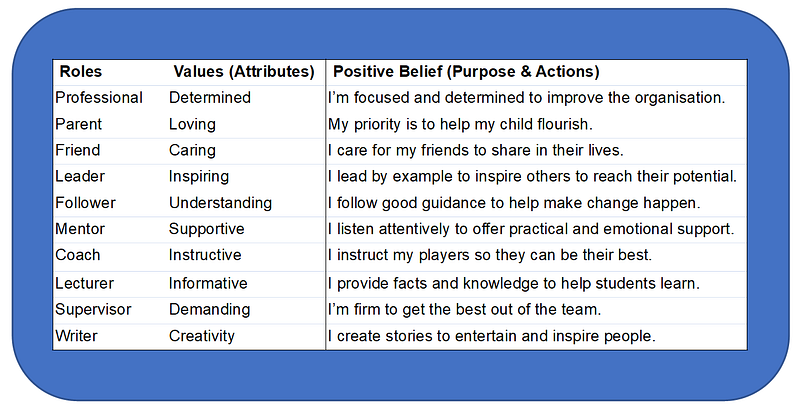
These simple examples can help us with framing a self-affirmation using the following 3-step process:
- Roles: We move between roles as the day unfolds. To help with framing the self-affirmation statement, you can start by asking, “What is my main role today?” Or, “What is my role right now?”
- Values: Values often depend on our situation or our role. A writer might aspire to creativity, originality, and clarity. In contrast, the leader could seek to be inspiring, kind, and charming. Of course, a persons values will be individual and influenced by their beliefs.
- Beliefs (Purpose): This is the what and why of doing what we do — now and for our future. You’ll notice each sentence starts with I and includes the conjunction to. The mentor example from the image above is, “I listen attentively to offer practical and emotional support.” The ‘what I do’ (I listen attentively), aligns to the ‘purpose’ (to offer…).
To illustrate, I can use a personal example. The self-affirmation is for my writer role, voiced out loud to ignite focus and create this article. In front of a mirror for 90 seconds (using my smartphone timer), with conviction and belief, I repeated the following:
“I’m focused and intelligent. I write fantastically and creatively.”
Now, whether an outsider judges the above sentence to be true is irrelevant here. The fact is the above affirmation activated my brain and created the feeling of reward to help me focus and become confident about writing.
As much as I feel I have more to learn as a writer, I believe the affirmation — and especially so during the activity.
The self affirmation is also a mindful activity. Focusing on the words, their sound, and their meaning is what will make them profound and compelling. This process will activate your brain and become uplifted.
The time when you feel the tingles down your spine is worthy of congratulations — this is a sign of nailing a self-affirmation!
The best time to do self-affirmations is likely to be in the morning, considering that researchers have found them to be more effective before a psychological threat. It also starts the day positively, with focus and purpose after just 90 seconds (or 2–3 minutes if you have the time).
That said, if you anticipate anything challenging, or unsettling to come then taking time for a short self-affirmation activity beforehand can be worth it.
If you’re self-conscious about speaking the words aloud around people then writing affirmations is equally beneficial, according to this study and others. Feel free to use the image above and the 3-step process as a guide. Self-affirmations are more profound if you create them yourself and ensure they align with your core values.
If you are completely new to self-affirmations, it might be worthwhile starting with the affirmation “I believe in myself.” Why? Because all self-affirmations work by believing their words. If you doubt yourself, don’t believe in yourself, then a self-affirmation is less likely to activate your brain.
You’ll notice my self-affirmation example above does not include the belief part of the 3-step process. Reason being is that the belief is the purpose, the aspiration.
But it’s our role and our values — the affirmation — that helps maintain a belief and motivate us to fulfil our purpose.
As purpose is our motivation, our reason for doing what we do, you could work backwards through the 3-step process. Simon Sinek would argue to start with the purpose, the why, in his popular book, ‘Start With Why.’ If you haven’t read it yet, it’s an inspiration for this activity, and in general to help us lead in life:
“Leading is not the same as being the leader. Being the leader means you hold the highest rank, either by earning it, good fortune or navigating internal politics. Leading, however, means that others willingly follow you — not because they have to, not because they are paid to, but because they want to.” Simon Sinek
Reflecting on my personal experience
Until my self-affirmation experience at 27 years old, a decade ago, my self-talk was mainly critical and negative. My whole life, I had never said the words, “I believe in myself.” The first time I did, I shuddered. As if the words ignited my brain and shocked my body.
I turned to hypnosis to help me relax, and I stumbled into self-affirmations. I was suffering from low-self esteem and chronic depression. My family gave me all the love you could wish for — and as important as it was, I was stuck.
Most of my actions back then were anxiety-driven.
See, my brain was suffering an emotional trauma. Turmoil initially triggered by sudden bereavement at 19 years old.
The shock of the loss damaged my brain (hippocampus) and triggered a lingering fear of my mortality. It produced a series of negative beliefs that reinforced feelings of unworthiness and self-loathing.
But self-affirmation helped me escape my prison — my depressed locked-down mind.
By activating my brain, self-affirmations unlocked the chains in my head— and set me free. Able to go where I want to be. So, I continue to use self-affirmations to keep my brain healthy, and to feel focused and confident.
it’s our role and our values — the affirmation — that helps maintain a belief and motivate us to fulfil our purpose.
Final thoughts
As a PhD, a trained scientist, I’m conscious about how stories and hyperbolic statements can bias opinions. Admittedly, I am biased because my first experience with self-affirmation was dramatic and compelling.
I have tried to find a scientific article that reports an outcome like mine. It seems I’m a one-off? But there is good science, over 225 published studies, documenting the benefits of self-affirmation — and that is why I recommend them.
So, will your self-affirmation experience be profound? Perhaps you’ve already tried and regularly use them?
Suppose you haven’t, and you’re considering it. Psychologist, Catherine Moore, discusses six benefits of daily self-affirmations, and says they help with developing:
“an adaptive, broad sense of self [that] makes us more resilient to difficulties when they arise. Whether it’s social pressures, health information that makes us feel uncomfortable, or feelings of exclusion, a broader self-concept can be an extremely helpful thing to have.”
The learning from this article then? Be kind to yourself. No, go further! Believe in yourself. Say the words, “I believe in myself.” Affirm them with conviction. Embody the words. Lead the way, and go out into the world to be you. The best you, you can be!
Affirmations (further information)
In the webinar there is a short 3-minute discussion on ‘self-affirmation’ at time points 46:11— 49:43 by psychologist Allan Zuckoff that is worth a watch.
Final note: Throughout the webinar, you’ll notice my goofy smile. Reason being is I’m a dietitian amongst distinguished psychologists I’ve admired for over a decade. Despite my cheer, at times, I felt out of my depth, and I’m not ashamed to say, “I used self-affirmations hours before the webinar to help me feel my best and at ease amongst greatness.”
“I used self-affirmations hours before the webinar to help me feel my best and at ease amongst greatness.”


