
A Short Guide on Affirmations in Life and Leadership
A lesson from over 30 years of psychology research and a decade of professional practice

Affirmations are uplifting. They see a good in us, what we are capable of, and even, who we are. It’s no wonder we respond with, “Thank you” — because we’re full of gratitude.
What a privilege then, to affirm someone, especially the people close to us.
Not to be confused with praise and compliments, the act of affirmation is a skill. It’s a communication skill, a motivational skill, and a leadership skill.
I first came across affirmation skills over a decade ago during Motivational Interviewing training, a counselling style founded in 1983 by the psychologist, William Miller.
Today, Motivational Interviewing is used in health, social care, schools, sports and even parenting, albeit in a health care setting. As a dietitian, I needed it for my client consultations, and yes, I noticed a profound change to my professional practice. Clients became uplifted, eager to work on their diet and lifestyle goals. That’s what we needed; motivation.
My passion for Motivational Interviewing led to a research doctorate, training fellow healthcare professionals, and lecturing. Over the years, I’ve been pleasantly surprised by how affirmation skills have become a part of my everyday life. I am grateful, as I honestly believe these skills have led to deeper, more meaningful relationships.
Maybe you’re a manager eager to inspire and uplift your employees? Perhaps you’re a health care worker interested in your clients’ motivation? Or, you’re a parent, keen to help your child flourish? Affirmation skills can help.
So, let’s begin by exploring what affirmations are in a motivational context.
Praise vs. Affirmations
When we affirm, we assert a fact, a truth. Consider the robotic response, “affirmative” — it means, correct.
Praise, on the other hand, can be described as an expression or act of admiration. In this scenario, it’s possible to compliment someone, only to see rolling eyes that portray the words, “Yeah. OK. Whatever.”
Well-meaning praise can miss its mark. Possibly because the recipient feels the praise to be unjustified, and they feel uncomfortable.
The point is, in the above scenario, whether a person accepts what we say or not, they are still praised. But someone has to believe our words to be affirmed.
When we praise or affirm, it’s possible to compliment with ‘excellent’ or ‘fantastic’. But to affirm conclusively— to hit the mark, and be compelling — we need to be congruent and genuine.
To be congruent is to be in touch with a situation. To share an understanding with someone, and have a ‘feel for the room’ — together. When we are congruent, we’re on the same page, in harmony. You’ve had this experience with a partner or friend while listening tentatively to them and feeling the emotions in their words. Listening is the key to congruence.
When we are not genuine, neither are our affirmations. If we don’t believe in what we are saying, why should the person on the receiving end do so?
Telling someone they are strong when you think they are weak is false praise. It is a lie. To be genuine, is not only to be truthful, but it’s also to be your authentic self. Authenticity breeds connection and fosters meaningful human relationships.
“Connection is why we are here. It’s what gives purpose and meaning to our lives.” — Brene Brown
Inspiration as a source of affirmation
Inspiration is profound. It’s motivating. When we’re inspired, we become uplifted with an urge to act. Psychologist, Barbara Fredrickson, describes the experience beautifully in her book, ‘Positivity’:
“Every so often, you come across true human excellence. You transcend the ordinary, seeing better possibilities than usual.”
Everyone needs a role model in their life. We can connect to them whether we have met them or not — a family member, a friend, a colleague, an influencer, a celebrity. When we observe qualities in our role model, we want to emulate them, or at least, emulate a particular aspect of their behaviour or personality.
When I take a moment to reflect on a role model in my life, a list of positive descriptors jump out:
Consistent, humble, hard-working — consistent, intelligent, diligent — consistent, curious, kind — consistent.
It’s obvious what I value most in my role model, their ability to be consistent. I strongly admire their many qualities, but what is it about this one attribute that makes me deeply connect with my role model?
Well, I know I strongly value consistency, consistency at work, with my fitness “routine”, and keeping in touch with family and friends. But, honestly, being consistent is a challenge for me.
The struggles we experience are what makes us admire the qualities of our role models. They are our inspiration; their attributes are the affirmations we hope for in ourselves.
Taking time to reflect on a role model, can start a process of self-discovery and clarify the qualities we value. So, what qualities do you value in general? What qualities do you feel you might lack, but value in other people? If you have no answer to the second question, then you have my sincerest congratulations. You are one of the few who has very high self-esteem with whom affirmations might not be so compelling.
You already have a spring in your step. You don’t need a boost. That is what we want for the people we love and lead — high self-esteem — nothing holding back their aspirations.
When you know who the role models are of, for example, a colleague, you can use that knowledge to help frame an affirmation. Deliver your words in a genuine and congruent manner, then — BOOM! That’s compelling. That’s motivating.
Affirmation delivery
Before we discuss affirmation delivery in-depth, I’d like to acknowledge that an eagerness to affirm someone comes from a place of compassion and kindness. For the person on the receiving end, such an expression can be very uplifting. This act is never wrong.
So, when it comes to our efforts to affirm people, it’s not about doing it right. Let’s steer clear of self-criticism here. Better still, kick it off a cliff and into the abyss. With this in mind, it’s time to explore the art of affirmation delivery.
The field of Motivational Interviewing states that affirmations should:
1) Notice positive actions in a person — something currently happening or done in the past.
2) Emphasise strengths, values, or qualities while also being genuine.
3) Come from a place of empathy and compassion. Not manipulation — that’s disingenuous.
Over the years, I’ve been tinkering with my communication style while keeping these three points in mind. I’ve also been studying and reflecting on behavioural science, both in attempts to improve my affirmation delivery. As I’ve developed my method, I’ve realised there are affirmations, and there are compelling affirmations.
The method: Double-up for a compelling affirmation
Let’s consider the following scenario:
We see an inspirational figure and say, “You are outstanding, fantastic, brilliant, excellent!”
These words alone can sound like praise. They can seem like haphazard compliments — hyperbolic approvals that lack depth and meaning. The above descriptors are also vague. The four words are synonyms, value judgements that could be at the top of a Likert scale.
In my experience, the person most likely to disregard these compliments is usually someone with low self-esteem. They struggle to accept praise. They’re in disbelief. The role of the affirmation is to challenge this disbelief. This is why it’s helpful to make a change — to do a double affirmation.
To double-up to make a compelling affirmation, you can do the following:
1) Start with a value affirmation.
I call value affirmations, ‘Likert-scale-words’. They are affirmations, such as outstanding, fantastic, brilliant, and excellent. Use these to compliment a person’s output, product, service, or action — such as an essay, a meal, a webinar, or a dance.
Be mindful that when you give a positive value affirmation, you’re giving someone a top score, a ten-out-of-ten. So, to be genuine, we have to feel, honestly, that someone produced or served to that high standard. This means that we are likely to affirm less often as we would praise, but its impact will be more compelling.
Including context also helps. So, for example, we could say, “that’s outstanding,” which is fine. Still, when we’re specific, such as, “your essay is outstanding,” it adds gravitas.
2) End with a quality affirmation.
A quality affirmation is a specific descriptor assigned directly to a person. Examples such as methodical, artistic, thorough, and talented, can all link with the value affirmations that we just explored. In practice, knowing the person you care about really counts. When you know what qualities they value, who their role models are, it’s easier to hit home with bold quality statements— and create compelling affirmations, such as:
- “Your essay is outstanding. You’re methodical.”
- “Your meal is fantastic. You’re artistic.”
- “Your webinar is brilliant. You’re thorough.”
- “Your dancing is excellent. You’re talented.”
Below is one of my ‘compelling affirmation’ tables. Feel free to experiment with it.
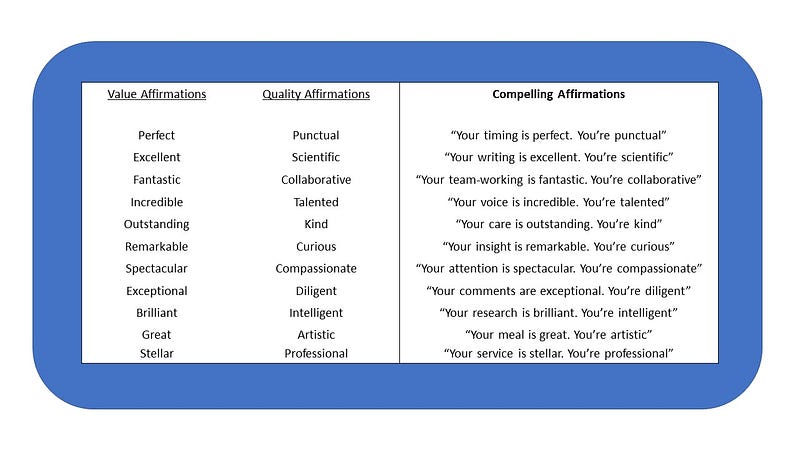
Depending on your style, it might feel natural to include a modifier. Such as:
- “Your meal is great. You’re very artistic.”
- “Your writing is excellent. You’re extremely scientific.”
Julian Treasure, author of ‘How to be Heard’, would contend against the above approach, however, arguing that it’s an unnecessary exaggeration.
“It [exaggeration] demeans our language actually, sometimes. For example, if I see something that really is awesome, what do I call it?”
I think he’s onto something, and with nearly 28 million views of his Ted Talk, ‘How to speak so that people want to listen,’ so do many other people. His words take us back to being congruent and genuine — to choose our words wisely.
The affirmation experience can also feel natural when we switch it. Instead of, value + quality affirmation, such as:
- Perfect + Punctual = “Your timing is perfect. You’re punctual.”
You can try:
- Punctual + Perfect = “You’re punctual— (and) — your timing is perfect.”
In this case, there appears to be no downside to changing the sentence. So, if switching suits you, do it. If including the conjunction ‘and’ seems more natural to you, then go for it — be compelling!
Context is everything
If we dissect an affirmation, we might wonder, “what does preparing a meal have to do with being artistic?” Maybe nothing. Maybe everything.
It might not be common to hear, but that can be what makes it compelling. I was once on the receiving end of this exact affirmation, and I felt instantly validated, uplifted, proud. Maybe because I’m a dietitian and I love food, or that I simply want my food to look a certain way. Artistic even.
I’m conscious that written affirmations don’t have equal gravitas when compared to their verbal counterparts. And that the affirmations discussed above might not resonate with you, or the people in your life.
This is because context is everything.
To be congruent — to affirm effectively — we need to be mindful of the circumstances, the situation, the personalities, and most importantly, the values of the people in our lives. Affirmations written as examples simply can’t capture that context.
But the point is that affirmations can feel compelling when we “double-up”.
If you tell someone that their essay is outstanding with no follow-up, then they might reply with, “What’s outstanding about it?” If we then qualify with “because it’s methodical.” Now, we’re assigning the qualifier to the product, not the person.
In this instance, can the person on the receiving end of the affirmation say, “I did an outstanding essay because I was methodical”?
They could, but the possibility is, that they subconsciously hear, “I did an outstanding essay because it was methodical.”
Now, they no longer own the positive affirmation, their product does. This situation can permit someone, especially with low self-esteem, to tell themselves that their behaviour was a one-off, a fluke.
When we maintain the value affirmation — for example, you’re methodical — we present a compelling scenario. We create the mental space for someone to believe that they can be or are a methodical person.
If a recipient values the quality of being methodical, they are more likely to internalise the affirmation as a positive self-belief. Their self-esteem builds, and with it, motivation — this process of internalising beliefs is from the research of Self Determination Theory.
The limits of affirmation
Affirmations, especially compelling affirmations, can give us validation. Build self-esteem. Ignite a spark. Being gifted an affirmation can help discover a new self-belief and improve self-efficacy (self-confidence).
Increased self-efficacy can be enough for certain people to try something different and be more at ease with the unknown. So, affirmations can help people to stop procrastinating and become reinvigorated with motivation.
But they not a panacea.
They are one communication skill, one motivational skill, one leadership skill. Nevertheless, I wholeheartedly believe that developing affirmation skills are certainly worth our time and effort.
We could all do with more positivity in our lives. Especially recently. What could be more positive and affirming, than when someone sees the good in us? When they not only see us but communicate that they do so? Is there anything more uplifting than when someone tells us what we always want to hear, and sometimes feel desperate for others to recognise?
You can be that compassionate agent. Inspire the people you love and lead. Or, at least, make their day with an affirmation. Maybe even a compelling affirmation.
“Love and compassion are necessities, not luxuries. Without them, humanity cannot survive.” — Dalai Lama


