
How My Article Ranked on Google #1 Page With SEO
A Step-by-Step Guide to Ranking on Google’s First Page with SEO Techniques. How One Article Used SEO to Reach #1 on Google’s Search Results.

Introduction:
Search engine optimization (SEO) is an essential aspect of digital marketing. It helps businesses and content creators reach a wider audience by optimizing their online content for search engines. In this article, I will discuss how I was able to rank my article, “Using ChatGPT to Create Darkweb Monitoring Tool,” on the first page of Google using SEO techniques. By sharing my experience with optimizing this article, I hope to provide insights and tips for others looking to improve their SEO strategies.
The Importance of SEO:
Before we delve into how to rank an article on the first page of Google, it’s essential to understand the importance of SEO. With the proliferation of the internet and the increasing number of websites and online content, it’s becoming harder for businesses and content creators to stand out. SEO helps you to optimize your online content to make it more visible to search engines, and as a result, more accessible to people who are searching for it.
Search engines like Google use algorithms to crawl and index websites and their content. These algorithms use various factors to determine the relevance and quality of content, including keywords, backlinks, user engagement, and more. By optimizing your content for these factors, you can increase your chances of ranking higher in search engine results pages (SERPs), thereby increasing your visibility and driving more traffic to your website.
How I Optimized My Article for SEO:
When it comes to ranking an article on the first page of Google, there are several key factors to consider. Here are the steps I took to optimize my article for SEO:
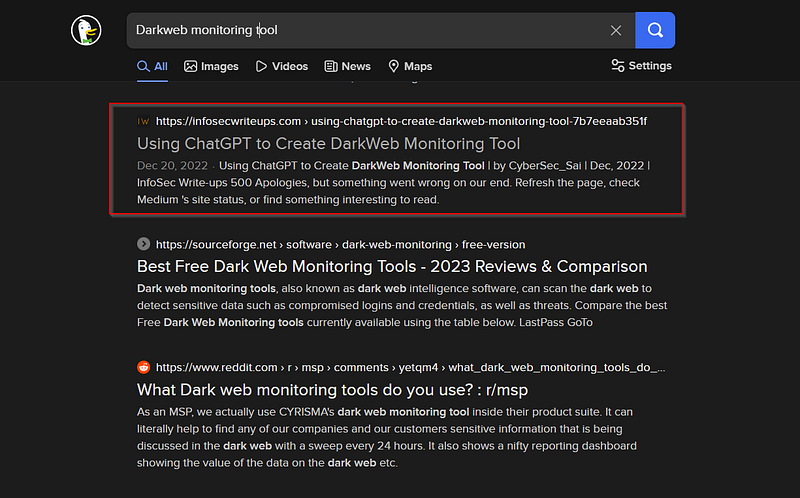
Conduct Keyword Research:
Keyword research is the process of identifying the keywords and phrases people are searching for related to your topic. By including relevant keywords in your article, you can increase the chances of it ranking higher in search engine results pages (SERPs).
To conduct keyword research, I used tools like Google Keyword Planner and SEMrush to identify relevant keywords and phrases related to my article. I also looked at the keywords my competitors were using to optimize their content. Based on my research, I identified the following keywords to target in my article:
- ChatGPT
- Darkweb Monitoring
- Artificial Intelligence
- Machine Learning
- Cybersecurity
Optimize Your Title Tag and Meta Description:
The title tag and meta description are two essential elements of on-page SEO. They appear in search engine results pages (SERPs) and help users decide whether to click through to your website. Therefore, it’s crucial to optimize them to make them as compelling and relevant as possible.
For my article, I optimized the title tag and meta description using the following guidelines:
- Include the target keywords in both the title tag and meta description.
- Keep the title tag between 50–60 characters and the meta description between 120–160 characters.
- Use active voice and compelling language to encourage users to click through to your website.
My title tag and meta description looked like this:
Title Tag: “Using ChatGPT to Create Darkweb Monitoring Tool — A Guide to Cybersecurity”
Meta Description: “Learn how to create a Darkweb Monitoring Tool using ChatGPT, Artificial Intelligence, and Machine Learning. Improve your cybersecurity with our step-by-step guide.”
Use Header Tags:
Header tags (H1, H2, H3, etc.) are another essential element of on-page SEO. They help search engines understand the structure and hierarchy of your content and highlight the most important information to users.
For my article, I used header tags to structure the content and make it easier for search engines and users to navigate. I used H1 tags for the main title and H2 tags for the subheadings. I also included the target keywords in some of the header tags to make them more relevant to search engines.
Include Relevant Images and Alt Text
Images and alt text are important components of on-page SEO. Including relevant images in your article can help break up the text and make it more engaging for users. Alt text, or alternative text, is a brief description of the image that appears when the image cannot be displayed. Search engines use alt text to understand what the image is about, so including relevant alt text can improve the SEO of your article.
For my article, I included relevant images to illustrate the concepts and steps described in the text. I also included alt text that described the image and included the target keywords where appropriate.
Write High-Quality, Engaging Content:
Ultimately, the most important factor in ranking an article on the first page of Google is the quality of the content. Search engines prioritize content that is informative, engaging, and relevant to the user’s search query. Therefore, it’s crucial to write high-quality content that meets these criteria.
For my article, I focused on creating informative and engaging content that provided a step-by-step guide for creating a Darkweb Monitoring Tool using ChatGPT, Artificial Intelligence, and Machine Learning. I included screenshots and examples to illustrate the concepts and steps described in the text. I also included links to relevant resources and further reading for users who wanted to learn more about the topic.
Measuring Success — Avenues for Improvement:
After optimizing my article for SEO, I monitored its performance using the Medium Stats Console. These tools provide valuable insights into how users are interacting with your blog and how your content is performing in different search engine results pages (SERPs).
Using Medium Stats, I tracked the number of visits to my article, the read ratio, and the fan count. I also looked at the demographics and interests of my audience to understand who was visiting my profile.
By tracking these metrics, I was able to identify areas where I could improve the SEO of my article and make adjustments to improve its performance.
Conclusion:
Ranking an article on the first page of Google using SEO techniques requires time, effort, and patience. It involves understanding the factors that search engines use to determine the relevance and quality of content and optimizing your content to meet those criteria. By following the steps outlined in this article, you can improve the SEO of your content and increase your chances of ranking higher in search engine results pages (SERPs). Remember, creating high-quality, engaging content that meets the needs of your audience should always be your top priority, and SEO should be used as a tool to help you achieve that goal.
Like My Work? Then Why Don’t You Support Me:
Buy Me A Coffee!
Also From Author:
- Russia, China, US, Ukraine — What Does Geopolitics Mean To Your Cyber Threat Intelligence Strategy?
- Did You Know Darkweb Has Its Own Courts and Justice System?
- How My Article Ranked on Google #1 Page With SEO
- Creating Darkweb Crawler using Python and Tor
- Using ChatGPT to Create DarkWeb Monitoring Tool
- How to Find Compromised Credentials on Darkweb?
- How I Earned My First Bug Bounty Reward of $1000
- How to Improve Your Bug Bounty Performance Over Time?
- Can TOR Keep You Anonymous? See How FBI Arrested An Illegal TOR User
- Explore Darkweb With These Surface Web Resources: A Large Collection of Darkweb Onion Links
- Don’t Get Arrested! Should You Use VPN for Bug Bounty Hunting?
- Hidden Secrets of LockBit Ransomware Revealed!!!
- Cyber Threat Intelligence is Not Just Indicators of Compromise. Fact Check!
- The Art of Assessing Cyber Threats: How to Identify and Mitigate Real Risks as a Pro
- Top 10 Active Ransomware Gangs: Geopolitics, Origin and Targets
- Beyond Dark Web: Telegram Emerges as the New Hub for Threat Actors
- You won’t believe how this AI tool can build a website in minutes!
- The ChatGPT Addiction: 3 Reasons Why ChatGPT Will Make You Obsessed!
- Know Your Adversary: Cuba Ransomware
- Ransomware Negotiations: Do’s and Don’ts
- How to Succeed in Bug Bounty?
- Top 7 Tips to Succeed in Bug Bounty Programs
- How to Get a Job in Cybersecurity?