
How Muscles Directly ‘Burn’ Fat
High-load resistance training should be considered as an optimal strategy for fat/weight loss.

We all know that a sedentary lifestyle increases the risks of various diseases that represent urgent public health concerns such as type 2 diabetes, heart failure, or breast and colon cancer. In the last decades, there is a consensus about the health benefits provided by regular physical activity, however, evidence regarding the molecular mechanisms that transduce these beneficial effects are lacking. Until now.
A new study published in the Federation of American Societies for Experimental Biology (FASEB) journal, showed that high load resistance training causes the overloaded muscles to release so-called micro RNAs that alter specific cellular pathways in fat cells to stimulate increased fat metabolism. Before diving deeper into the molecular biology of these findings, I have to acknowledge the core truth of metabolic science:
Calories ingested versus calories burned is the fundamental and most important formula for fat loss and weight management in general.
However, the percentage of that weight loss that comes from different cell types and tissues (fat vs. muscle, etc.) varies depending on several factors.
So let’s go back to the findings of the newly published study.
That muscles are metabolic demanding tissues is pretty well known. Muscles require calories during rest and when you use that muscle it burns calories. Your daily metabolic needs — the food you need to consume to maintain your body weight — is higher when you have more muscles. Sounds pretty logical right?
In mice and humans, this new research showed that high-load resistance training also has a direct molecular effect on lipolysis — the metabolic pathway to mobilize stored fat/energy during fasting or exercise. In fact, high-load resistance training can increase the amount of energy burned in a calorie deficit by altering a particular molecular pathway.
This is how it works.
When muscles are subjected to high-load resistance training, the muscular overload releases mini bubbles into the extracellular space called vesicles. Those vesicles contain ‘cargo’ from the muscle, the so-called micro RNA — single-stranded RNA which has the ability to alter the expression of other genes and proteins — in particular, miR-1. The vesicles travel to the fat cells and alter specific cellular pathways in those fat cells.
When arrived at the fat cells, miR-1 goes into the fat cells and shuts down the activity of one particular protein, Tfap2α, and subsequently, it also shuts down the activity of another protein called Cebpα.
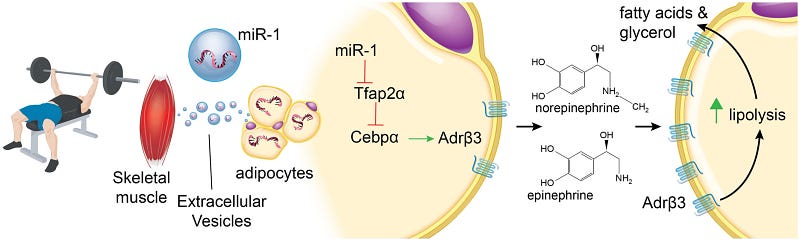
You can already forget those protein names but what is really important to understand is that shutting down the activity of these two proteins leads to the increasing amount of the Beta-3 adrenergic receptors (Adrβ3) on fat cells.
The Adrβ3 receptors are at the surface of fat cells and it makes those cells more susceptible to releasing their contents and burning those contents for energy, in the presence of adrenaline/epinephrine. Burning off those contents is also called lipolysis or fat “burning”.
None of this violates the core truth of metabolic sciences, i.e, calories in versus calories out.
This study nicely shows that the release of microRNAs from overloaded muscles that travel to fat cells makes it such that a greater percentage of the caloric deficit is compensated for by the extraction of fatty acids from fat.
This study reveals the power of understanding the mechanisms of fat burning. When one can understand the mechanisms, better choices can be made.
So what’s the actionable takeaway from these results for you?
If you want to burn body fat, other forms of exercise are of course valuable too, however, high load resistance training directly increases fat burning and thus should be considered as an optimal strategy for fat/weight loss.
Thank you for your interest in science! Feel free to put questions, comments, and suggestions for future articles in the comment section.
If you want to support:
- If you are not a Medium member yet, you can my referral link so I can get a part of your fees from Medium, you don’t pay any extra.
- Subscribe to my Newsletter to get best tutorials, research, education, and scientific-based tools for everyday life directly in your email inbox.
While you’re here, check out one of my other articles.


