Data Science, Mathematics
How Much Math do I need in Data Science?
Math skills are essential in data science and machine learning
Authors: Benjamin O. Tayo and Gideon Takor
Benjamin O. Tayo LinkedIn Profile: https://www.linkedin.com/in/benjamin-o-tayo-ph-d-a2717511/
Gideon Takor LinkedIn Profile: https://www.linkedin.com/in/gideon-takor-mba-28835820/
I. Introduction
If you are a data science aspirant, you no doubt have the following questions in mind:
Can I become a data scientist with little or no math background?
What essential math skills are important in data science?
There are so many good packages that can be used for building predictive models or for producing data visualizations. Some of the most common packages for descriptive and predictive analytics include:
- Ggplot2
- Matplotlib
- Seaborn
- Scikit-learn
- Caret
- TensorFlow
- PyTorch
- Keras
Thanks to these packages, anyone can build a model or produce a data visualization. However, very solid background knowledge in mathematics is essential for fine-tuning your models to produce reliable models with optimal performance. It is one thing to build a model, it is another thing to interpret the model and draw out meaningful conclusions that can be used for data-driven decision making. It’s important that before using these packages, you have an understanding of the mathematical basis of each, that way you are not using these packages simply as black-box tools.
II. Case Study: Building A Multiple Regression Model
Let’s suppose we are going to be building a multi-regression model. Before doing that, we need to ask ourselves the following questions:
How big is my dataset?
What are my feature variables and target variable?
What predictor features correlate the most with the target variable?
What features are important?
Should I scale my features?
How should my dataset be partitioned into training and testing sets?
What is principal component analysis (PCA)?
Should I use PCA for removing redundant features?
How do I evaluate my model? Should I used R2 score, MSE, or MAE?
How can I improve the predictive power of the model?
Should I use regularized regression models?
What are the regression coefficients?
What is the intercept?
Should I use non-parametric regression models such as KNeighbors regression or support vector regression?
What are the hyperparameters in my model, and how can they be fine-tuned to obtain the model with optimal performance?
Without a sound math background, you wouldn’t be able to address the questions raised above. The bottom line is that in data science and machine learning, mathematical skills are as important as programming skills. As a data science aspirant, it is therefore essential that you invest time to study the theoretical and mathematical foundations of data science and machine learning. Your ability to build reliable and efficient models that can be applied to real-world problems depends on how good your mathematical skills are. To see how math skills are applied in building a machine learning regression model, please see this article: Machine Learning Process Tutorial.
Let’s now discuss some of the essential math skills needed in data science and machine learning.
III. Essential Math Skills for Data Science and Machine Learning
1. Statistics and Probability
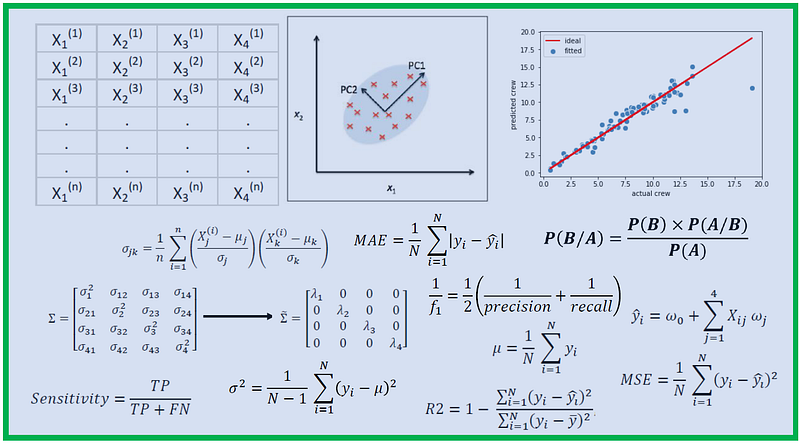
Statistics and Probability is used for visualization of features, data preprocessing, feature transformation, data imputation, dimensionality reduction, feature engineering, model evaluation, etc.
Here are the topics you need to be familiar with: Mean, Median, Mode, Standard deviation/variance, Correlation coefficient and the covariance matrix, Probability distributions (Binomial, Poisson, Normal), p-value, Baye’s Theorem (Precision, Recall, Positive Predictive Value, Negative Predictive Value, Confusion Matrix, ROC Curve), Central Limit Theorem, R_2 score, Mean Square Error (MSE), A/B Testing, Monte Carlo Simulation
2. Multivariable Calculus
Most machine learning models are built with a dataset having several features or predictors. Hence, familiarity with multivariable calculus is extremely important for building a machine learning model.
Here are the topics you need to be familiar with: Functions of several variables; Derivatives and gradients; Step function, Sigmoid function, Logit function, ReLU (Rectified Linear Unit) function; Cost function; Plotting of functions; Minimum and Maximum values of a function
3. Linear Algebra
Linear algebra is the most important math skill in machine learning. A data set is represented as a matrix. Linear algebra is used in data preprocessing, data transformation, dimensionality reduction, and model evaluation.
Here are the topics you need to be familiar with: Vectors; Norm of a vector; Matrices; Transpose of a matrix; The inverse of a matrix; The determinant of a matrix; Trace of a Matrix; Dot product; Eigenvalues; Eigenvectors
4. Optimization Methods
Most machine learning algorithms perform predictive modeling by minimizing an objective function, thereby learning the weights that must be applied to the testing data in order to obtain the predicted labels.
Here are the topics you need to be familiar with: Cost function/Objective function; Likelihood function; Error function; Gradient Descent Algorithm and its variants (e.g. Stochastic Gradient Descent Algorithm)
IV. Summary and Conclusion
In summary, we’ve discussed the essential math and theoretical skills that are needed in data science and machine learning. There are several free online courses that will teach you the necessary math skills that you need in data science and machine learning. As a data science aspirant, it’s important to keep in mind that the theoretical foundations of data science are very crucial for building efficient and reliable models. You should, therefore, invest enough time to study the mathematical theory behind each machine learning algorithm.
V. References
Linear Regression Basics for Absolute Beginners.
Mathematics of Principal Component Analysis with R Code Implementation.


