
CAUSALITY
How much is a human life worth?
An economic and biochemical answer to the question policymakers are struggling with right now

$6.4 trillion
Social distancing is the practice of physically distancing yourself at least 2 meters from other people, and it’s been used for years as a way to combat viral spread.
It’s also what the girls in middle school would do whenever I walked by — I truly admire their foresight.
Morgan Stanley predicts social distancing measures to reduce COVID-19 spread will result in a 30% drop in US GDP — the equivalent of $6.4 trillion. That’s just the U.S.A. Imagine the whole world.
President Donald Trump recently expressed (and rescinded) sentiments about re-opening the American market in time for Easter. Many models indicate this could result in the loss of hundreds of thousands of lives, so policymakers are left with an impossible decision:
Save the people or save the economy?
There’s a problem with that question — it’s not an either/or choice, and it’s not impossible. An economy is made of people; saving people generates economic benefit.
But how much benefit? Policymakers must be able to quantitatively justify public health-related decisions— to do that, they have to determine the dollar value of one human life.
Does that sound callous and messed up? Probably — but this is the third edition of my series Causality, so I wanted to spice things up. After all…
“We need a little controversy” — Eminem, 2002
Of course, it’s impossible to truly quantify the value of a life — but that’s never stopped us anyway. I’m focusing on how to attach a dollar value to a human life, so the philosophical arguments are taking the sideline for now (sorry Aristotle).
There are a few different ways to answer this question…
- “Pay me if you want to live.” — Economics (and the Terminator, I think?)
- “An arm and a leg. And another leg. And the other arm. And the other parts of your body.” — Biology (and maybe the black market for organs?)
- “My Chemical Finance” — Chemistry (or is this that punk band from the 2000s?)
Are you from Tennessee? ’Cause you’re the only $10 million I see…
Economically speaking, of course. 😉.

Economists use price as a way to quantify how much you value goods and services.
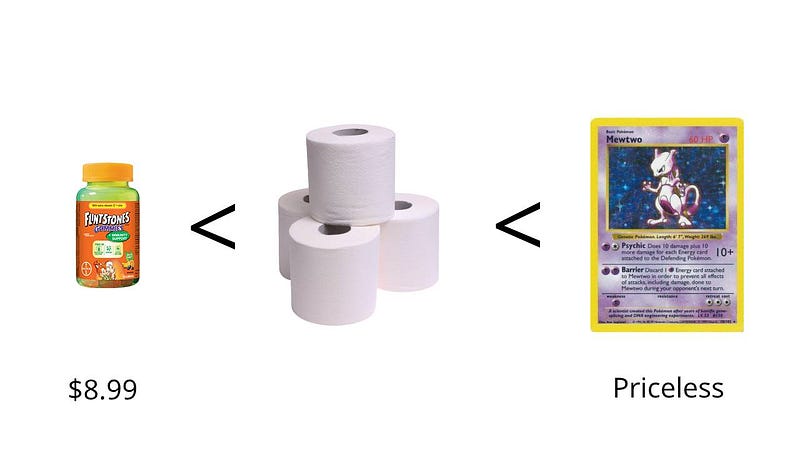
Price can also be used to determine how much you value your own life:
The value of a statistical life (VSL) is the local tradeoff rate between fatality risk and money. Basically, how much are you willing to pay to reduce your chances of death?
One of the easiest ways to do this is by looking at the price of something (usually a safety product or service), then dividing it by the probability that it’s going to reduce your risk of fatality (effectiveness):

Let’s flash forward to the near future, where your unmatched success and good looks have made you a frequent target for assassination. You decide to hire a bodyguard.

Her services are $150,000/year, but she’s the best in the business — she’ll reduce the probability of you dying by 1 out of 100/year. Let’s plug these into our formula:
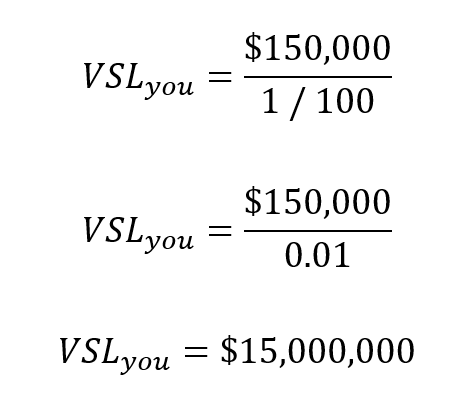
Congratulations, you’re worth $15,000,000! However, this isn’t the only way to figure VSL.
Another way is to measure the tradeoff between salary and workplace security. Basically, how much more do I have to pay you for you to accept a riskier workplace?
Divide the increase in wages demanded by workers by the corresponding increase in their risk of death:
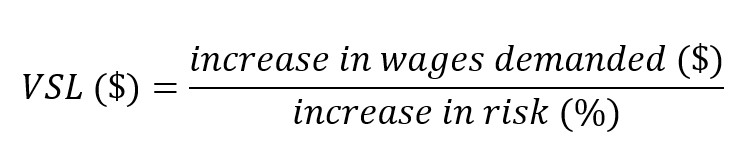
Let’s say that you somehow become even more successful and good-looking than you already are — we all thought it was impossible, and yet somehow, you did it. Your enemies become even more dangerous.

The risk of death your bodyguard faces increases by 1 in 1,000. As such, she demands a $5,000 increase in her salary. You’re happy to oblige — so now, what’s her VSL?
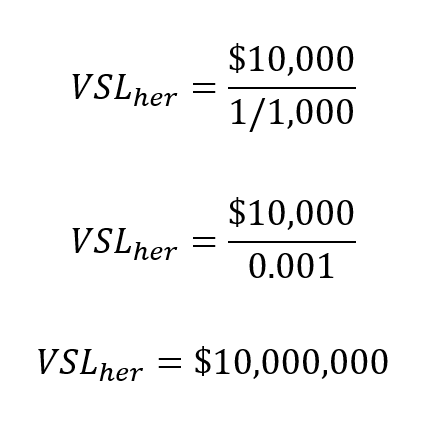
She’s worth $10 million! But why is it lower than yours?
VSL is positively income elastic.
Let’s use a different example — smoke detectors. If you have a high level of income, you have no problem buying a $25 smoke detector. If you have a lower income, you might wait until it’s on sale for $15. (Let’s assume it reduces your risk of fatality by 1 out 100,000):
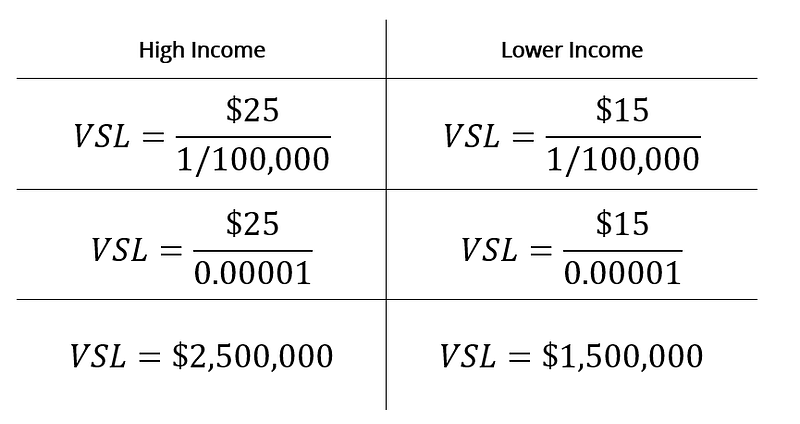
The lower-income individual values their life $1,000,000 less (at least for this specific product)— but see, that’s not necessarily accurate. They just can’t afford to spend as much on risk reduction.
There are some more nuances as to how this appears across different nations, but clearly, there are some key limitations to this model.
Despite that, VSL is still pretty useful.
- It helps us quantify risk aversion.
- It makes it easier to decide on public health policy.
Economists average multiple VSLs from varying safety products/services and wage rates; Viscusi (2018) determined the American VSL to be around $10 million USD. Accounting for inflation from 2004, Canadian VSL seems to be around $8 million USD.
So, if anyone ever tells you that you look like a million bucks, they’re LYING — you should probably cut them off and out of your life. Do you know what you probably shouldn’t cut off/out?
An arm and a leg. And probably your kidneys.
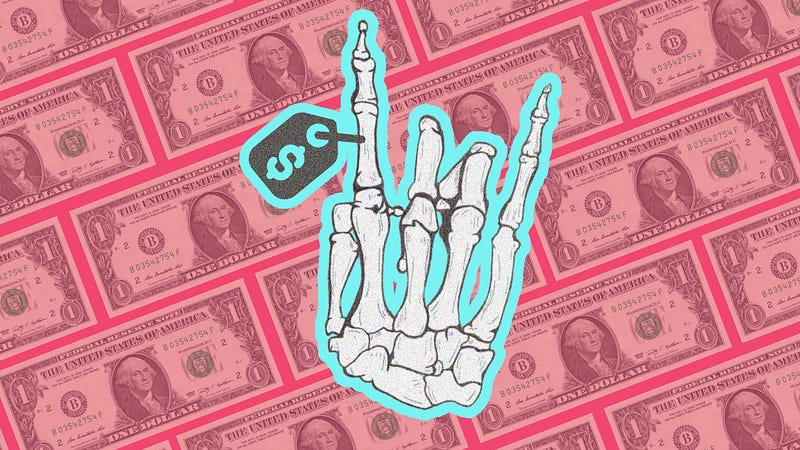
Researching this part of the article has undoubtedly put me on several federal crime watchlists.
The challenge inherent in putting a price on the human body is that… well, it’s not what we would define as ‘legal’. Most parts of the world don’t allow people to sell their organs, so the figures have a fair amount of uncertainty around them.
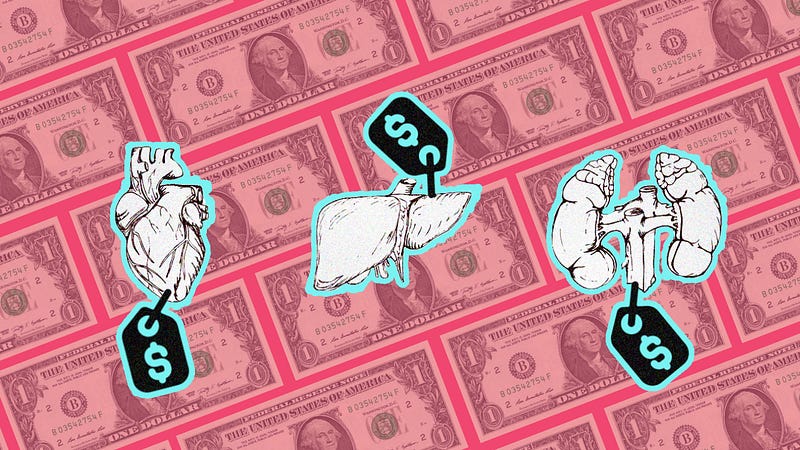
That being said, here are some approximate figures for different components of the body according to a WIRED investigation:
- Heart — $800,000: This is the organ that pumps blood through your body, and it involves a very sophisticated procedure to transplant. That might be why the average billing for a heart transplant in the U.S. is close to $1.4 million — if someone has stolen your heart, tell them to give it back RIGHT NOW.
- Liver — $500,000: The liver detoxifies your body, so it’s exposed to various chemicals — luckily, it’s really good at regenerating itself, even from as little a 25% of the original organ! While we don’t know the whole story of how exactly this happens (some evidence points to increased telomerase levels) it means you can get away with only selling part of your liver.
- Kidney — $260,000: I’m sure you’ve heard of people selling their kidneys as a joke — they help filter blood and make urine. (And you’ve got two of them.)
Blood is worth about $337/pint, women in the U.S. can rent out their wombs for $80,000–150,000, and a full human skeleton could run you over $4,000.
These prices change around the world and depending on the legality of the trade. When you take the total of all priced parts of the body, estimates can range from $250,000 to upwards of $45 million.
If that figure seems crazy, take a breath.
Speaking of breathing…
Do you like oxygen? Then you’ll like 65% of me 😉
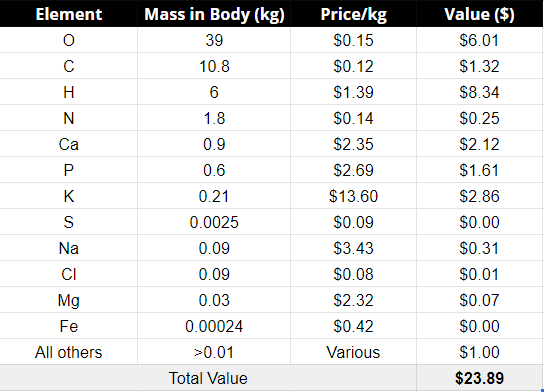
My chemical makeup is worth around $24.
At the most reductionist level, we can look at the elements that make up the human body:
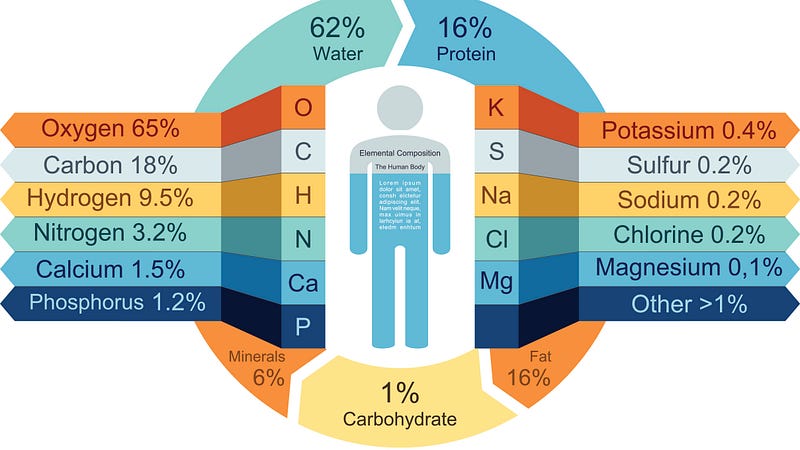
Oxygen, carbon, hydrogen, nitrogen, calcium, and phosphorus make up about 99% of our mass.
If you ripped my atoms apart and sold them, you could probably get some money for them. After looking at multiple sources, I eventually settled on ThoughCo’s chemical breakdown and the average element prices found here to build out this chart:
I played around with a few different weights so I could map this function on Excel:
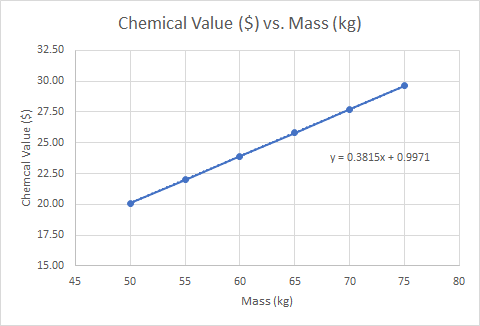
y=0.3815x + 0.9971
Swap your own mass in kilograms in the equation above for x, and y will be equal to your approximate elemental value — as you can see, mine is $23.89. That’s at least 3 or 4 Big Macs.

Yeah, that’s a bummer.
So how much is a human life worth?
- Economically speaking (and depending on where you live/how much you make) probably around $10 million.
- The sum total worth of the organs, bones, and assorted mush that make up your body is upwards of $45 million.
- Ripped apart atom from atom, your elemental value is a function of your mass: value in $=0.3815(mass in kg)+ 0.9971. (I’m about $24).
Why does this matter to me?
- Planning to hold someone hostage? Use their VSL when negotiating a ransom amount. I don’t condone kidnapping — but if you must, do so with economic reasoning. (I’M KIDDING).
- If you’re really struggling to cover those student loans, remember that you don’t need 100% of your liver to have a good time.
- When you inevitably defeat your enemies and the assassins they sent after you, don’t atomize them — it doesn’t seem like the fiscally responsible thing to do.
This is part of my series Causality, where I try to answer a question we’re all asking ourselves right now through the lens of different sciences + disciplines. Check out the other editions below:
Hi, I’m Murto and I’m a 17-year-old entrepreneur and student in Toronto, Canada. If you have any feedback for me on this article, or if you just want to chat, please reach out to me on LinkedIn! Next steps:
- Vanquish your enemies
- Kick some ass
- Have a great day
Thanks!


