
CAUSALITY
Why are you so into TikTok?
Economics, artificial intelligence, and neurochemistry can explain the platform’s popularity
Maybe it’s you. Maybe it’s your kids. Maybe it’s your grandma. Gary Vaynerchuck won’t stop talking about, 12-year-olds are dancing in the streets, it’s mayhem.
TikTok is quickly growing into one of the world’s most popular social media platforms — but where did it come from, and why is it so great?
The Chinese app lets you make short videos with different sounds — there’s comedy, dancing, and assorted unspeakable Internet horrors. It’s also got my favourite video on the planet:
It’s especially popular with young people (including me) who spend hours on the app. Before you get into any long-term relationship with this platform, let’s try to figure out why TikTok is taking the world by storm:
- “Jumping off a bridge is more fun if you’re doing it with all your friends” (Economics)
- “So tell me what you want, what you really, really want” (Data science/AI) (Also the Spice Girls, 1996)
- “I can’t feel my face when I’m with TikTok — because I’m addicted” (Neurochemistry) (and The Weeknd circa 2015, maybe)
Everything is better with friends
Network effects explain why you get on the platform in the first place.
Network effects are a hot topic in the business world. They can act as a moat against competition if you’re a business, reduce acquisition costs for platforms, and help you build a natural monopoly.
So what are they?
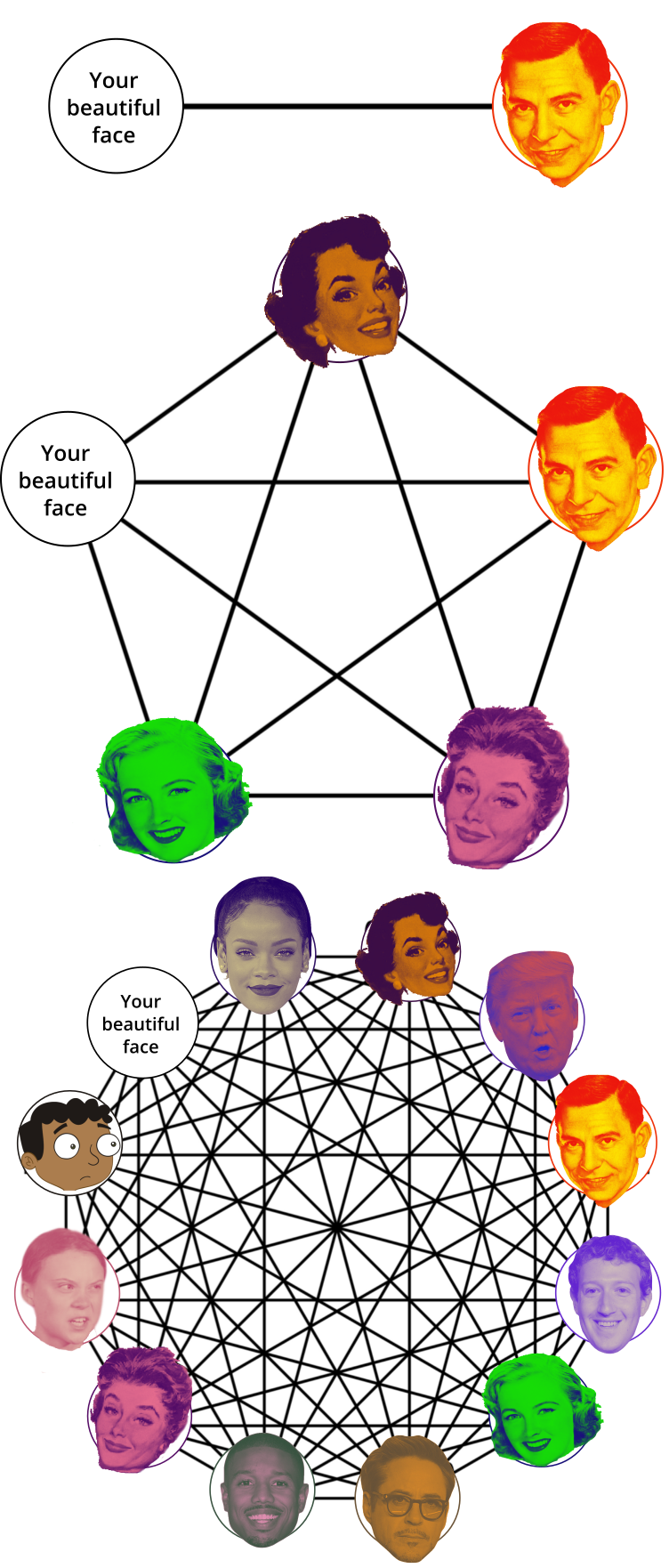
Think back to ancient times, when you first made your Facebook account. Let’s say hypothetically that there was only one other person on the platform, your best friend Fernando. You each can only make one connection (with each other), so Facebook isn’t really that valuable/useful as a connection platform.
But then Esmerelda, who is unable to decide whether she loves you or Fernando, joins Facebook to sort things out. Not ones to leave her side, her best friends Catalina and Natalina join as well. Suddenly, with five of you on board, ten interactions are possible. Facebook is starting to get more valuable and useful.
As the utility of Facebook grows, more people are interested in having an account. This means they start to join, and the number of possible interactions skyrockets; after seven more of your friends join (making 12) 66 interactions/connections can be made. More people joining Facebook makes the social network more valuable: this then incentivizes more people to join. Suddenly, your telenovela of a love life has built the biggest social platform in the world.
When the value of your product increase as more people use it, it benefits from a network effect.

You can see this in platform-based businesses like Uber and Airbnb, ethernet and fax machines, and of course, social media/networking platforms like Facebook and TikTok.
When your friends join TikTok, it makes having an account more valuable/useful to you. After you join, TikTok becomes more valuable/useful to your other friends.
Boom. Network effects. Soon enough, we all join the 1.5 billion people who have downloaded the app and the 500 million people you use it every month.
Network effects can explain why you join TikTok, but why do you stay?
Because it knows what you want.
What you really, really, want.
You may have heard that TikTok is really good at figuring out exactly what kind of videos you want to see. That’s an understatement.
The Chinese social media has built a very robust recommendation engine: this is the central part of how TikTok uses data and algorithms feed you content you’ll probably enjoy — it’s also a form of artificial intelligence.
No one knows the specifics about TikTok’s recommendation engine, but there’s a good chance it follows the collaborative filtering process. The fundamental idea is that people who agreed on things in the past will agree on the same/similar things in the future.
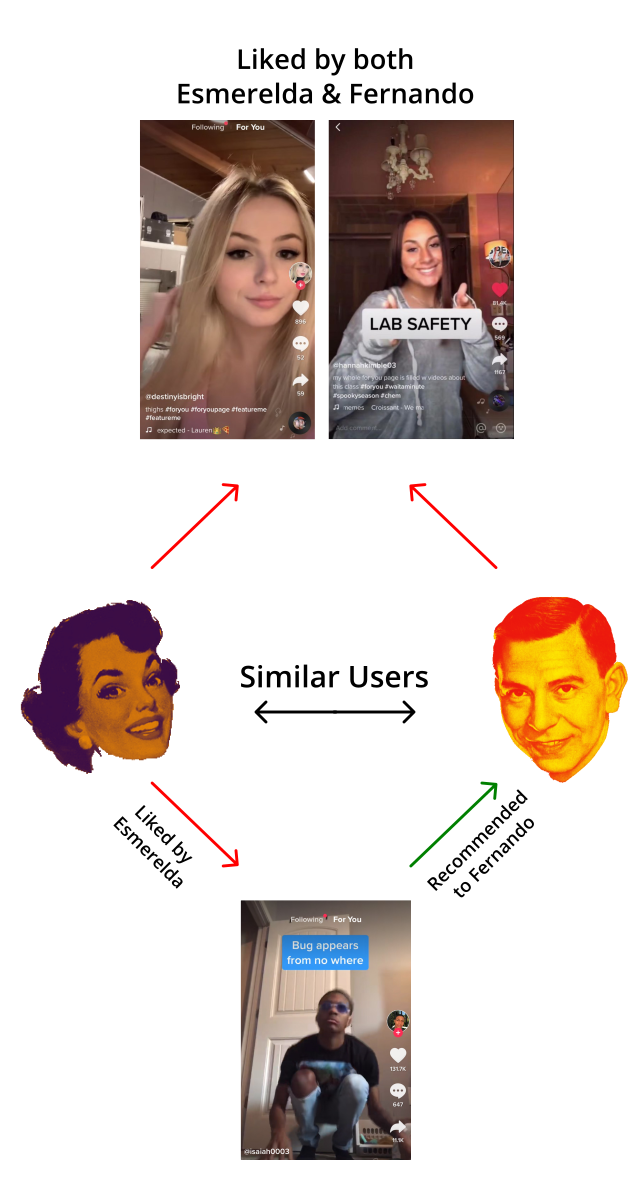
TikTok observes your behaviour on the app; what kind of videos do you like, share, and comment on, how long do you watch it, who do you follow, and other metrics to measure your engagement.
This all helps build a profile of what you like and dislike. The engine then recognizes other users with similar preferences and looks at videos they’ve liked but you haven’t seen yet.
Voila, those videos are served to you on the For You page.
Why is TikTok so good at this?
Unlike many other companies that use recommendation engines for content, TikTok can get a feel for your tastes really quickly.
This may be because TikToks are so short — most are 15 seconds or under. That means you’re providing the algorithms a lot of data about your tastes in a short period of time.
(Not to mention the 1 billion users they can compare you against!)
I’ve said the word ‘algorithm’ a lot. That may sound daunting (and makes me seem smarter than I am) but it’s simpler than you think. TikTok might use a memory-based approach, which is what we’ll look at now:
We want to find out if you’re going to like TikTok #5, so we’ll take a weighted average of everyone’s recommendation (essentially whether they liked it or not) for it. If someone is more similar to you, their recommendation gets more weight. After all, if they’re like you, they must have great taste.
The correlation (similarity) between two users can be determined using this formula:
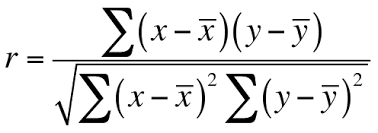
To get the predicted value of how Person X may rate item i, which in this case is TikTok #5, this formula can be used:
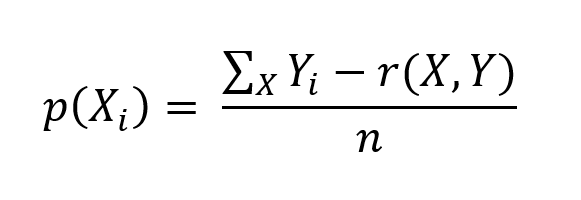
That’s one way of using the memory-based approach. Given how big TikTok is, they might employ a model-based approach, like through a clustering algorithm: these also give weights to recommendations.
The difference lies in the fact that these algorithms will use unsupervised machine learning (finding patterns in data without any pre-existing labels) to determine the similarity between users. Check out this article for other collaborative filtering techniques:
Even if TikTok uses other techniques, there’s clearly a lot of data science that goes into making sure you get content catered for you — that’s why you stay.
But then why do so many find it difficult to leave the platform?
Once you go TikTok, you’ll never …Chris Rock? Flip-flop? Hit stop?
TikTok can be as addictive as any other drug.
You’ve probably heard of dopamine.
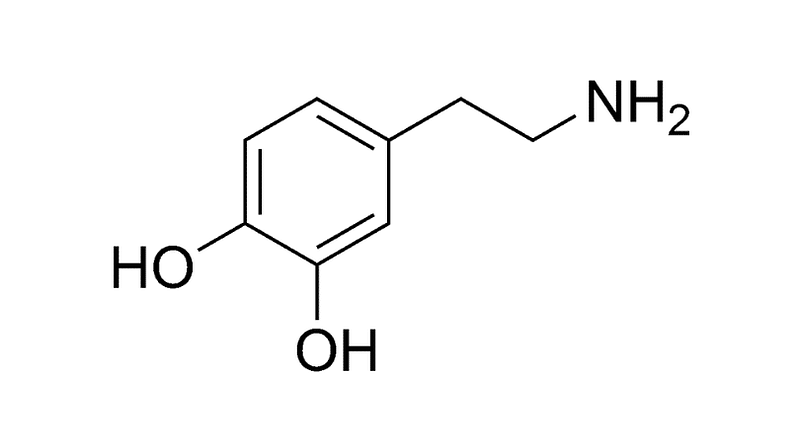
Anybody who thinks they “know psychology” will try to bring it up in conversation somehow — like I’m doing, right now.
Dopamine is a neurotransmitter; that means its a chemical messenger that sends signals through your brain cells (neurons). Different neurotransmitters are associated with different behaviours — dopamine releases whenever you do something like:
- Eating good food (ex. an Osmow’s half-and-half shawarma)
- Talking to your crush (Esmerelda please text me back)
- Defeating your enemies
- Successful social interactions
Dopamine makes you feel good, and rewards for beneficial behaviours so you repeat them.
There are four major dopamine pathways in the brain — one of them is associated with milk production, so depending on your hobbies, we probably don’t have to worry about it for now.
The other three are reward pathways that activate when we’re experiencing rewarding things, and strengthens the connection between the associated stimulus (the thing that causes the experience) and the reward.
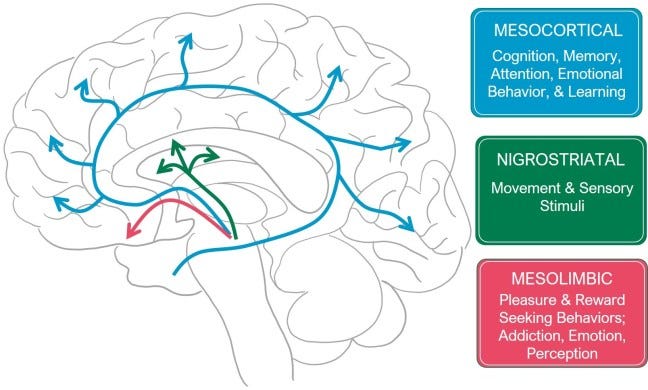
Drugs like amphetamines are structurally similar to dopamine, so they’re able to enter the neurons already containing dopamine — this forces the real dopamine out into the next neurons, firing up the reward pathway.
Other drugs hijack the dopamine pathways in different ways, but the common product is an excessive release of dopamine, which motivates you to repeat the action that caused it i.e. take more drugs. As a result, your neural circuits will adapt, and these behaviours are reinforced — boom, addiction.
Drugs aren’t the only things that can hack your reward pathways. Positive social interaction can trigger the same neural response as a hit of cocaine.
Okay, that’s not true — they’re significantly weaker, but chances are you have positive social interaction more often than you have cocaine. Just a guess.

Social media provides us with endless interactions, so those pathways keep on activating — long-term adaptions to your excess of dopamine could lay the groundwork for a social media addiction.
As discussed earlier, TikTok is really good at showing you things you’ll like, so that dopamine is firing. Puppies, sunsets, Esmerelda — the more you see things consider cute/attractive, the more dopamine is released. When people like your videos or comments, that activates your reward pathways as well.
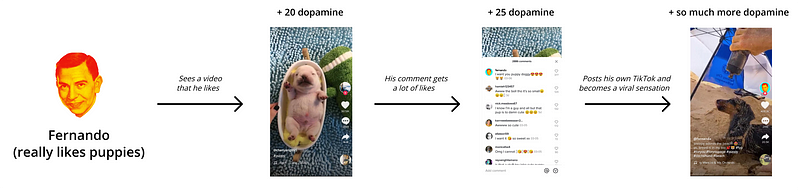
Since all that dopamine is telling your brain that scrolling through TikTok is a beneficial behaviour, it’s really hard to get off.
So why are you so into TikTok?
- Because all your friends are on it — that’s why you joined.
- TikTok’s algorithms have figured out exactly what you like to watch — that’s why you’re on it so much.
- Seeing things you like triggers your reward pathways, slowly making you addicted — that’s why you can’t leave.
Why does this matter to me?
- If you ever start a business, building it around a network effect can make your product mega-defensible against competitors.
- You know how you get targeted ads about things you were dreaming about? It’s because most services that use recommendation engines know what you want before you do.
- I might start giving you all compliments at the start of all my articles to hijack your dopamine pathways and make you addicted to my content.
This is part of my series Causality, where I try to answer a question we’re all asking ourselves right now through the lens of different sciences + disciplines.
Hi, I’m Murto and I’m a 17-year-old entrepreneur and student in Toronto, Canada. If you have any feedback for me on this article, or if you just want to chat, please reach out to me on LinkedIn! Next steps:
- Vanquish your enemies
- Kick some ass
- Have a great day
Thanks!


