
How Learning Languages Has Enriched My Life
And why everyone should be multilingual — Chapter 2
I studied Arabic and Russian for my first degree. This may seem an eccentric combination — my University certainly thought it was and tried very hard to dissuade me. But I, aged 17, had a very clear rationale.
I wanted to learn languages that would enable me to speak to as many people as possible, across as many countries as possible. They should be languages that were too hard for me to pick up on my own. And languages that would materially change my experience of visiting the countries in which they were spoken. This was, after all, just as the Berlin Wall was falling. And at the beginning of the emergence of Islamic extremism. The Soviet bloc and the Arab world, right on Europe’s doorstep, were impenetrable, other and menacing to us.
The course of my life, as I was finishing school and applying to University, pivoted on the Russian word for a bed bug.
Klop.
My preferred University — Cambridge — was so keen to deter me from my chosen path of study that they obliged me to sit two additional entrance exams to win my place. These exams fell weeks after all other exams had ended. The Russian exam landed on the morning after our school leavers’ party. I was feeling extremely sorry for myself as I trudged, alone, to the small, wood-paneled room designated my exam room.
A major part of that exam was a comprehension passage, I think by Tolstoy, about a journey by overnight sleeper train. A key protagonist in this passage was the bed bug. Somehow, I knew this word. I had never knowingly learnt it, certainly never used it. And yet, in my hour of need, it leapt into my head.
This has happened to me many times since. Somehow, traversing the world with your ears open, you unwittingly imbibe words, phrases, constructions, meanings. They live within you, stretching your perception, until one day they tumble unheralded out of your mouth, or pen, when you need them. Like hoarded treats.
Years later, I soaked up Portuguese while working as a reporter in Angola. Compared to Arabic and Russian it was a breeze. I never took a class. I learnt it as a child learns a language — from listening, reading and a desperate desire to make myself understood. I will never forget the first time I opened my mouth and a fully formed subjunctive fell out.
“Se for assim…”
“If it were so…”
I didn’t even know what part of speech is was. Just that this was what was needed to convey my desired meaning.
Thanks to those Russian bed bugs, I secured a place on my chosen course.
My decision to study Arabic in addition to Russian at University was cemented when, aged 16, I joined a school archaeology trip to Egypt. It was my first time outside Europe. Only a four-hour flight away from home, and yet startlingly alien and alluring. Having detached a strange man’s unwelcome paws from me for maybe the fifth time in a week, I decided that I needed to learn how to speak Arabic so that I could return, learn more about this fascinating world, and shame these men into keeping their hands to themselves.
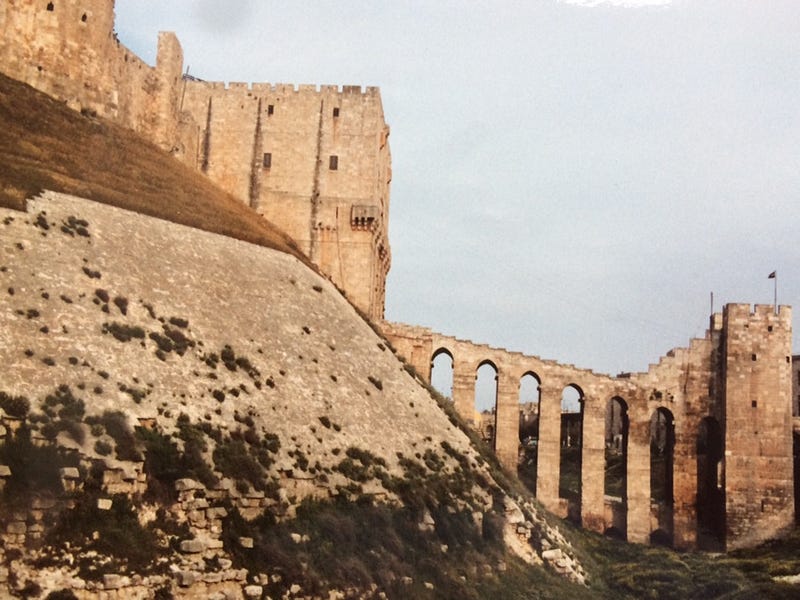
Seven years later, brushing up my spoken Arabic ahead of my final undergrad exams, I travelled to Syria for a month. After three weeks staying with a family in Damascus I took a bus, north, to Aleppo. Halab. Beautiful Aleppo, with the crusader castle on the hill and the vast sprawling souq spreading beneath it like a skirt. Lord knows what is left of any of that now.
On the bus, I met a man named Bilaal. A doctor, travelling with his teenage daughter to visit his sisters in Aleppo. I was the only foreigner on the bus. He tried to speak to me in English. I stubbornly responded in Arabic. He was concerned,
“Why are you travelling alone? It’s not safe. Where will you stay in Aleppo? Who do you know there?”
I told him I knew no one. Would find a place to stay when I arrived. I shared their packed lunch of eggs, flatbread, hard cheese, pickled vegetables. And when we arrived in Aleppo they insisted that I accompany them to their family’s home, that I stay with them. Hospitality is a revered civic duty in the Middle East.
I stayed in their flat for the next week, ate at their table, battled to convince one of Bilaal’s sisters that she mustn’t vacate her bed for me. I saw the town in their company, through their eyes and ties. I wonder what has become of them now.
Speaking Arabic transformed me from an impersonal blonde object of desire and a target, to a daughter, a sister, someone to be fiercely protected. Prejudice and racism works both ways. Language holds the power to break down those stereotypes, to build bridges and lay bare commonality.
Learning Arabic also drew on all my reserves of stubborn determination. To a native speaker of Indo-European languages, Arabic is utterly alien and extremely hard. It requires a complete change of mindset, logic, assumptions. As, I am sure, would Chinese, Japanese, Zulu or Maori — any language from a totally different origin and system. It rebases and reshapes you.
To speak another language well you cannot take your — in my case — Anglophone self and merely translate word for word. It doesn’t work. You have to absorb completely different systems of grammar, parts of speech, sentence structure — and translate yourself through them. You become the person that those linguistic tools allow you to express. The more different the second language is to your own, to greater the transformation you have to undergo to speak it well. And in the process you strip yourself back, lay bare your core, and the essence of what it is that you want to say. Remake yourself through the words of the other. And really listen. I can think of no better training for empathy, no better antidote for racism and insularity.
To learn Arabic you actually have to learn two quite different languages — written “Classical” Arabic — which has stayed true to the Medieval language of the Koran and is the same throughout the Arabic speaking world. And spoken “colloquial” Arabic — which varies widely across the expanse of the Arab world. It is possible that an illiterate Moroccan and an illiterate Yemeni, each speaking their own version of colloquial Arabic, would be unable to understand each other. But if they could both read and write classical Arabic they could “standardise” their dialects back, across the centuries and the migration out of the Saudi desert, towards the classical, until they reach a point of mutual understanding.
I had been studying Arabic for a year before I could even look up a word in an Arabic dictionary. People assume that this is because of the need to learn a new alphabet. But that only takes a few days. Learning to make all of the new sounds takes a while longer. But it is the structure of the language that poses such a challenge.
All Arabic words derive from a three-letter root. For example — K-T-B gives kataba — to write. That three-letter verb is form one of the root. Each root can exist in up to fifteen different verb forms. In form two the middle letter is doubled — Kattaba. In form three a long A is added after the first letter — Kaataba. Form four adds an A in front of the first letter — Aktaba. By form ten your three letter root has transformed into Istaktaba.
Each form — loosely — brings a similar evolution to the meaning of the initial root. Form two is causative or intensive — “to make someone write”, but also, “to deploy troops”. Form three is associative — doing something with others. Kaataba is “to correspond with someone”. Form four is causative; Aktaba means “to dictate to someone”. By the time you arrive at forms ten and beyond there may be only the most tenuous connection to the meaning of the root. Istaktaba means “to have a copy made of something”. Arabic is a profoundly poetic language; the tendrils of meaning and association that unfurl from each verbal root sketch out that intrinsic poetry.
And each one of those verb forms spins off nouns, participles, adjectives and gerunds. Kaatib — writer. Kitaab — book. Maktaba — library. Istiktaabi — dictaphone. And so forth. Each three-letter root can potentially spawn many hundreds of words. And in a dictionary, all of them will be listed under that one root. To look up any one of them you have to know enough grammar first to find the root, then to know the form, and then to identify the part of speech. You begin to see the challenge!
After a year of studying Arabic in University classrooms, I was barely out of the starting blocks — particularly in spoken Arabic. So, for the summer holiday I travelled to Jordan where I lived and worked for two months in a home for severely disabled children, in the rubbly desert an hour outside Amman.
All of the staff in the home were female, mainly Palestinian refugees. None could speak any English. The management regime was fascistic — we were literally locked inside the building and banned from going out. I only escaped once a week, on a Friday, when the man who had arranged the placement sent his chauffeur to collect me and whisk me away to high society dinners and parties in town. He was the Minister of Education, a wise and wonderful man, also a Palestinian refugee and a friend of my lecturer. I — briefly released from my confinement — was dazzled, disoriented and desperately underdressed.
The children’s home was the perfect immersive plunge pool for compulsory language acquisition. I had no choice but to attempt to understand and communicate in Arabic. When I arrived I could only express myself approximately to the level of a three-year-old. Communicating as a three-year-old, I was in turn treated like a three-year-old by the staff. Essentially as they treated their charges. Over the space of those two months, I felt myself shrinking, regressing, becoming that small uncertain person that my linguistic limitations let me express. By the end, though, I had managed to pick up a great deal.
To this day if I see okra I think first of the Arabic word for it:
Baamiya.
Before my journey to Jordan, I had never encountered okra, had no word for it. I still cannot stomach it. Hairy on the outside, slimy in the middle. There is some lurking in my fridge right now — my husband loves it. I, however, find it repellent. In the children’s home we had a set menu for each day of the week. Tuesdays was baamiya and lamb stew, with rice. One of our tasks was to prepare the food — for all of the staff and the children. This involved topping and chopping a veritable mountain of baamiya every Tuesday. The sight of okra, even now, transports me straight back to sitting on the cool floor tiles, with a knife, an enormous metal platter piled with baamiya, and itchy slimy hands.
Likewise, the first word that pops into my head if I see tweezers is:
Malqut
(From the root laqata — to gather, collect, pick up)
My bored, incarcerated colleagues took exception to my unruly eyebrows and, after a few weeks, unshaven legs. Why bother to tame either — I thought — no one was going to see them. The other girls decided to pin me down and pluck me like a pheasant, one hair at time, with malqut.
And so, in just those two months, learning Arabic gave me new words, new thought processes, and an entry to the full gamut of Jordanian society. It forced me to listen intently, to stay strong and determined, and to remake myself in the words of others. And it definitely taught me humility — including at the mercy of several sets of tweezers.
And then, as a result of spending those two months in the company of Palestinians, I went to the West Bank for a year, at the peak of the Intifada.
Intifada: literally “a shiver, shudder, tremor”. The name given to the Palestinian uprising against Israeli occupation. From form eight of nafada — to shake something off.
And there I learnt a great deal more.
You can read Chapter 1 of this series here:
And Chapter 3 here:


