
How is facial recognition technology being used around the World?
Visualizing the implementation of the controversial tech in different countries
Last time I wrote about the controversial tech, a tiny startup by the name of Clearview AI was in the spotlight on how it was being used by law enforcement in multiple jurisdictions via its groundbreaking facial recognition app. Not just that, but it was reported that the startup was selling its controversial product to private companies we well.
Ever since the information about the company became public late last year, it has received scathing criticism from different circles. The controversial app that can search 3 billion photos across multiple platforms has since been banned for use by New Jersey & San Diego Police departments in the U.S.
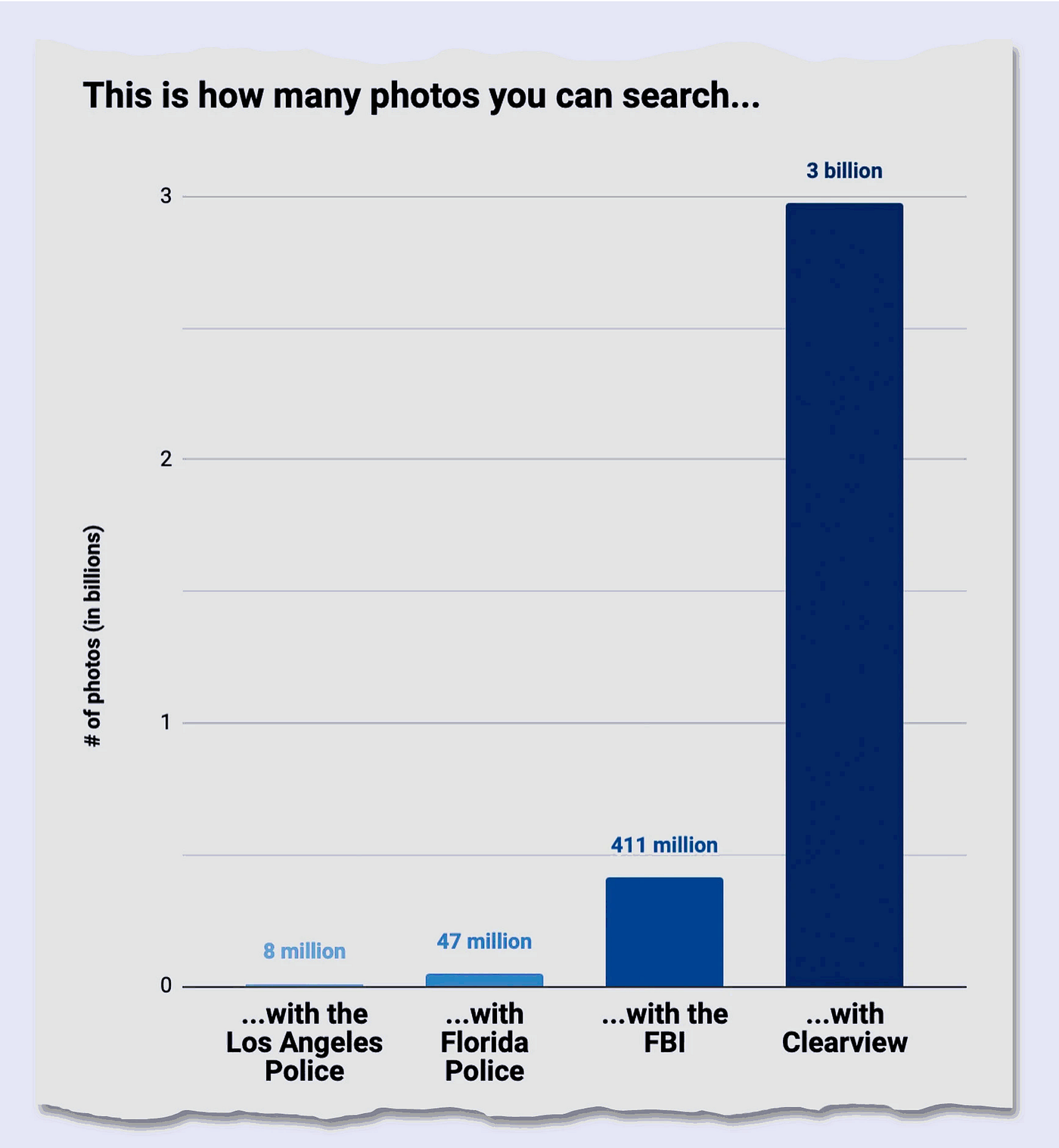
Following multiple cease-and-desist orders from Facebook, YouTube, Twitter, & other companies over its practices and severe backlash, Clearview AI feeling the heat recently announced that it would stop selling controversial facial recognition app to private companies. It also said it would take preventive measures barring its technology to collect any metadata associated with the photos.
While the debate around the merits and demerits of using the futuristic technology rages on, countries around the world are increasingly using it in some form or the other —from public CCTV cameras to biometric identification systems at airports, facial recognition technology is a much more common sight these days.
The most common & the simplest use of facial recognition on a daily basis is unlocking your smartphone. Although this is one of the most basic forms of technology, more advanced systems of mass surveillance are employed by the authorities in various jurisdictions around the World.
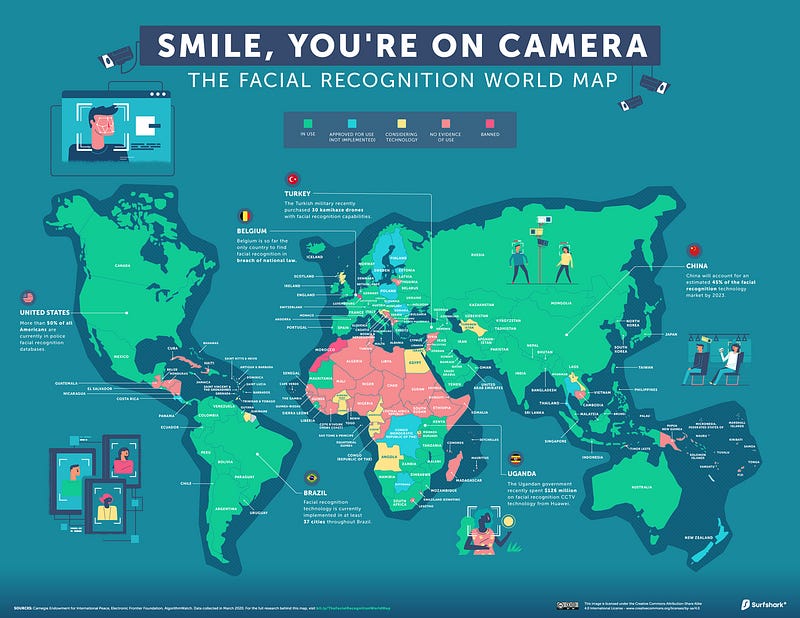
And this is where today’s visualizations come in — prepared by a VPN service called SurfShark, it classifies 194 countries and regions on their usage of technology for mass surveillance. The infographic at the top presents a Global picture of how it is being used in various countries — the breakup of different regions is as follows:
North America, Central America, and the Caribbean
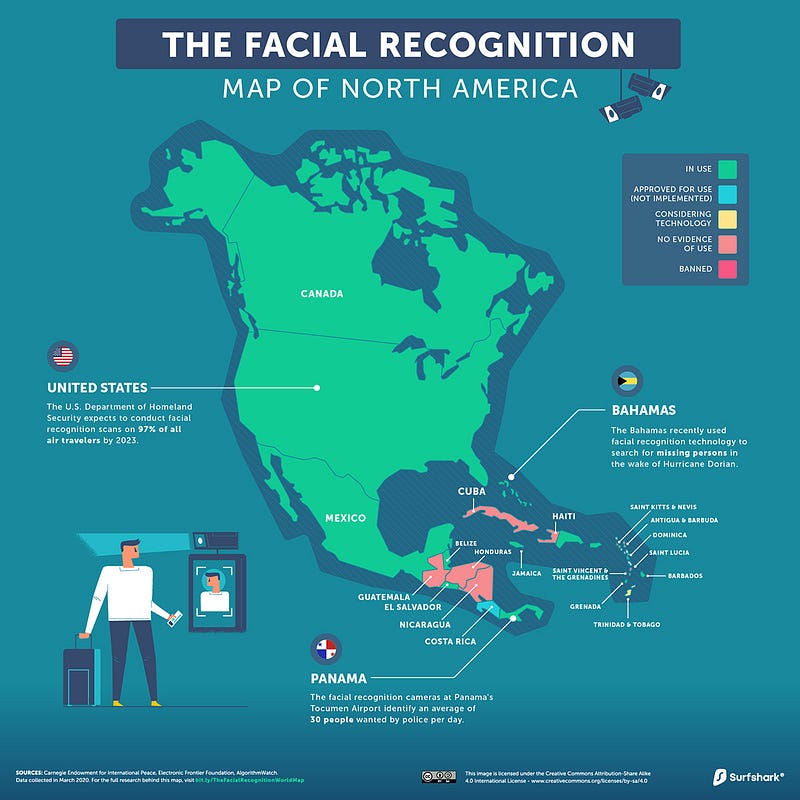
Considering it is the most wired country in the World, the United States sees one of the most extensive uses of the technology — According to a Pew Research, 59% of Americans are in favor of implementing facial recognition technology, considering it acceptable for use in law enforcement. The Department of Homeland Security unveiled its “Biometric Exit” plan, aiming to use facial recognition technology on nearly all air travel passengers (97%) by 2023.
Despite the controversy angle, the technology has seen its usefulness in emergency situations too. When Hurricane Dorian hit the Bahamas in the late summer of 2019, it launched a blockchain-based missing person database “FindMeBahamas” to identify thousands of displaced people.
Europe
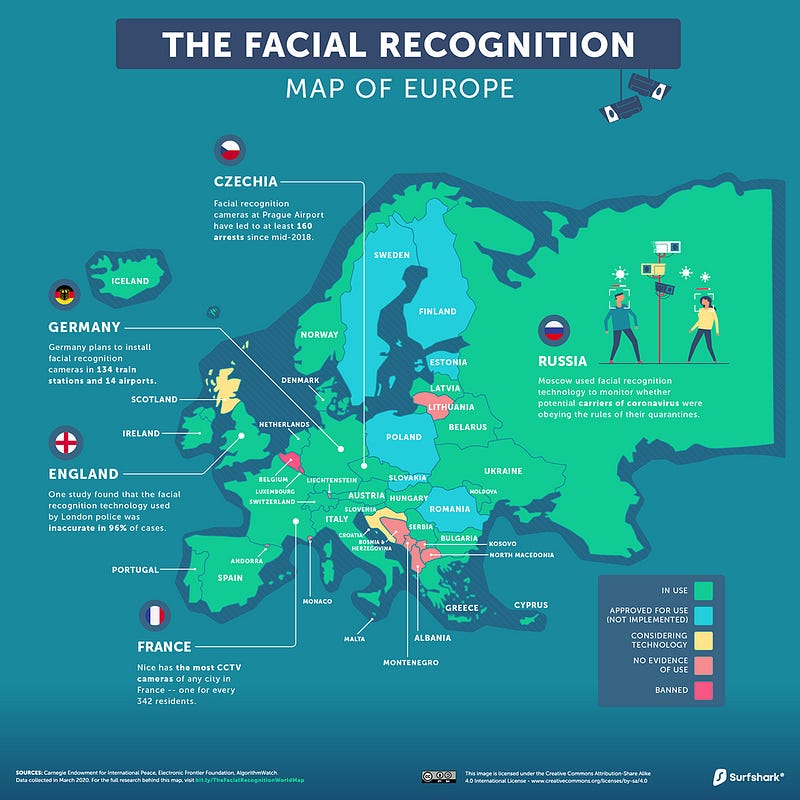
Europe is at crossroads when it comes to the use of personal data. On the one hand, it has strict data regulation regimes like GDPR, while on the other it is currently being used across 26 European countries, despite 80% of Europeans not keen on sharing facial data with authorities. Two of the three governments officially opposed to the use of this technology are in Europe — namely Belgium and Luxembourg.
Middle East and Central Asia
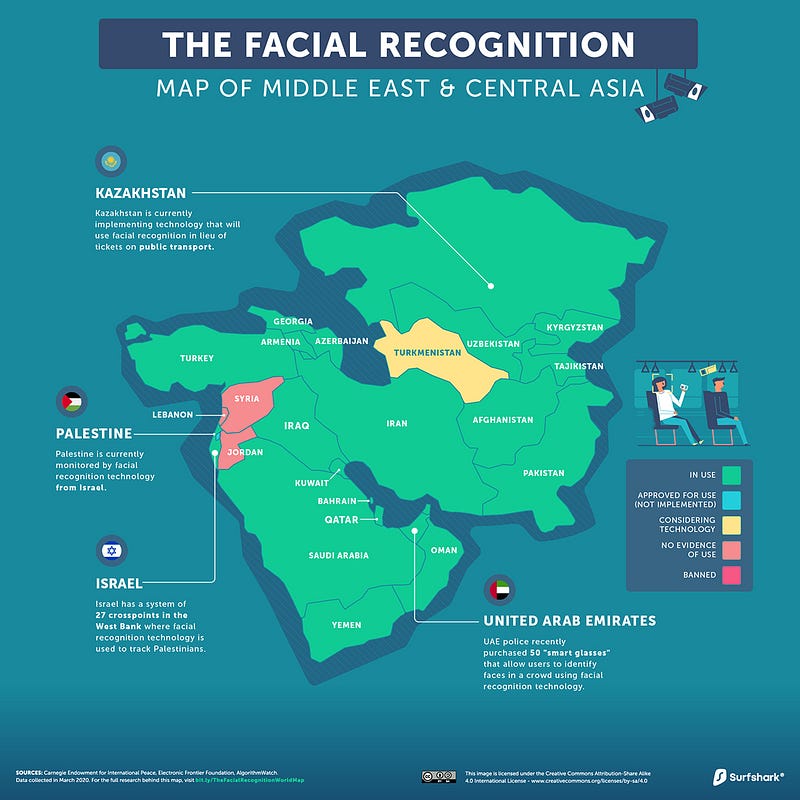
This volatile region is seeing the use of technology for the purpose of border security and monitoring law & order situation. The biggest example in this regard is Israel which uses the technology at 27 crosspoints in West Bank (Palestine) to keep track of the Palestinians.
South America
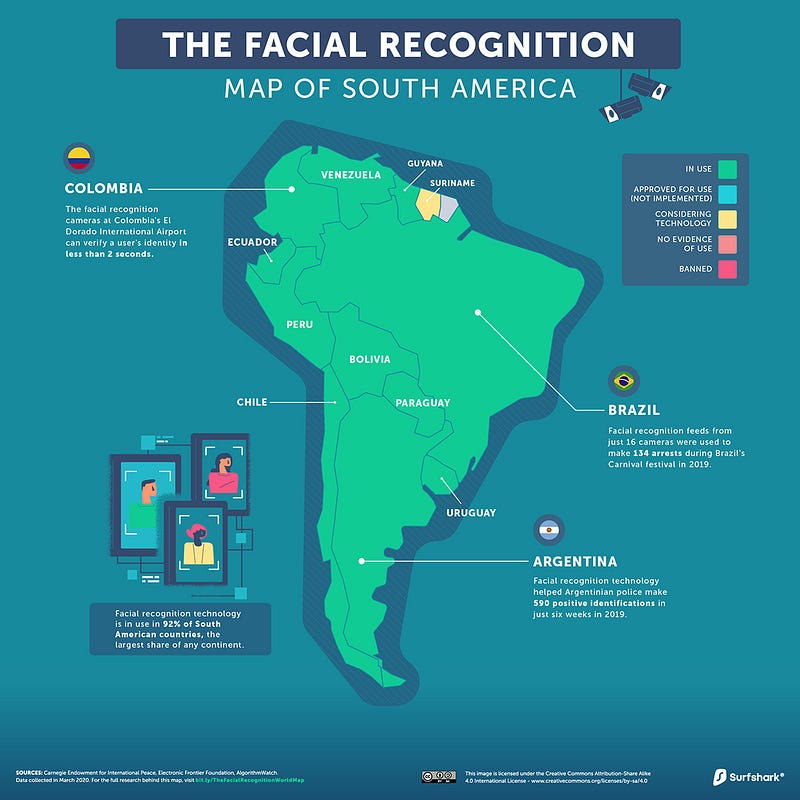
As evident from the information above, the most apparent use of facial recognition technology in Latin America is directed towards controlling crime — Brazil used it to capture Interpol’s second-most wanted criminal. Although dissenters argue it can be utilized to subdue political disagreement, 92% of the countries in the continent used the technology, the largest share of any continent.
East Asia and Oceania
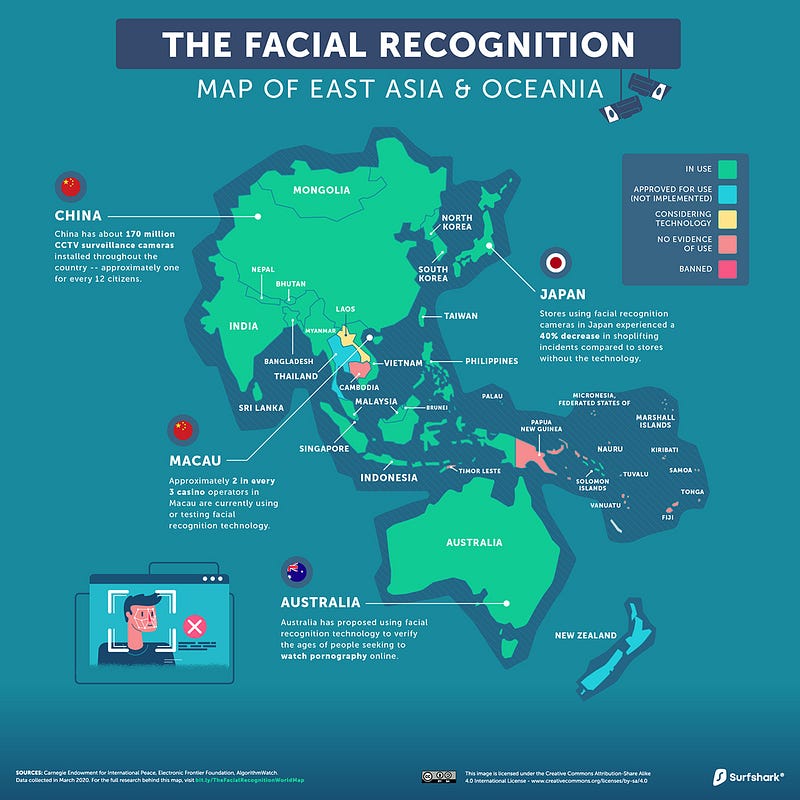
This region perhaps exhibits the most diverse use case of facial recognition technology. Coupled with biometric identification, it has been used as an effective tool to control the spread of the COVID-19 pandemic in countries like China, South Korea, Taiwan & Singapore.
China stands out in the world when it comes to using facial recognition — where an estimated 170 million surveillance cameras (CCTVs) or one for every 12 of its citizens, are watching their every moment. This number is expected to balloon to 570 million in the near future.
Africa
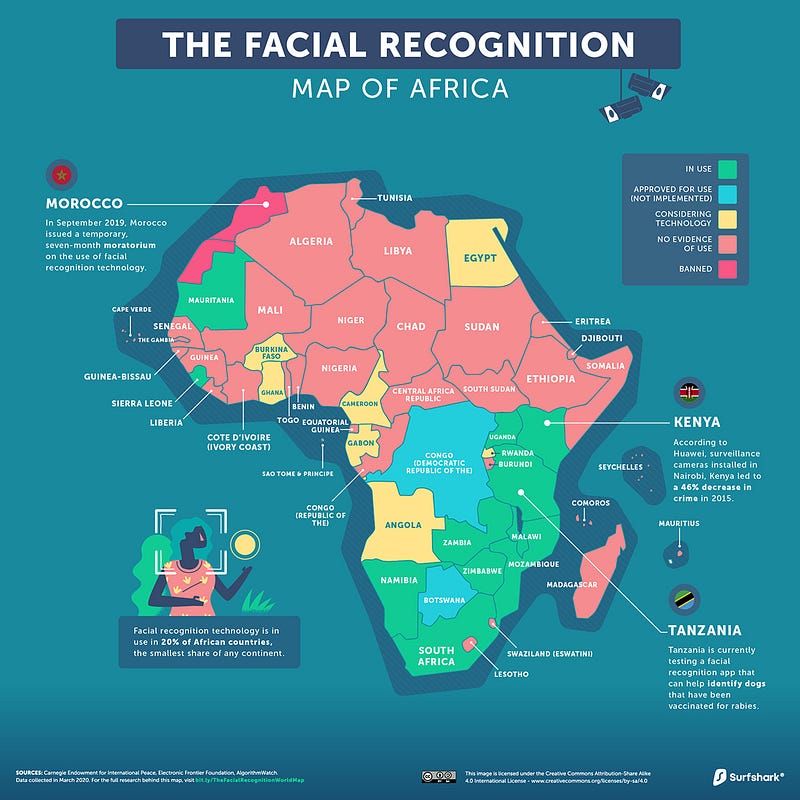
The least connected region in the World understandably has the lowest numbers of using the controversial technology — only 20% of the countries in the continent use it. However, this number might change very quickly in the future as Chinese companies aggressively invest in the tech infrastructure in the region. Surveillance cameras deployed in the Kenyan capital Nairobi has seen a 46% decline in crime rate since 2015.
Here is a summary of how facial recognition is being used in different countries. The methodology for the research is outlined here.
- In Use — 98 countries
- Approved, but not implemented — 12 countries
- Considering technology — 13 countries
- No evidence of use — 68 countries
- Banned — 3 countries
The data above clearly suggests that the majority of the countries in the world are using facial recognition technology in some form or the other. And despite strong reservations by certain sectors, the technology is here to stay.