
The increasing use of facial recognition by Law enforcement agencies
This little known AI startup is becoming a favorite of law enforcers around the world.
It was last year that the tech hub of San Francisco took the bold move of banning Facial Recognition by any of its 53 departments — in turn becoming the first city in the U.S to pass such a ban. Ever since that decision, many municipalities in the U.S have followed suit. This was a little strange considering Silicon Valley is much well-known to embrace technology than to regulate it or shun it completely like in this case.
But the move had some sound reasons behind it. Serious drawbacks were noted in the AI system being used to identify people — the algorithms employed turned out to be racially biased, especially when they attempted to identify women or people with darker tones, not to mention the invasive nature of the technology.
The European Commission is taking a tougher line on Artificial Intelligence (AI) than the United States, which would strengthen existing regulations on privacy and data rights, as reported by Reuters. According to a paper seen by the news agency, it suggests a temporary ban of five years on facial recognition to give enough time to EU regulators to address the abusive & nefarious use aspect of the futuristic technology.
Interestingly, the big techs are at opposite ends of the spectrum when it comes to such a ban. While Sunder Pichai, CEO of Google, agreed to employ a proportionate approach when drafting rules for the EU temporary ban, Microsoft is adamant that the only way to improve technology is to use it & then fix the problems.
Recently, the U.S published AI regulatory guidelines which included limiting authorities’ overreach, however, EU is taking a much aggressive & proactive approach as it did with the data regulations a couple of years ago. For now, though, despite the obvious flaws, which exhibit human bias, the intrusive technology continues to be used by law enforcement agencies around the World.
Despite the claim of U.S regulators that their recent AI framework would limit the authorities’ overreach, The New York Times recently reported that a tiny startup by the name of Clearview AI — a brainchild of an Australian techie, Ton-That, is helping law enforcement in multiple jurisdictions via its groundbreaking facial recognition app. Interestingly, the startup remained in obscurity until late 2019.
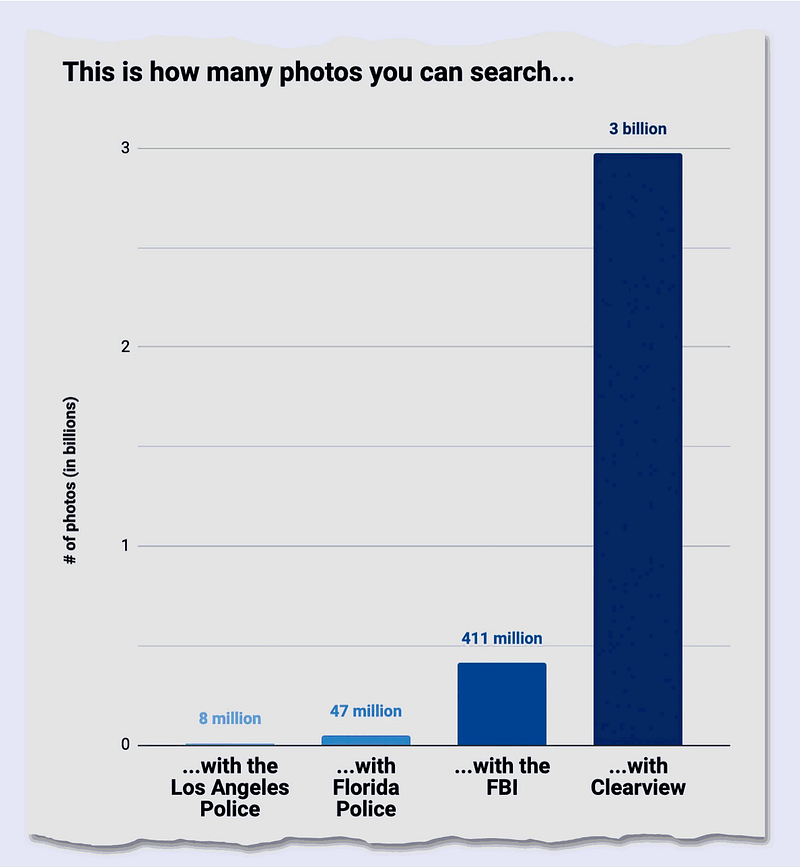
NYT analyzed system relies on a backbone database of more than three billion images scraped from Facebook, YouTube, Venmo and millions of other websites. The groundbreaking facial recognition app thus goes far beyond any other record searching database currently being used by any government department or in the private sector (chart above).
All you have to do is to take a picture of the person in question and upload it. In return, you get to see the public photos of that person, along with links to where those photos appeared. Federal and state law enforcement officers in the U.S who have been piloting this app have little knowledge of the black-box algorithm that is employed by the app but are happy with its success rate of resolving cases in the states of Florida, New Jersey & Indiana.
According to Clearview, more than 600 law enforcement agencies have started using its facial recognition system. The system which employs programming language coupled with AR glasses is freakishly accurate at identifying every person it sees — from their names to where they live, what they do & even their friends. As if this was not enough, Clearview has apparently also licensed its product to a few private companies for security purposes.
The company claims that its AI tool finds correct matches for up to 75% of the time. This, however, will need to be verified by an independent facial recognition algorithms agency like the National Institute of Standards and Technology. According to the company and government officials, Federal law enforcement, including the FBI, Department of Homeland Security & Canadian law enforcement authorities are trying this novel technology.
In related news, London Metropolitan Police has announced that it will be deploying live facial recognition cameras on the city streets to nab suspects involved in serious and violent crimes. The clearly signposted cameras will be live for 5–6 hours at a time and will target specific areas. This is a follow up to an early pilot in the city & deployment by South Wales Police.
The situation is even scarier in China if you are concerned with privacy — where an estimated 170 million surveillance cameras are expected to balloon to 570 million by 2021. This vast network of CCTVs is actively being used to monitor the 1.4 billion of its citizens whereby they are given social scores based on their behavior. And they are making no fuss about it.
Consumer advocacy groups & privacy campaigners are protesting the use of facial recognition technology on the pretext that it is inaccurate, pries on people’s private space & blatantly intrusive. Finding the right balance between the risks involved & curbing innovation would be the biggest challenge. While concerns grow around the controversial use of technology, law enforcement agencies don’t seem deterred. How do you feel about it?