
A new COVID-19 outbreak in China might point to a mutating Virus
The newly infected patients in the provinces Jilin and Heilongjiang appear to carry the virus for longer
The current pandemic has been truly a global event in every sense of the word. Countries like Russia and Brazil, who were doing relatively better earlier during the pandemic, are now seeing a worsening outbreak and top the list with the most number of infections behind the United States. However, China, where this pandemic originated remains the single point of interest for everyone.
China has received some scathing criticism from the U.S on not being transparent about the viral outbreak. President Trump has gone as far as saying that COVID-19 is a lab-produced infection by China & blamed WHO for believing China, before cutting off US aid to the organization. Although the World Health Organization (WHO) has been quick to dismiss the claim by the US President, it has certainly raised some eyebrows in the West.
President Xi of China, on the other hand, has said his country would increase funding to WHO for its vaccine efforts and encouraged other countries to do the same. He also reiterated that China’s virus vaccine would be “Global Public Good” when available.
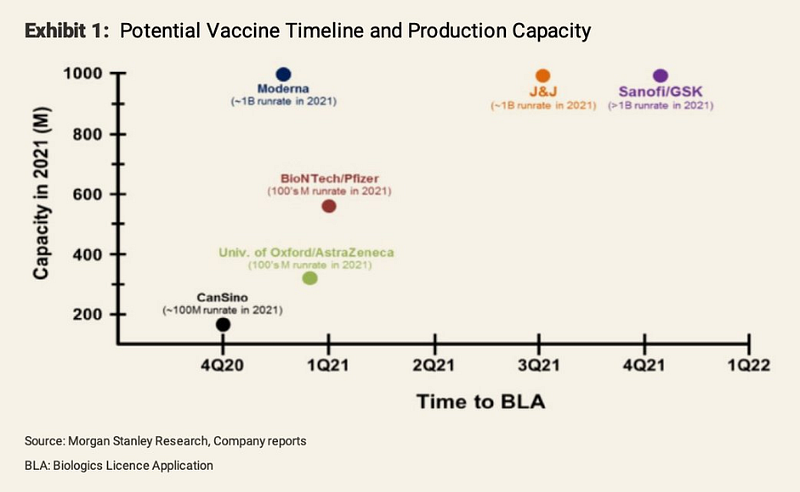
While the merits of this argument will continue to be debated for the months and years to come, the whole world is currently focused on getting the global economy back on track, which has been rattled by the prolonged lockdowns. Also, most of the energies are currently focused on controlling the pandemic and developing a vaccine as soon as possible. There are currently more than 100 different vaccine trials in different stages of testing. But some of them are ahead of the game than others (chart below).
“The longer period during which infected patients show no symptoms has created clusters of family infections.
Genetic sequencing has showed a match between the northeast cases and Russian-linked ones”
~ Qiu Haibo, One of China’s top critical care doctors
Most of these vaccines in development are based on the early virus genome shared by the scientists and based on the premise the SARS-COV2 (COVID-19) does not mutate much. Earlier results showed that the strain that affected the people in Europe and North America showed 4–10 different mutations, but they have certainly proved to be more contagious than the one we saw in China.
A recent study by researchers at the Los Alamos National Laboratory — LANL(New Mexico, U.S) along with scientists at Duke University and the University of Sheffield in England identified 14 different spike protein mutations that are accumulating in various strains. Although the preprint study (yet to be peer-reviewed) received pushback from various experts, a new outbreak of cases in China may be validating the claim.
As reported by Bloomberg, a new outbreak of the pandemic in the northern provinces of Jilin and Heilongjiang, the coronavirus is manifesting itself differently among the recently infected cluster of patients. Chinese doctors are observing that the symptoms are taking longer to emerge and the cases are getting longer to get resolved as well.
Apparently the patients are taking longer than the normal 1–2 weeks to develop symptoms. This delayed onset is making it difficult for the health authorities to catch such cases before they spread to others. 46 cases reported over the past two weeks across three cities of Shulan, Jilin city & Shengyang in the two provinces have sparked renewed lockdown measures over a region of 100 million people.
Other notable observations in this new outbreak show damage restricting mostly to the lungs, whereas patients at the origin in Wuhan suffered multi-organ damage across the heart, kidney, and gut — something also seen in cases in Europe & North America. Some experts still believe that many structural changes in the virus causing mutations lead to no discernible changes at all. They are still skeptical about the observations in China are related to a mutation, and that more direct evidence is needed.
Chinese officials believe that the new cluster infections in the northeast happened due to contact with infected arrivals from Russia, as proven by genetic sequencing, which shows a match.
Even if the virus has not mutated, this should be a lesson to all the countries that are getting impatient with the re-opening of their economies. There still seems so much more that we still don’t know about the virus, which can eventually hinder the efforts to control its spread. If China, which has one of the most comprehensive virus detection and testing regimes globally is struggling to get a handle on it, what makes other countries any different.
Opening economies too quickly could risk a second wave that could bring needless suffering and death. And with the earliest possible vaccine not slated to be mass-produced before Jan. 2021, will that be a prudent course of action?