
COVID-19 has an incubation period of 5.1 days, according to a novel study
This figure affirms earlier estimate and supports the 14-day quarantine period recommended by health authorities
Finding a cure for a disease or as in this case trying to slow down the spread of the COVID-19 pandemic, it is imperative that we understand it fully. Researchers, scientists & doctors around the world have been hard at work at understanding the mechanics behind the virus’s propagation, its composition, who is most at risk and what can be done to slow it down. Efforts for a possible vaccine are ongoing and will take anywhere between 12–18 months.
An earlier comprehensive Chinese study outlined the recovery & fatality rate among different age groups and determined which age group is the most vulnerable and why. As it turns out, the older you are the more susceptible you become. And people with pre-existing conditions are the most vulnerable. We also know that the most effective tool to control the spread is to exercise social distancing apart from following these prevention tips.

To add to this list, a novel study by Johns Hopkins Bloomberg School of Public Health has affirmed the previous estimate of COVID-19 having an incubation period of 5.1 days. The incubation period is basically the time period between the initial exposure to the viral organism to the time when symptoms appear. Incubation periods vary depending on the disease, for example, Influenza (1–3 days) and measles (9–12 days).
“Based on our analysis of publicly available data, the current recommendation of 14 days for active monitoring or quarantine is reasonable, although with that period some cases would be missed over the long-term.”
~ Justin Lessler, Study senior author
The study examined 181 confirmed cases of the coronavirus to reach the conclusion that the median incubation period of the disease was 5.1 days. It also confirmed that 97.5% of the patients infected with COVID-19 would develop symptoms within 11.5 days. One should not assume that the infected person is good after the median incubation period. The second number is much more important, which is why the health authorities have recommended a prudent 14-day quarantine period after a suspected exposure.
Senior author of the study, Justin Lessler points to the fact that there might be a small minority where the incubation period might even extend beyond the 14 days period. The same study concluded that the ratio of such cases would be about 1% or 101 out of 10,000 cases that would develop symptoms beyond 14 days. Extended monitoring might be needed for such patients. This might also be an important statistic to know for healthcare workers who are exposed to such patients without wearing protective equipment.
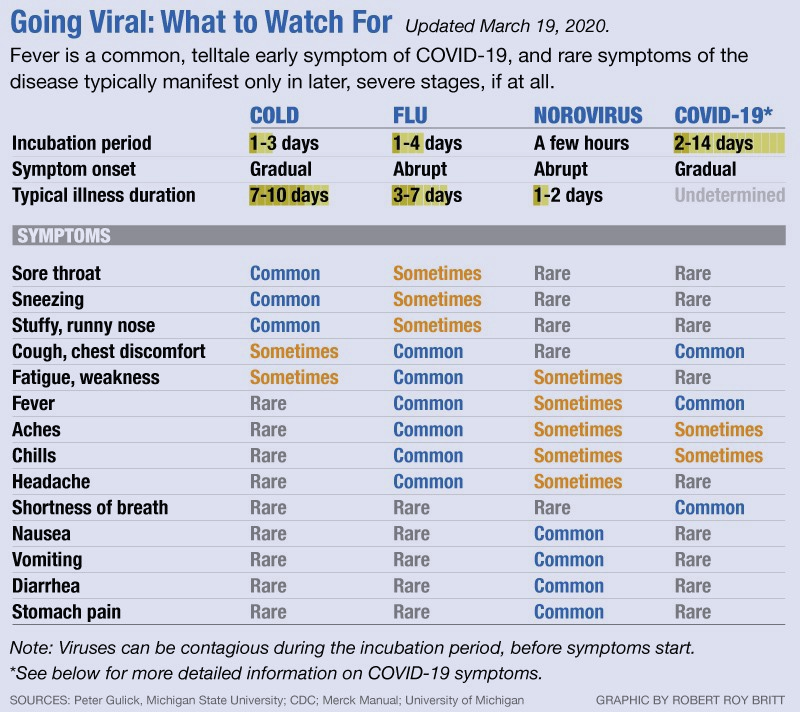
COVID-19 shares a similar median incubation period with its predecessor SARS. While the common cold, also caused by types of coronaviruses has an incubation period of 1–3 days (chart above). Important to know here that the disease’s incubation period is different from the period a person may be contagious.
Evidence in the new study suggested that the disease’s latent period is shorter than the incubation period. The latent period is the time from initial exposure to infectiousness. However, it is not known how contagious an infected person is during the incubation stage.
The research was published in the journal Annals of Internal Medicine.