
MEDIUM ARTICLE DESIGN & SEO DESCRIPTIONS
How Important Is Your Medium SEO Description?
Your Medium SEO Description is just as crucial to getting views and reads on your Medium story as a Meta Description Tag is to a website’s page description.
According to the Mythbusters Monday blog, “…a meta description is that grey text that is right underneath a link whenever you’re doing a Google Search.”
The same can be said about your Medium SEO description.
Some will infer it is unimportant because you only get paid when paid Medium members read your article. That’s only half true.
If someone finds your article and reads it, then joins Medium anytime within 30 days, you will get paid for their read time.
Plus, if someone is searching Google for the subject you wrote about and you write the Medium SEO Description properly, they will be shown your article on the search engine results page.
I have received more than one writing proposal because someone saw my article on Medium and decided I was a good match for their business —especially cryptocurrency.
In another article, I explained to my readers that I was approached to write an article for them and publish it on Medium. They paid me 120 USDT ( a crypto stablecoin called Tether), and it made $354 so far on Medium.
Suppose a colleague saw my story online but was too busy to read it. They remember it was about how to relax and unwind, so they go to Google and type in “Medium” and “relax and unwind.” These are the search engine results pages (SERP) that will come up:
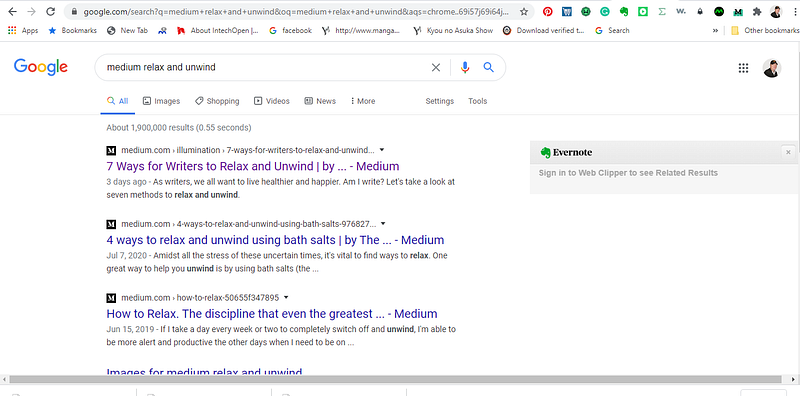
If they click on that first result, they will be taken to my story,
See how that works. It works almost exactly like that for a webpage meta description tag.
What if the searcher doesn’t even know about Medium, but they’re a writer looking for ways to relax and unwind? They might type “ways for writers to relax and unwind” into the Google search. Here’s what would happen:
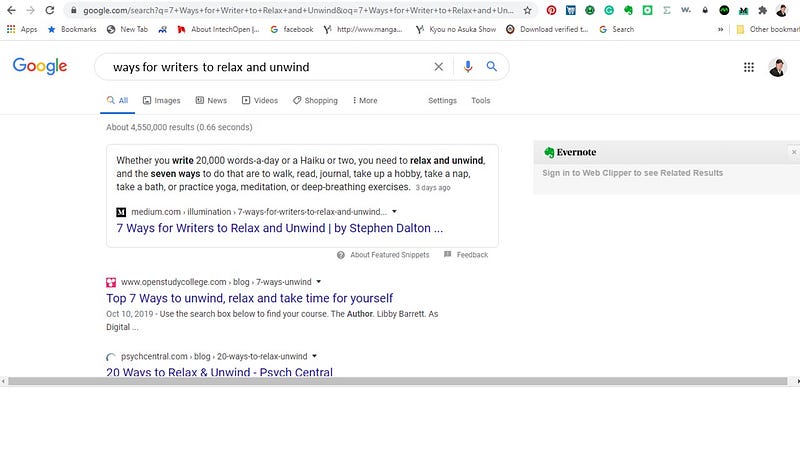
The SERP will give the searcher the entire SEO description or meta description tag you typed into Medium or your website.
In this case, it is 244 characters with spaces, “Whether you write 20,000 words-a-day or a Haiku or two, you need to relax and unwind, and the seven ways to do that are to walk, read, journal, take up a hobby, take a nap, take a bath, or practice yoga, meditation, or deep-breathing exercises.”
See how your matching search words are highlighted within the description.
Google says, “Search Engines will “bold” (or highlight) those terms in the search results when a user has performed a query with those terms.”
Many unfamiliar with setting up a webpage or creating copy for a website might not realize what a meta description tag is or its importance.
What are Meta Description Tags?
A meta description tag is typically between 120 and 160 characters with spaces.
According to the Moz article, Meta Description, “The meta description is an HTML attribute that provides a brief summary of a web page.”
The meta tag should be between 150 and 160 characters with spaces for your WordPress or Wix web page. But you want it long enough that it describes what your webpage or Medium story is about.
Since you never know which search engine the person searching will use, you should put the meat of your story within the first 160 characters so that no essential point of your story is truncated or cut off. Although, Medium’s optimum length appears to be around 180 characters with spaces.
Google, Yahoo, Bing, or whichever search engine is getting used will truncate more than their limit and put a read more prompt there.
It is vital to keep it short so that the searcher knows what your story or webpage is about without clicking to read more.
Website Meta Description Tags & Medium SEO Description
Are these the same? Technically, the Meta Description Tag and the SEO Description serve the same purpose.
The page's title might not give the web searcher or medium reader enough information to discern whether that article or story is what they are looking for.
Of course, that is why we use strong titles and subtitles. If you see a story on Medium titled, Where Is Your Head? You might believe that the story is about an invisible illness, only to find out it is an erotic story.
Somewhere between the subtitle and the SEO description, you should narrow down the story's subject.
However, Google states that “…neither Meta Descriptions nor Meta keywords factor into Google’s ranking algorithms for web search.”
Those are simply tools to hopefully send the searcher to the right place to find what they need.
Meta description tags and Medium SEO descriptions are essential in getting the searcher’s attention on the SERP. These are quick, “tweet” type blurbs, which tell the searcher what the page or Medium story is about.
Is what they are searching for within these pages or articles? When 5.8 billion searches of Google occur across the globe daily, it is essential that you use the best verbiage possible to describe your page or Medium story.
Easy Character Count in Word
To keep from counting the characters, highlight your phrase, click Review on the Word toolbar, then Word Count. Look for Characters (with spaces), and you will know how many characters your SEO description or meta tag contains.
Before publishing your Medium article, click on the three dots between your picture and Publish, then more settings, then scroll down to “SEO Description,” type in the description, and save.
To say that your SEO description or meta tag is a “window to the world” is a little overdramatic, but it is an excellent method of getting searchers to your work, either on your website or Medium.
Some will say that it is unimportant, or there is no proof that deliberately planning your meta tags or SEO descriptions will drive more traffic to your website or Medium story, but for the time it takes to do it, why risk it?
One last note: I’m not sure if it’s true on Medium, but on your website, do not use special characters like $ or % within your meta description, as that will cause Google to cut off the rest of the meta description.
References:
https://www.seoworks.com/the-importance-of-title-tags-and-meta-descriptions/
More of My Stories

Stephen Dalton is a retired US Army First Sergeant with a degree in journalism from the University of Maryland and a Certified US English Chicago Manual of Style Editor. Currently living in the Philippines, Stephen is a Top Writer in Virtual Reality.
You can see his portfolio here. Email [email protected]


