avatarStephen Dalton

Free AI web copilot to create summaries, insights and extended knowledge, download it at here

4838

Abstract

st match this clarity.</p><h2 id="c76a">The Second Deadly Sin of SEO: Incorrect configuration of the Content Management System (CMS) or website maintenance.</h2><p id="2d82">WordPress celebrated 16 years of existence this year, 2020. WordPress is the most widely used open-source (free) CMS on the planet with nearly 455 million users.</p><p id="b301">However, if you do not configure and maintain it properly, it may be slowed considerably. Non-optimized images, videos directly uploaded to your site, and conflicting plugins will cause it to lag opening.</p><p id="3d87">Optimize your images with <a href="http://www.jpegmini.com/"><b>JPEG Mini</b></a>, <a href="http://www.punypng.com/"><b>Puny Png</b></a><b>,</b> or another image optimizer before uploading. Avoid uploading videos directly to your site, use <a href="http://www.youtube.com/"><b>YouTube</b></a> or <a href="http://vimeo.com/"><b>Vimeo</b></a> instead, and embed it. When you directly upload a video to your site, every time someone shares or embeds that video you become the host.</p><p id="285d">This will drastically slow your load time, which you don’t want. The average searcher will wait two or three seconds before moving on to the next entry on the search engine results page (SERP).</p><h2 id="d13b">The Third Deadly Sin of SEO: Duplicate content is not that deadly!</h2><p id="864f"><b><i>“It’s important to realize that if you look at content on the web, something like 25 or 30 percent of all of the web’s content is duplicate content.”</i></b><a href="https://www.searchenginewatch.com/2013/12/17/googles-matt-cutts-a-little-duplicate-content-wont-hurt-your-rankings/"><b>Google’s Matt Cutts</b></a></p><p id="9fea">Edit, add to, and republish previous content to give yourself the “most bang for your buck.” Instead of writing new material, or hiring someone to write new content, re-use the content on your site that is still relevant.</p><p id="375a">When I, as a web content writer, regenerate articles, or blogs that I have published in the past, I check the links to ensure they are still good. Then, I read the comments to ensure I address any concerns or updates my readers have addressed.</p><p id="8852">When writing for the web, we cannot possibly keep up with every update or new release regarding what we have written.</p><p id="f3e2">An excellent article regarding duplicate content was written by Neil Patel on Kissmetrics, <a href="https://blog.kissmetrics.com/myths-about-duplicate-content/"><b><i>3 Myths About Duplicate Content</i></b></a>.</p><h2 id="23db">The Fourth Deadly Sin of SEO: Not utilizing Social Media to its fullest!</h2><p id="483c"><b><i>“52% of small businesses use social media to promote their businesses…” — <a href="https://smallbiztrends.com/2018/03/how-small-businesses-use-social-media-in-2018.html">Small Business Trends</a></i></b></p><p id="6cc3"><b><i>Yet, “Less than 20% of small and medium-sized business websites have a link to a Facebook page and fewer have links to Twitter and LinkedIn.”</i></b> <b><a href="https://smallbusiness.yahoo.com/advisor/resource-center/top-blogging-statistics-45-reasons-blog-180101993/">Yahoo! Small Business</a></b></p><p id="1d87">The notion that only a little more than half of all small businesses are using social media seems like a waste of a valuable asset. There are approximately 3 billion people using Facebook and billions more using YouTube, LinkedIn, Twitter, Pinterest, and others.</p><p id="b996">Why wouldn’t a small business owner tap into that market to promote their business? Most of these platforms allow free advertising, while others charge a small amount to boost your post to reach tens of thousands of local users. At the very least, you should have a matching <a href="https://www.facebook.com/business/learn/set-up-facebook-page"><b>Facebook Business Page</b></a> linked to your website.</p><h2 id="912c">The Fifth Deadly Sin of SEO: Not investing enough time or money in SEO.</h2><p id="190f"><b><i>“Ninety-one percent of US internet users search every month. 3.5 Billion Google searches are made every single day!”</i></b><a href="https://www.wordstream.com/blog/ws/2019/02/07/google-search-statistics"><b>Word Stream</b></a></p><p id="7d77"><b><i>“75% of users never scroll past the first page of search results.”</i></b><a href="https://www.forbes.com/sites/ajagrawal/2017/08/30/how-to-optimize-your-seo-results-through-content-creation/#2e56e9272aa3"><b>Forbes</b></a></p><p id="946c">You should be writing SEO infused articles and blogs for your website frequently. I would say at least one per week. When you consider the facts above, there is no better Return-On-Investment (ROI) than well-written content that keeps a reader on your site long enough to answer your call-to-action (CTA).</p><p id="99a5">If you are not a proli

Options

fic writer, you should hire someone to write content for you and concentrate your efforts on the business.</p><p id="3939">Writing articles and blogs that promote your business with relevant keywords and keyword phrases, along with a fully-optimized website will eventually get you into the top five of search engine results.</p><p id="e5c4">What’s more, you should use local SEO. Local SEO uses names of town, cities, and famous landmarks to help Google narrow a searcher’s request when they ask, a question containing “near me”.</p><h2 id="aa4e">The Sixth Deadly Sin of SEO: Ignoring the Potential of Blogging.</h2><p id="15a4"><b><i>“Companies that blog have 97% more inbound links.”</i></b> & <b><i>“Study Shows Business Blogging Leads to 55% More Website Visitors”</i></b><a href="https://www.ontargetagency.com/ask-on-target/hubspot-study-shows-blogging-leads-to-55-more-traffic"><b>Hubspot</b></a></p><p id="a6a5">Inbound links and site visitors are the exact reason for maintaining a website for your business. In order to get people to visit your site, you need relevant content that attracts readers. Although writing a blog about your business seems like too much work, it is perhaps the cheapest form of advertising you can devote your time or money to get results.</p><h2 id="657f">The Seventh Deadly Sin of SEO: Not focusing on the user.</h2><p id="c2c4"><b><i>“The most active demographic group for blogging is 21-to-35-year-olds, with 53.3% of the blogging population.”</i></b><a href="https://www.sysomos.com/reports/blogger-demographics"><b>Sysomos</b></a></p><p id="079a">Although this survey points to the largest group of users for blogging as the 21 to 35-year old age group, it is always wise to speak to the people you believe to be the most interested in your product. If you sell adult diapers, for instance, that age group would definitely not be the right age group.</p><p id="f8a7">Consciously avoid the seven deadly sins and seek instead the pearl that is SEO.</p><h2 id="4f8b">References:</h2><p id="22c0"><a href="http://searchenginewatch.com/sew/news/2200730/organic-vs-paid-search-results-organic-wins-94-of-time">http://searchenginewatch.com/sew/news/2200730/organic-vs-paid-search-results-organic-wins-94-of-time</a></p><p id="18b3"><a href="http://searchenginewatch.com/sew/news/2319706/googles-matt-cutts-a-little-duplicate-content-wont-hurt-your-rankings">http://searchenginewatch.com/sew/news/2319706/googles-matt-cutts-a-little-duplicate-content-wont-hurt-your-rankings</a></p><p id="4975"><a href="http://www.biakelsey.com/Company/Press-Releases/120416-Less-Than-20-Percent-of-SMB-Websites-Link-to-Social-Presence,-According-to-SMB-DigitalScape.asp">http://www.biakelsey.com/Company/Press-Releases/120416-Less-Than-20-Percent-of-SMB-Websites-Link-to-Social-Presence,-According-to-SMB-DigitalScape.asp</a></p><p id="fc43"><a href="http://www.puredriven.com/SEO">www.puredriven.com/SEO</a></p><p id="65b8"><a href="http://www.searchenginejournal.com/24-eye-popping-seo-statistics/42665/">http://www.searchenginejournal.com/24-eye-popping-seo-statistics/42665/</a></p><p id="a792"><a href="http://blog.hubspot.com/blog/tabid/6307/bid/5014/Study-Shows-Business-Blogging-Leads-to-55-more-Website-Visitors.aspx">http://blog.hubspot.com/blog/tabid/6307/bid/5014/Study-Shows-Business-Blogging-Leads-to-55-more-Website-Visitors.aspx</a></p><p id="2226"><a href="https://www.sysomos.com/reports/blogger-demographics">https://www.sysomos.com/reports/blogger-demographics</a></p><p id="3c9a"><b>Note:</b> This post contains affiliate links. Read my <a href="https://readmedium.com/my-affiliate-marketing-disclosure-statement-a75847622c25">disclosure statement</a> for additional information. “As an Amazon Associate, I earn from qualifying purchases.”</p><figure id="098f"><img src="https://cdn-images-1.readmedium.com/v2/resize:fit:800/1*0Iyn9x0x_kQ1CKLoYleHWg.png"><figcaption>About the Author Photo by Jean Springs from Pexels</figcaption></figure><p id="9017">Stephen Dalton is a retired US Army First Sergeant with a degree in journalism from the University of Maryland and a Certified US English Chicago Manual of Style Editor. Currently living in the Philippines, Stephen is a Top Writer in Virtual Reality.</p><p id="d11c">You can see his portfolio <a href="https://thewriteresults.contently.com/">here</a>. Email <a href="mailto:[email protected]">[email protected]</a></p><p id="554f"><a href="https://the-write-results.info/book-reviews/"><b>Website</b></a> | <a href="https://www.facebook.com/rosalyn.escobido/"><b>Facebook</b></a> | <a href="https://twitter.com/daltonspatriots"><b>Twitter </b></a>| <a href="https://www.instagram.com/daltonspatriots/"><b>Instagram</b></a> | <a href="https://www.reddit.com/user/TheWriteResults/"><b>Reddit</b></a></p></article></body>

HOW TO USE SEO ON YOUR WEBSITE

How to Avoid SEO’s “Seven Deadly Sins”

Search engine optimization (SEO) in your web content is crucial to getting readers or customers to your website through organic search. What are SEO’s seven deadly sins?
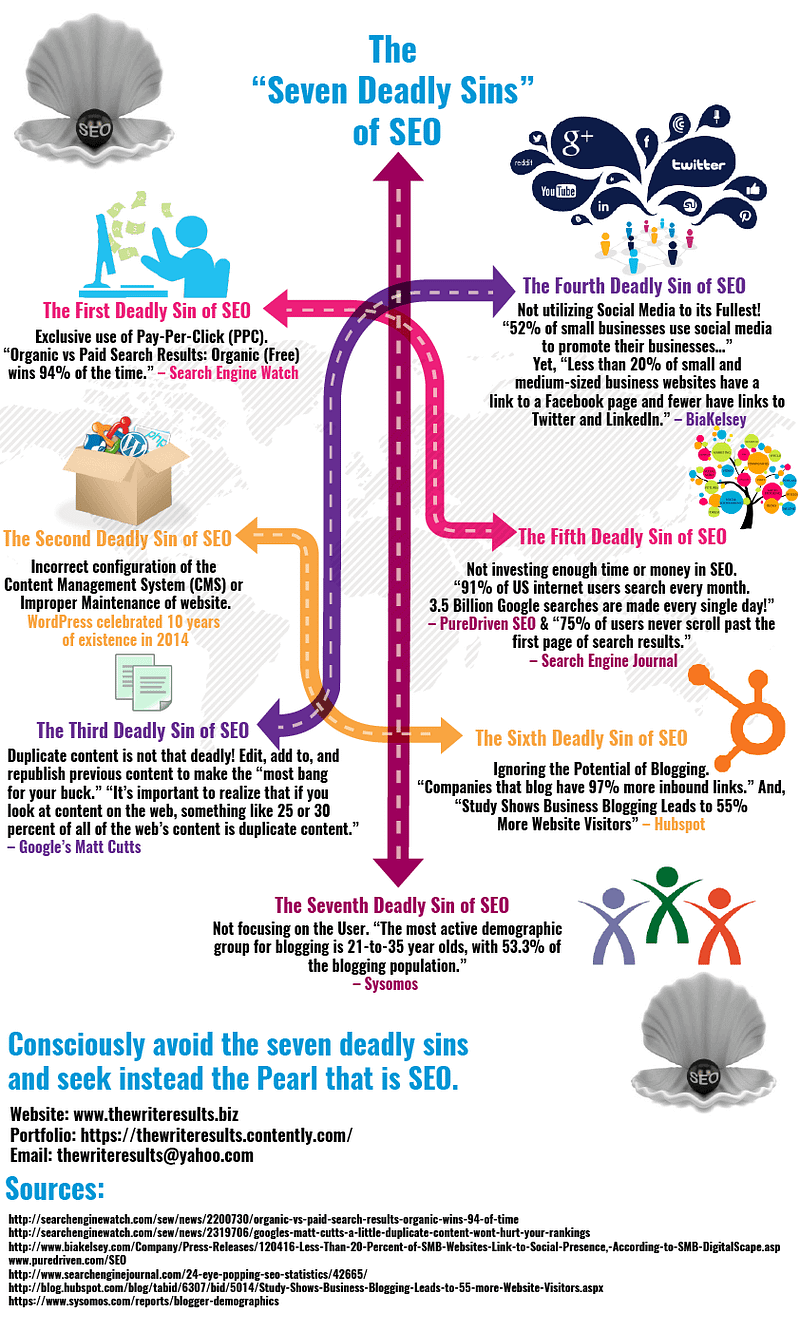
SEO Seven Deadly Sins Infographic Created by the Author

What is crucial is that you write meaningful, quality content for your potential customers to read.

However, some things are more important to share with your readers than others. Relying too much on one over another will not kill your website. Except when you steal other people’s work and claim it as your own.

I will talk about duplicate content later and how that is not really as dangerous as many people fear. And there are methods to ensure what you share on your website, which you have already shared elsewhere like on Medium, Facebook, or Vocal or other social media platforms. These are “canonical tags.”

According to Moz, “Using the canonical tag prevents problems caused by identical or “duplicate” content appearing on multiple URLs.” I will refrain from trying to explain to you how to tag your articles to prevent problems and say if you are publishing your work in a second location, read this article by Moz.

Also, when you are adding an article to Medium that you have on your blog, you may wish to use the import tool. According to Medium publication guidelines, “By using Medium’s official import tools, you can reap the benefits of high discoverability on Medium while still crediting all authority towards your own blog using Medium’s canonical URLs.”

Therefore, you can use Medium’s domain authority and quality backlink status to pull your blog’s PageRank up.

Well, enough about all that and let’s get into the “Seven Deadly Sins” of SEO on your website.

The First of SEO’s Seven Deadly Sins: Exclusive use of Pay-Per-Click (PPC). SEO versus AdWords.

“Organic vs Paid Search Results: Organic (Free) wins 94% of the time.”Search Engine Watch

Many small business owners are enamored with Google’s AdWords. Why wouldn’t they want to use a marketing strategy that includes a system of advertising where you directly target those interested in your product or service?

Although it makes sense to use advertising that is initially free and you only pay when it is used, the wise business owner uses a balanced strategy that makes use of both PPC and organic search results to get their business noticed.

Now, you might be asking yourself, what is organic search? Organic search is what you type into Google, Bing, or Yahoo! What comes back is known as the search engine results page (SERP). Those results you see with the word Ad in a little box are PPC.

When you click on a SERP entry that is PPC, it costs the owner. They are hoping that you will buy so that they will make their money back.

When you use a marketing strategy that places too much faith in a system that gets results only six percent of the time, you are losing out on a significant audience of prospective customers.
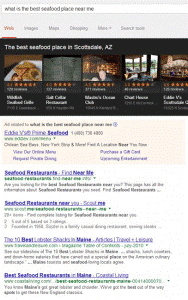
“Best Seafood Place Near Me” search result Google

A good web content writer makes the most of your advertising budget. When you pay a web content writer to produce rich content by writing on topics that promote your business using relevant keywords, keyword phrases, focus keywords, synonyms, and surrounding text that proves your site is selling what the searcher needs. Google’s Hummingbird algorithm uses all those factors to determine where your page ranks on search engine results.

Consider the article written by Hardik Sondagar for Quora, How does the Hummingbird algorithm work? His illustration was one of the best I have seen.

Notice how the algorithm correctly surmises the searcher is looking for a seafood restaurant in the first two search results but incorrectly surmises that “me” is the state abbreviation for Maine. That is how comprehensive the algorithm is. Your writing must match this clarity.

The Second Deadly Sin of SEO: Incorrect configuration of the Content Management System (CMS) or website maintenance.

WordPress celebrated 16 years of existence this year, 2020. WordPress is the most widely used open-source (free) CMS on the planet with nearly 455 million users.

However, if you do not configure and maintain it properly, it may be slowed considerably. Non-optimized images, videos directly uploaded to your site, and conflicting plugins will cause it to lag opening.

Optimize your images with JPEG Mini, Puny Png, or another image optimizer before uploading. Avoid uploading videos directly to your site, use YouTube or Vimeo instead, and embed it. When you directly upload a video to your site, every time someone shares or embeds that video you become the host.

This will drastically slow your load time, which you don’t want. The average searcher will wait two or three seconds before moving on to the next entry on the search engine results page (SERP).

The Third Deadly Sin of SEO: Duplicate content is not that deadly!

“It’s important to realize that if you look at content on the web, something like 25 or 30 percent of all of the web’s content is duplicate content.”Google’s Matt Cutts

Edit, add to, and republish previous content to give yourself the “most bang for your buck.” Instead of writing new material, or hiring someone to write new content, re-use the content on your site that is still relevant.

When I, as a web content writer, regenerate articles, or blogs that I have published in the past, I check the links to ensure they are still good. Then, I read the comments to ensure I address any concerns or updates my readers have addressed.

When writing for the web, we cannot possibly keep up with every update or new release regarding what we have written.

An excellent article regarding duplicate content was written by Neil Patel on Kissmetrics, 3 Myths About Duplicate Content.

The Fourth Deadly Sin of SEO: Not utilizing Social Media to its fullest!

“52% of small businesses use social media to promote their businesses…” — Small Business Trends

Yet, “Less than 20% of small and medium-sized business websites have a link to a Facebook page and fewer have links to Twitter and LinkedIn.” Yahoo! Small Business

The notion that only a little more than half of all small businesses are using social media seems like a waste of a valuable asset. There are approximately 3 billion people using Facebook and billions more using YouTube, LinkedIn, Twitter, Pinterest, and others.

Why wouldn’t a small business owner tap into that market to promote their business? Most of these platforms allow free advertising, while others charge a small amount to boost your post to reach tens of thousands of local users. At the very least, you should have a matching Facebook Business Page linked to your website.

The Fifth Deadly Sin of SEO: Not investing enough time or money in SEO.

“Ninety-one percent of US internet users search every month. 3.5 Billion Google searches are made every single day!”Word Stream

“75% of users never scroll past the first page of search results.”Forbes

You should be writing SEO infused articles and blogs for your website frequently. I would say at least one per week. When you consider the facts above, there is no better Return-On-Investment (ROI) than well-written content that keeps a reader on your site long enough to answer your call-to-action (CTA).

If you are not a prolific writer, you should hire someone to write content for you and concentrate your efforts on the business.

Writing articles and blogs that promote your business with relevant keywords and keyword phrases, along with a fully-optimized website will eventually get you into the top five of search engine results.

What’s more, you should use local SEO. Local SEO uses names of town, cities, and famous landmarks to help Google narrow a searcher’s request when they ask, a question containing “near me”.

The Sixth Deadly Sin of SEO: Ignoring the Potential of Blogging.

“Companies that blog have 97% more inbound links.” & “Study Shows Business Blogging Leads to 55% More Website Visitors”Hubspot

Inbound links and site visitors are the exact reason for maintaining a website for your business. In order to get people to visit your site, you need relevant content that attracts readers. Although writing a blog about your business seems like too much work, it is perhaps the cheapest form of advertising you can devote your time or money to get results.

The Seventh Deadly Sin of SEO: Not focusing on the user.

“The most active demographic group for blogging is 21-to-35-year-olds, with 53.3% of the blogging population.”Sysomos

Although this survey points to the largest group of users for blogging as the 21 to 35-year old age group, it is always wise to speak to the people you believe to be the most interested in your product. If you sell adult diapers, for instance, that age group would definitely not be the right age group.

Consciously avoid the seven deadly sins and seek instead the pearl that is SEO.

References:

http://searchenginewatch.com/sew/news/2200730/organic-vs-paid-search-results-organic-wins-94-of-time

http://searchenginewatch.com/sew/news/2319706/googles-matt-cutts-a-little-duplicate-content-wont-hurt-your-rankings

http://www.biakelsey.com/Company/Press-Releases/120416-Less-Than-20-Percent-of-SMB-Websites-Link-to-Social-Presence,-According-to-SMB-DigitalScape.asp

www.puredriven.com/SEO

http://www.searchenginejournal.com/24-eye-popping-seo-statistics/42665/

http://blog.hubspot.com/blog/tabid/6307/bid/5014/Study-Shows-Business-Blogging-Leads-to-55-more-Website-Visitors.aspx

https://www.sysomos.com/reports/blogger-demographics

Note: This post contains affiliate links. Read my disclosure statement for additional information. “As an Amazon Associate, I earn from qualifying purchases.”

About the Author Photo by Jean Springs from Pexels

Stephen Dalton is a retired US Army First Sergeant with a degree in journalism from the University of Maryland and a Certified US English Chicago Manual of Style Editor. Currently living in the Philippines, Stephen is a Top Writer in Virtual Reality.

You can see his portfolio here. Email [email protected]

Website | Facebook | Twitter | Instagram | Reddit

Design
Creativity
Writing
SEO
Blogging
Recommended from ReadMedium