
How I Made $5,608 Last Month With Just 3 Activity Books
Here’s the breakdown.

When I first got into publishing a few years ago, “no content” books like journals and notebooks were all the rage.
There were people uploading dozens (sometimes hundreds) of these “books” each day via Amazon’s self-publishing platform (KDP), hoping that a few of them would make sales.
This is like playing the lottery — you have no control over the end result. All you can do is keep buying tickets.
The problem is that this strategy did work for a few people in the beginning.
They made some cash and then created courses claiming to show other people how to cash in like they did (three years prior.)
These courses sold like wildfire because there was very little skill required to make these notebooks.
Anyone with access to Canva could create one of these “books” in 15 minutes or less.
Eventually, Amazon became flooded with so many notebooks that this method no longer worked for the people who were merely shooting blind into the abyss of the Amazon algorithm.
Honestly, this never appealed to me because it seemed like WAY too much work.
My personal philosophy is “work smarter, not harder.”
Why would I waste months cranking out thousands of notebooks in exchange for pennies when I could earn the equivalent of a full-time income with say, 3–5 books?
Last month, my top 3 activity books alone generated $5,608 in royalties (net profit, not gross sales.)
This isn’t surprising to me because I reverse-engineered these results rather than relying on “luck.”
Here’s how —
1. Know Your Numbers
What does it take to make $5600 with just three books?
For this, we need to know our average royalty per sale. This is the profit you make after Amazon takes its cut.
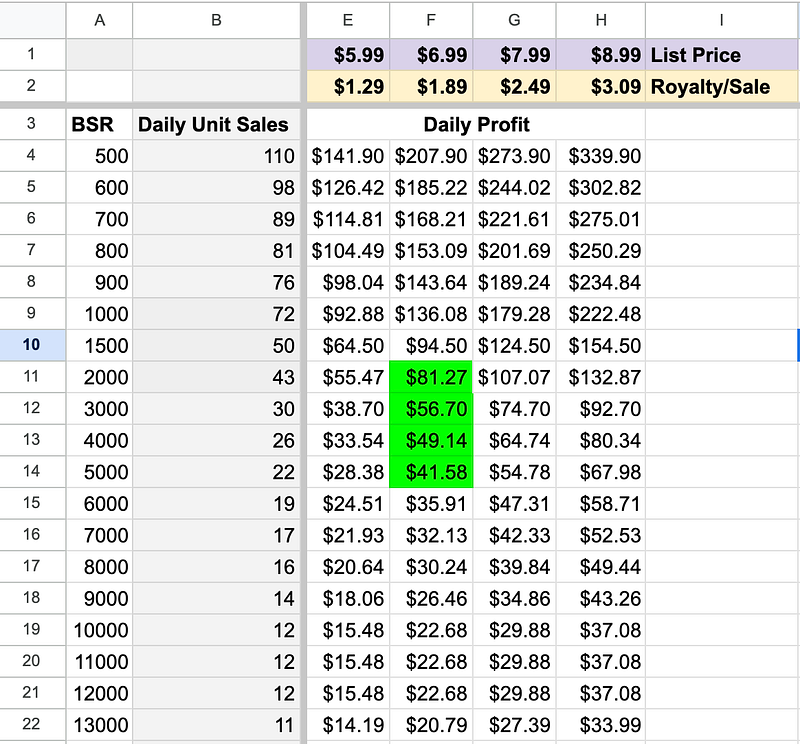
I made this handy little grid for my own reference for a standard 6x9 inch paperback with about 110 pages.
I made one of these for every size and page range I publish in.
Let’s play with some numbers…
A 6x9 paperback priced at $6.99 would produce a royalty of $1.89 per sale.
If you want to make $5600 per month, you’d need to generate $186 per day — which, spread across three books, is an average of $62 per book per day.
Which works out to an average of 33 copies per book.
(33 copies x 3 books) x $1.89 royalty = $187/day
That means, your three books need to have a BSR that consistently lives between 5000–2000.
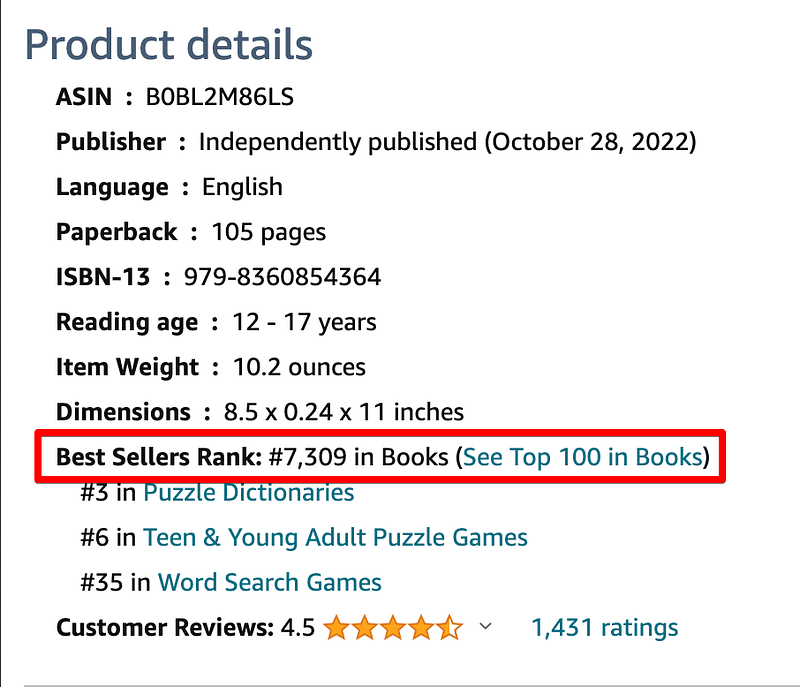
BSR = Amazon’s “best seller rank.” This number is listed at the bottom of every product page. The lower the number, the better.
Now that we know what numbers we’re working with, we need to find a niche that is capable of supporting our goal.
2. Where is this BSR range possible?
If you have experience with self-publishing, you might think a BSR of 2000–5000 is unattainable. But chances are, you may have been publishing in a niche that was unable to support this volume of sales.
That’s not your fault — it’s not something most people consider when they set out to write a book.
Every niche is different.
This is why I’ve been focusing heavily on activity books for adults, seniors, teens, and kids.
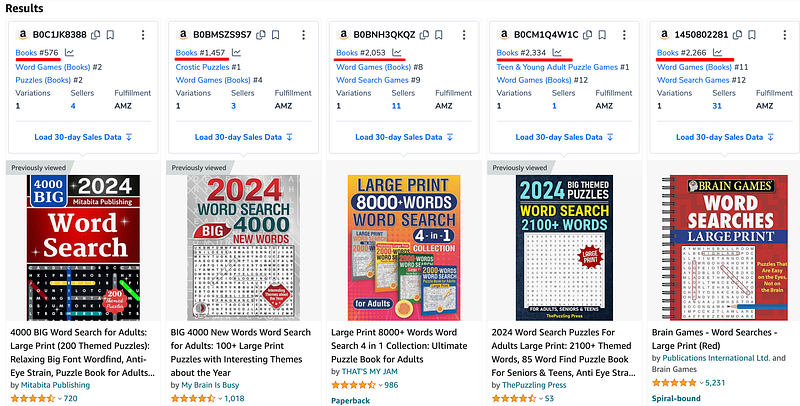
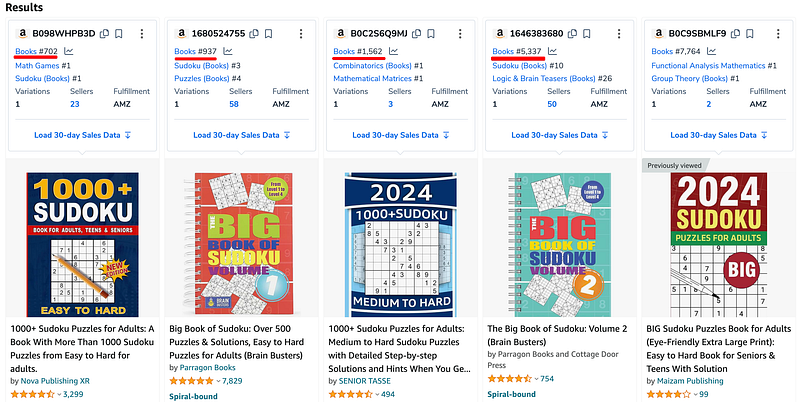
These niches have many books that are selling in the 500–5000 BSR range.
This is a tier often occupied by well-known authors and celebrity biographies — but we can also get there with word searches, lol!
Here are some examples —
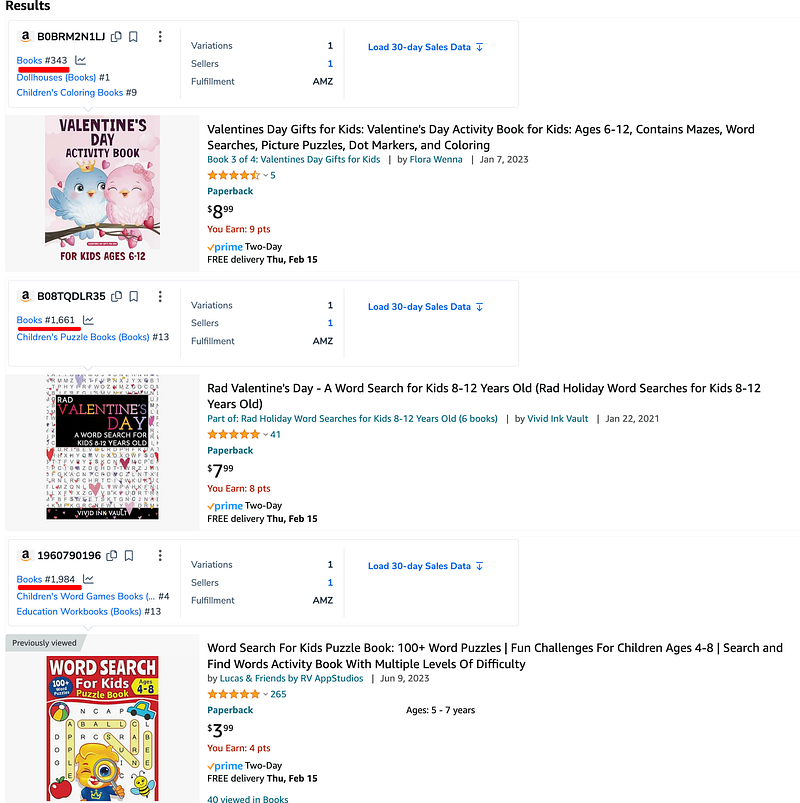
I could go on and on...
What most people don’t realize is that these types of books sell thousands of copies per day, and they are incredibly easy to make.
I use a low-cost tool called Bookbolt to create puzzle books like these.
However, simply throwing a word search book up on KDP probably won’t get you to the target BSR range of 2000–5000.
There are a few more steps…
3. High Volume Keywords
When customers go to Amazon to find a product, they start by entering a keyword or phrase into the search bar.
Some keywords are searched thousands of times per day, while others aren’t searched for at all.
One of the big keys to succeeding here is to find relevant keywords that get a lot of searches per day and then put them in your books:
- title,
- description,
- A+ content, and
- backend keywords (inside KDP.)
This tells the Amazon algorithm when to show your book to customers based on what they search for.
Showing your book to 10,000 customers a day will always result in more sales than showing it to 25 people.
This is why keywords matter.
If you don’t know how many people are searching for the keywords you put in your title/subtitle and description, YOU ARE FLYING BLIND.
There are many strategies out there for doing this kind of research.
Personally, I use Helium 10 to find the best keywords in my niche.
They have a free plan if you want to test it out.
Or, if you want to upgrade to get all the features I use, you can save 20% using my referral link here.
I wrote a detailed Helium 10 keyword research tutorial here.
Targeting the right keywords (with the highest sales volume) will give you a huge advantage over your competitors — most of which, are NOT doing this type of research.
THIS is the main reason why I’ve been able to get above average results with my books so quickly.
Okay, we’ve got our keywords — just two steps left to go!
4. Cover
The interiors of activity books are pretty standard.
If you use a tool like BookBolt to create your puzzle and solution pages, you’re good to go.
Your interior will NOT really give you much of a competitive edge.
However, your cover DOES matter.
It must match the quality and “vibe” of the other best-selling books in the niche.
For this, I type my main keyword into Amazon and look at the top 3–5 books (that are NOT ads.)
Then, I do my best to create a cover that “fits in” with these best-selling books.
This does NOT mean “copy.”
If you just “copy” the cover of another book, yours will not stand out.
You want your book to “fit in” but also stand out.
I create my own covers, but if you’re not confident in your cover design skills (and don’t wish to learn), you can outsource this via Fiverr, Upwork, 99 Designs, or find an independent cover designer to work with.
Your cover will make or break your sales — don’t skimp here.
One step left…
5. Amazon Ads
The brutal reality of selling on Amazon is that you will likely need to use their ad system to jump-start your sales.
One of the big “ranking” factors on Amazon is how many sales your book has made recently.
The more sales your book makes, the better your BSR gets, and the more keywords you’ll be ranked for organically.
Basically, if you want to make sales without ads, you need to prove to Amazon that people actually want to buy your book.
If you’re just getting started with Amazon ads, I recommend using their “auto” ad option.
Auto ads are easy to set up, and they work well because Amazon knows best when it comes to showing your book to people who will most likely buy it.
I also run “phrase” and “exact” match ads for my target keywords (from step 3 above) — this helps me rank for these keywords faster.
Typically, I’m more aggressive with my ad spend in the first week or two after a new book is published.
Once the book starts to move up in rank, I pull back on ads and allow organic sales to take over.
If the book starts to slip, I can always add a little more “ad juice” to give it another push.
However, if it looks like the book just isn’t going to make it to the top, I stop the ads, assess why it’s not performing, and try again with a new book.
That’s it!
Note: This isn’t just for activity books — that just happens to be what I’m focusing on at the moment.
You can use these steps to create profitable books for almost any niche on Amazon, Barnes & Noble, Audible, Google Play, and more.
Recap
- Choose an income goal and calculate out how many copies you’ll need to sell per day and what BSR range you need to hit to make that a reality.
- Search Amazon to find a niche that has books in your target BSR range.
- Find the highest volume keywords for the niche and include them in your title, subtitle, description, A+ content, and backend keywords (in KDP).
- Create (or commission) a cover that can compete with the top 3–5 ranked books for your primary keyword.
- Use Amazon ads to push your book up the rankings.
Collect your royalties!
- Wash, rinse, repeat.
I’m currently working on a personal challenge to grow my one-person publishing business to $25,000/month by the end of 2024.
Right now, I’m about 43% of the way there.
If you’re interested in doing something similar, you can find more information here:
This article contains my referral links for Helium 10 and BookBolt, which, along with the Jasper AI writing assistant, are some of my absolute favorite tools for “profit publishing.”


