
How Foreigners from East Asia Experience Japan Differently
Some things are definitely less exotic for an East Asian
A couple of weeks ago, I took part in a Clubhouse discussion hosted by Maya Matsuoka and Timothy Sullivan with the provocative and slightly tongue-in-cheek title — “Does an Asian experience Japan differently?”
There are many who, coming from outside of the East Asian sphere — usually from the Occident — find Japan a crazy bag of weirdness and exoticness.
How much of it is down to the exoticization and fetishization of the Orient?
After all, Oscar Wilde has written before that Japan does not exist.
Before I discuss my take on this question — two caveats. As an ethnic Chinese-Singaporean living in Japan, my observations might not be generalizable to the experience of every person with East Asian heritage living in Japan.
Although Singapore is technically a part of Southeast Asia, the population is predominantly ethnic Chinese. I have never lived in China, and obviously, Singapore isn’t 100% East Asia. But I think it’s close enough for me to make these comparisons.
Chinese characters — same same, but different
Let’s start with the obvious. Chinese characters — the hated yet equally fascinating kanji characters that deter so many people from learning the Japanese language.
Of course, just knowing kanji alone is insufficient to read and write Japanese. One needs to be able to understand hiragana and katakana to be able to write real Japanese.
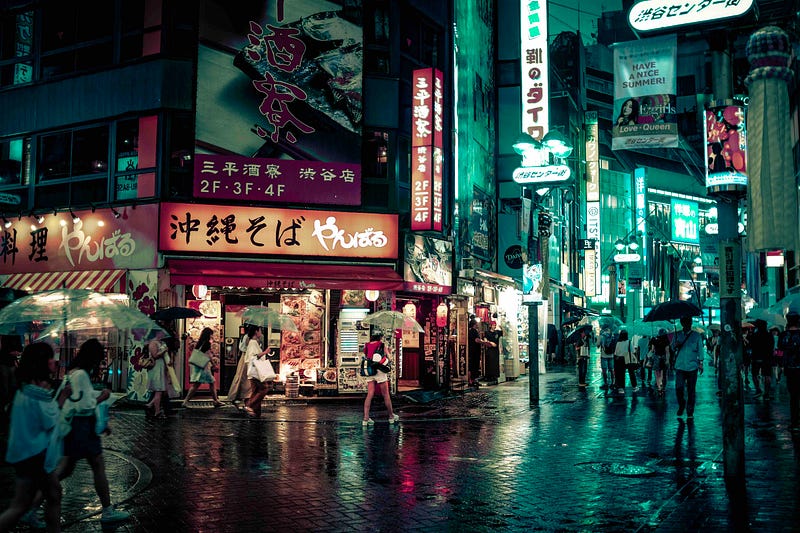
Still, kanji make up a large part of the Japanese language. And since the origin of kanji is — surprise — Chinese, anyone with at least a rudimentary background in Chinese will not find Chinese characters in Japanese too strange.
I grew up studying Chinese — the simplified form used in Mainland China (which is different from the traditional form used in Hong Kong and Taiwan).
We were forced to memorize thousands of Chinese characters. And I was not particularly good at it. The way Chinese was taught in school was based on rote learning, and I hated it.
I failed my Chinese examination during my graduating year in the Singaporean equivalent of middle school.
Still, that knowledge helped me when I started studying Japanese more than a decade ago. I got lucky. The most difficult part — the psychological obstacle to overcome reading what probably looks like hieroglyphics to others wasn’t there for me.
Sure, there are some differences.
The kanji written in Japan is slightly different. There are “made-in-Japan” kanji. Both Chinese and Japanese have simplified Chinese characters, but sometimes in very different ways. Take for example the word “music”:
- Traditional Chinese: 音樂
- Japanese: 音楽
- Simplified Chinese: 音乐
Also, in Japanese, the same Chinese character can be pronounced differently depending on the context. And then their pronunciation changes when you mix them up in different ways — and not always in very standard ways.
And this is probably inconsequential for most people — but even some stroke orders are different (who cares, right?)
Wait — there’s more. There are random kanji thrown together only for their sound, the so-called ateji.
Ok, so there are new tricks and new ways to write, think, and read kanji.
The slightly tricky part is to unlearn what we think we already know about Chinese characters.
But writing Chinese characters is not something difficult at all for me — even if I cannot write them from memory most of the time. Still, I find it odd when foreigners mention that they’ve lived in Japan for decades without even knowing how to write their addresses in Japanese.
And I bet everyone from the East Asian sphere would think the same thing.
The ghost of Confucius haunts us
The shared cultural legacy of Confucius underlies much of East Asian culture. Hierarchy and harmony play a bigger role than they might do in the West. And in an Asian context, these are taken for granted.
For someone from the United States of America, where individualism and liberalism prevail, the concept of knowing your social rank, and the idea of suppressing the self in order to preserve harmony may seem like odd ideas out-of-place in the modern world.
Yet, without accepting the concepts of social rank, social harmony, and a worldview that situates the self within a larger social group, it would be impossible to begin to even speak the Japanese language.
In the same way that the historical legacy of Greek philosophy and Christianity form the philosophical bedrock of Western civilization, it is not an exaggeration to say that Confucianism (and Buddhism, to a lesser extent) form the pillar of East Asian civilization…
History and geography bind Japan with the rest of Asia
Japan is an island nation.
Yet it is also intricately tied to the larger history of Asia both in ancient and modern times.
Japanese culture would not have arisen without the huge influx of new ways of life like rice farming, tea culture, Confucian concepts, governance, Chinese characters, Buddhism, and so on — all of which came from the Asian continent.
A couple of generations ago — and although this isn’t talked about much today — Japan colonized Taiwan.
The government developed the infrastructure in Taiwan. Many ethnic Chinese born in Japan were afforded the same rights as Japanese citizens. They could study in the imperial universities in Japan.
One of them even became the founder of Nissin Noodles — the company that would go on to invent instant ramen and forever change the life of every hungry poor student.
Yes — Momofuku Ando was born in Taiwan, and he was ethnically Chinese.
Today, most Taiwanese people have a good impression of Japan.
With the rest of Asia, the complex history with Korea and China colors how Koreans and Chinese are viewed in Japan and how people from those countries — including families who have been in the country for generations — are perceived by the Japanese.
As for me, I was born in Singapore. My grandparents lived under the Japanese occupation — and my grandfather told me that it was not a good time at all. Today, things are peaceful, and I sincerely wish Japan will never go to war again.
In the 1990s, a lot of Japanese pop culture influenced the Chinese-speaking pop world. Japanese songs were covered in Chinese by Hong Kong and Taiwanese stars.
I grew up listening to these songs never realizing that they were originally Japanese pop songs… until I heard them again in Japan, sung in the original Japanese language.
Japan, it would seem, had a major part to play in my childhood.
The blessing and curse — no one realizes we’re foreigners
But perhaps the biggest difference is that people like us do not look very different from Japanese people. Especially if we adopt the ways of dressing, hairstyling, makeup, and even ways of moving after having lived here for a while.
Living in Japan and speaking Japanese does that to you — you start to bow on the phone. I’m sure there are even more Japanese mannerisms I exude that are unknown to me and can only be observed by my friends back home.
And indeed, when I went home in August this year, a friend said that I behaved like a Japanese person — whatever that means.
For the most part, I can pass as a Japanese person — as long as I don’t have to speak too much — otherwise, my non-native Japanese pronunciation and subtly not 100% fluent language will give me away.
But that’s not a bad thing.
No one ever bothers me to engage in an English conversation.
No one takes a second look at me when I walk down the street.
No one starts speaking to me in English — except at the airport when I hand my passport to the counter and then all of a sudden, they start speaking English to me.
(Hey, I was just speaking to you in Japanese!)
I’ve often heard that foreigners don’t get to practice their Japanese because Japanese people will automatically start speaking English to them. That hasn’t really happened to me.
I can be at peace without anyone bothering me. I can blend in and disappear undetected.
So much so that sometimes I forget my own foreignness.
But Japan is still a very different country, in the end
Despite all of the commonalities — Japan is still Japan.
Japan is unlike any other place I’ve been to.
Japan shut itself off during the Tokugawa shogunate and developed its unique culture. Most of what we think of as traditional Japanese arts blossomed during this era.
Japan also took a very different path to modernity.
The country was forcefully thrust into modernity when the “Black Ships” of Commodore Perry sailed into Tokyo Harbor.
So, Japan had no choice but to become modern. Japan had to learn from the west or risk becoming conquered, colonized, and humiliated.
Today, modern Japan is best understood as a complicated country with multiple layers of cultural artifacts built on even more layers of cultural artifacts that were all imported from elsewhere.
Some part of the cultural ethos is uniquely native to Japan. Much of it comes from a Confucian heritage. Other ideas are from Buddhism. And more recent ideas come from a western influence.
And all of that shows up in Japanese material culture. Even something as simple as Japanese food reflects all of that diversity.
This relative ease with which Japan absorbs foreign culture is still something I constantly marvel at.
And sometimes, just sometimes, this makes me think after living in Japan for a long while, that I’ve still barely scratched the surface when it comes to understanding Japan.
That is a perspective most foreigners will surely share — regardless of where they are from.
The author is an editor of Japonica, a Japan-focused publication, but also writes on a wide variety of topics. His key topics of interest are society, culture, modern work, creator economy, and cryptocurrency, with the occasional fictional story, creative piece, or personal essay. Discover his most-read stories here.


