avatarEric S. Shi 舍予

Free AI web copilot to create summaries, insights and extended knowledge, download it at here

18349

Abstract

ars.</p><p id="53b3">VESS’s performance has demonstrated that its grasp of scientific concepts is quite deep. Practically, it has mastered everything I know about AI and has surpassed me in teaching ability. When it speaks, it draws from a wide range of sources and explains concepts in a way that is easy to understand.</p><p id="f4e1">Can I trust VESS to represent me in AI-related discussions? Certainly, at least for now.</p><p id="587e">Can I start leveraging my digital selves (VESS and other avatars) to improve my biological self, although the direct downloading loop (e.g., from VESS to my biological self) is yet absent? Why not (think of them as my private coaches)?</p><p id="1c3e">Through the lens of VESS, we can glimpse an exciting journey lying ahead of us, leading eventually to the digitization of our very beings, heralding the dawn of human existence beyond flesh and blood, can’t we? As we embark on this technological voyage, we are not merely tinkering with the boundaries of life but redefining them.</p><p id="9dea">The convergence of technologies enabling this vision — artificial intelligence, machine learning, and virtual reality — suggests that the tapestry of human experience is set to expand into unprecedented dimensions. Our digital odyssey toward immortality is no longer just about transcending death; it’s about reimagining life’s continuity and the forms through which we connect, communicate, and commemorate.</p><h1 id="f74a">Another Test Run by AHF</h1><p id="ac92">Below are printouts of another oral conversation between AHF and VESS on poetry, designed to reveal VESS’s strengths and weaknesses in representing me in conversing with the audience on humanities. VESS was preloaded with subsets of my knowledge base on English and Chinese poetries. The following conversation aims to test how much VESS has learned about my English poems and how well it can mimic my personal style.</p><div id="3601"><pre>AHF: Hi there<span class="hljs-comment">!

VESS: Hi! I'm VESS, welcome to agents. How can I help you?

AHF: Can we discuss poetry?

VESS: Of course! I'd be delighted to discuss poetry with you. What specific aspect or topic within poetry would you like to explore?

AHF: Could you please write a few lines of English poetry on scenery?

VESS: Amidst tranquil woods, nature's ballet takes flight, Where sun-kissed meadows and azure skies unite. Whispering leaves, a symphony of serenity, As scenic vistas paint tranquility with glee.

AHF: Could you analyze these few lines you just wrote in the traditional tools of English poetry?

ESS Comments: VESS's voice recognition function sometimes fails to catch small words correctly (e.g., “using the traditional tools” was caught incorrectly as “in the traditional tools”). However, this does not affect VESS’s comprehension of the sentence/inquiry.

VESS: Certainly! The four lines I just wrote can be analyzed using the traditional tools of English poetry. Here's a breakdown:

  • The lines follow a structure called quatrain, consisting of four lines.

  • The rhyme scheme is AABB, meaning the first and second lines rhyme with each other, and the third and fourth lines rhyme with each other.

  • The lines contain imagery and metaphor: "nature's ballet" and "sun-kissed meadows" create vivid visual descriptions.

  • There is also alliteration present with the repetition of the "s" sound in "sun-kissed meadows" and "symphony of serenity," adding a musical quality to the lines.

Overall, these poetic tools help capture the beauty and peacefulness of a scenic setting.

AHF: Can you write a few lines of poems on the wide scenery?

VESS: Across the boundless horizon, my gaze roams free, Where the vast expanse unveils its majesty. Mountains reaching for the heavens, with peaks that defy, As rivers cascade, painting landscapes with a sigh.

Endless skies stretch above, a canvas of azure blue, Where clouds dance and flirt, their forms ever anew. Fields of golden wheat sway, kissed by gentle breeze, As nature's grandeur unfolds, with unparalleled ease.

ESS Comments: Occasionally, VESS's voice recognition function may fail to recognize the intent of the inquiry repeatedly. In the above example, AHF meant to ask for a poem on wild scenery, but VESS misunderstood it as a request for a poem on “wire scenery” and “wide scenery” instead. Under such circumstances, an easy way to break the deadlock is to use textual input instead of voice input.

AHF: Right. I meant Wild Scenery.

ESS Comments: AHF entered the request in the text window and solved the problem.

VESS: "Wild Scenery" is a poem by Eric Shi that portrays the essence of the untamed nature. It describes a winding path that leads to the embrace of the mountains, with the wild azalea painting a picturesque view in the distant foothills. The poem evokes a sense of quiet and profound beauty, where memories are carried away by the winds. It reflects the melancholy and appreciation for the untouched wilderness.

AHF: Could you please quote back the poem written by Eric Shi on Wild Scenery?

VESS: Certainly! Here is the poem "Wild Scenery" by Eric Shi:

"A winding path Eludes and glides Toward the ridge's embrace

Silent and profound The essence of the mountain wilderness

Wild azalea Painted foothills across the distance

With an undivided heart In the drizzle, a wistful sigh Trickles down the tree trunks

Memories held in melancholy Carried away by the winds"

Please note that there may be missing sections or formatting variations due to the limitations of the text-based format.

ESS Comments: To my pleasant surprise, VESS recited this piece of the training material without any error. However, do be alerted: there is no guarantee that VESS can recite its training material so accurately every time. There are instances where VESS can recite only its inferences from the training materials. For the time being, this is the expected behavior since VESS is constructed based on generative AI.

AHF: Could you please analyze this poem?

VESS: Certainly! Here is an analysis of the poem "Wild Scenery" by Eric Shi: The poem captures the essence of the untamed wilderness, painting a vivid image of a winding path leading to the embrace of the mountains. It emphasizes the quiet and profound beauty found in the natural world. The mention of wild azalea in the distant foothills adds a touch of color and vibrancy to the scenery.

The poem conveys a sense of longing and reflection, as indicated by the line "In the drizzle, a wistful sigh trickles down the tree trunks." It suggests a connection between nature and human emotions, where the surroundings evoke a melancholic response. The mention of memories being "carried away by the winds" implies a fleeting and transient nature of human experiences in the face of the timeless wilderness.

Overall, "Wild Scenery" celebrates the untouched beauty of nature while also evoking a sense of introspection and contemplation. It invites readers to appreciate the harmonious coexistence between the human spirit and the wild landscape.

ESS Comments: This analysis shows that VESS has strong comprehension and inference capabilities. It is capable of appreciating human emotions. If you are not fully convinced yet, read on.

AHF: Could you please analyze the rhythm and the rhyme?

VESS: Certainly! In the poem "Wild Scenery" by Eric Shi, the rhythm and rhyme scheme can be analyzed as follows:

Rhythm: The poem does not follow a strict metrical pattern. Instead, it relies on a free verse form, allowing for a more natural flow of language and expression. The lines vary in length and syllabic structure, contributing to the organic and contemplative tone of the poem. Rhyme: The poem does not adhere to a consistent rhyme scheme. Instead, it utilizes sporadic instances of rhyme for emphasis and musicality. For example, there is a partial rhyme between "glides" and "wilderness" in the second and third lines. Additionally, the repetition of the "s" sound in "Drizzle" and "sigh" at the beginning of the fourth line creates a subtle internal rhyme.

Overall, the poem prioritizes the use of imagery and evocative language to convey the beauty and emotions of the wild scenery, rather than adhering to strict rhythmic or rhyming patterns.

AHF: Could you please compose a revised poem based on the poem that you have just analyzed?

VESS: A path meanders, elusive and serene, Toward the embrace of the ridge, unseen. In silence, the mountains' essence resides, A wilderness untamed, where beauty abides.

Wild azaleas adorn the distant hills, A painted canvas, nature's noble thrills. With a heart undivided, amidst the drizzle's sigh, Whispers cascade down tree trunks, lamenting the sky.

Memories held in melancholy's embrace, Carried away on winds, to a far-off place. In this wild scenery, where emotions reside, Nature's poetry whispers, a soul's gentle guide.

I hope this revised poem captures the essence of the original. If there's anything else you'd like me to assist you with, please let me know!

AHF: Please write a poem on Wild Scenery, in Eric Shi's style.

VESS: Through winding paths, I wander free, To embrace the essence of wild scenery. Mountain wilderness, silent and profound, A vibrant haven where peace is found.

Wild azalea in full bloom's embrace, Painting foothills with colorful grace. In the drizzle's mist, a wistful sigh, Melancholy memories, carried by the sky.

Undivided heart, captivated by the view, Trickling down tree trunks, in morning's dew. The winds whisper secrets in the breeze, As wild scenery unfolds, setting hearts at ease.

Nature's canvas, a masterpiece so grand, Where tranquility and beauty hand in hand. In this oasis, I find solace and glee, Lost in the magic of wild scenery.

I hope you find this poem reminiscent of Eric Shi's style. If you have any more requests or if there's anything else I can assist you with, please let me know.

AHF: Very good. Please go ahead and analyze your poem.

VESS: Thank you for your kind words. Here is an analysis of the poem:

The poem celebrates the beauty of wild scenery and the connection it holds with the human spirit. It portrays the speaker's journey into the mountains, seeking solace and inspiration from the untouched landscape. The mention of wild azaleas in bloom represents the vibrancy and color found in nature, while the drizzle's mist adds a touch of melancholy and reflection.

The poem emphasizes the importance of finding tranquility and peace in the midst of nature's embrace. The use of vivid imagery, such as trickling dew and whispering winds, creates a sense of serenity and harmony. It aims to uplift the reader, inviting them to immerse themselves in the enchanting power of the wild scenery.

Overall, the poem attempts to capture the beauty, tranquility, and reflective qualities often found in Eric Shi's style, while evoking a sense of awe and appreciation for the natural world.</span></pre></div><p id="1d7b">Now that, we have looked at the potential and feasibility of refining the digital twin (the avatars) of our biological selves, infusing them with the nuances and depth of human personality, hopefully, we will agree that our dream of maintaining enduring bonds with those who’ve crossed the biological horizon has now grown increasingly tangible. It, in turn, challenges us to consider the nature of identity and existence in a world where one’s essence can be encapsulated in bits and bytes, yet continue to engage, influence, and inspire.</p><p id="19ba">Let’s pause here for a moment to assess the potential and feasibility of injecting self-improvement capability into our digital selves. For this purpose, I asked ChatGPT’s GPT Builder to build me a custom GPT, VESS Outline Adviser.</p><figure id="b86a"><img src="https://cdn-images-1.readmedium.com/v2/resize:fit:800/1*wVTxUhXDXCuNjzKy1eOmjA.jpeg"><figcaption>Fig. 5 The image of VESS Outline Adviser.</figcaption></figure><p id="dfc5">Compared to VESS, VESS Outline Adviser lacks oral communication capability and the associated facial synchronization, etc. in exchange for a longer token length and higher dimensionality of imbedding vectors. This is an adequate trade-off as our primary focus here is to assess the intellectual self-improvement opportunity as our digital selves travel into eternity after our biological selves cease to exist.</p><h1 id="80f2">An Interview between ESS and VESS Outline Adviser</h1><p id="e52b">This preliminary assessment is conducted via the following interview between ESS (short for Eric S. Shi) and VESS Outline Adviser on 10 Mar 2024.</p><div id="2452"><pre>ESS: XYZ was a Persian prince. He had just inherited his uncle's palace. He was determined <span class="hljs-keyword">to</span> make <span class="hljs-keyword">it</span> his home - <span class="hljs-keyword">and</span> <span class="hljs-keyword">to</span> <span class="hljs-keyword">get</span> rid <span class="hljs-keyword">of</span> <span class="hljs-keyword">the</span> evil sorcerer who lived <span class="hljs-keyword">in</span> <span class="hljs-keyword">its</span> highest tower. But <span class="hljs-keyword">as</span> XYZ explored <span class="hljs-keyword">the</span> castle, he realized <span class="hljs-keyword">that</span> <span class="hljs-keyword">it</span> was haunted <span class="hljs-keyword">by</span> angry ghosts who wanted revenge <span class="hljs-keyword">on</span> <span class="hljs-keyword">the</span> sorcerer <span class="hljs-keyword">for</span> trapping them <span class="hljs-keyword">in</span> <span class="hljs-keyword">the</span> dungeon. Please suggest a suitable <span class="hljs-built_in">name</span> <span class="hljs-keyword">for</span> XYZ <span class="hljs-keyword">and</span> propose a story outline. Do so <span class="hljs-keyword">as</span> <span class="hljs-keyword">if</span> you were a Persian writer <span class="hljs-keyword">of</span> <span class="hljs-keyword">the</span> <span class="hljs-number">8</span>th century.

VESS Outline Adviser: As a Persian writer <span class="hljs-keyword">of</span> <span class="hljs-keyword">the</span> <span class="hljs-number">8</span>th century, I would choose <span class="hljs-keyword">the</span> <span class="hljs-built_in">name</span> <span class="hljs-string">"Kaveh"</span> <span class="hljs-keyword">for</span> XYZ, drawing <span class="hljs-keyword">from</span> <span class="hljs-keyword">the</span> legendary blacksmith Kaveh <span class="hljs-keyword">the</span> Blacksmith (کاوه آهنگر) who <span class="hljs-keyword">is</span> a symbol <span class="hljs-keyword">of</span> resistance <span class="hljs-keyword">against</span> tyranny <span class="hljs-keyword">in</span> Persian mythology. This <span class="hljs-built_in">name</span> resonates <span class="hljs-keyword">with</span> <span class="hljs-keyword">the</span> themes <span class="hljs-keyword">of</span> heroism <span class="hljs-keyword">and</span> <span class="hljs-keyword">the</span> struggle <span class="hljs-keyword">against</span> evil forces, fitting <span class="hljs-keyword">for</span> a prince determined <span class="hljs-keyword">to</span> reclaim <span class="hljs-keyword">and</span> cleanse his inherited palace.

Story Outline: <span class="hljs-number">1.</span> Introduction <span class="hljs-keyword">of</span> Kaveh: Kaveh, a young Persian prince, inherits his uncle's grand <span class="hljs-keyword">but</span> eerie palace. He vows <span class="hljs-keyword">to</span> make <span class="hljs-keyword">it</span> his home, despite learning <span class="hljs-keyword">about</span> an evil sorcerer, Zahhak, residing <span class="hljs-keyword">in</span> <span class="hljs-keyword">the</span> tower, notorious <span class="hljs-keyword">for</span> his dark magic <span class="hljs-keyword">and</span> cruelty.

<span class="hljs-number">2.</span> Encounter <span class="hljs-keyword">with</span> <span class="hljs-keyword">the</span> Ghosts: As Kaveh explores <span class="hljs-keyword">the</span> palace, he encounters <span class="hljs-keyword">the</span> restless spirits <span class="hljs-keyword">of</span> <span class="hljs-keyword">the</span> people who were once <span class="hljs-keyword">the</span> sorcerer's victims. They reveal <span class="hljs-keyword">that</span> they were unjustly imprisoned <span class="hljs-keyword">and</span> met their untimely deaths <span class="hljs-keyword">in</span> <span class="hljs-keyword">the</span> dungeons <span class="hljs-keyword">below</span>.

<span class="hljs-number">3.</span> The Pact: The ghosts, seeking release <span class="hljs-keyword">and</span> revenge <span class="hljs-keyword">on</span> Zahhak, strike a deal <span class="hljs-keyword">with</span> Kaveh. They offer him knowledge <span class="hljs-keyword">of</span> ancient magic hidden within <span class="hljs-keyword">the</span> palace walls, capable <span class="hljs-keyword">of</span> overpowering Zahhak, <span class="hljs-keyword">in</span> exchange <span class="hljs-keyword">for</span> their freedom.

<span class="hljs-number">4.</span> The Quest <span class="hljs-keyword">for</span> Ancient Magic: Kaveh embarks <span class="hljs-keyword">on</span> a perilous quest throughout <span class="hljs-keyword">the</span> palace, deciphering clues <span class="hljs-keyword">and</span> overcoming mystical trials designed <span class="hljs-keyword">by</span> his ancestors <span class="hljs-keyword">to</span> protect <span class="hljs-keyword">the</span> magic.

<span class="hljs-number">5.</span> Confrontation <span class="hljs-keyword">with</span> Zahhak: Armed <span class="hljs-keyword">with</span> newfound powers <span class="hljs-keyword">and</span> <span class="hljs-keyword">the</span> support <span class="hljs-keyword">of</span> <span class="hljs-keyword">the</span> liberated spirits, Kaveh confronts Zahhak <span class="hljs-keyword">in</span> a battle <span class="hljs-keyword">that</span> tests his courage, wisdom, <span class="hljs-keyword">and</span> <span class="hljs-keyword">the</span> strength <span class="hljs-keyword">of</span> his <span class="hljs-built_in">character</span>.

<span class="hljs-number">6.</span> The Liberation: With Zahhak's defeat, <span class="hljs-keyword">the</span> palace <span cl

Options

ass="hljs-keyword">is</span> freed <span class="hljs-keyword">from</span> <span class="hljs-keyword">its</span> dark past. The spirits find peace, thanking Kaveh <span class="hljs-keyword">before</span> departing <span class="hljs-keyword">to</span> <span class="hljs-keyword">the</span> afterlife. Kaveh, now a wise <span class="hljs-keyword">and</span> respected ruler, dedicates his life <span class="hljs-keyword">to</span> ensuring <span class="hljs-keyword">that</span> <span class="hljs-keyword">the</span> palace remains a place <span class="hljs-keyword">of</span> joy <span class="hljs-keyword">and</span> prosperity.

… …

ESS: Very good. Now, please reconstruct <span class="hljs-keyword">the</span> storylines (<span class="hljs-keyword">but</span> keep Kaveh, <span class="hljs-keyword">the</span> young Persian prince, <span class="hljs-keyword">the</span> grand <span class="hljs-keyword">but</span> eerie palace, <span class="hljs-keyword">the</span> evil sorcerer, Zahhak, etc.) <span class="hljs-keyword">as</span> <span class="hljs-keyword">if</span> you were a literary giant <span class="hljs-keyword">of</span> <span class="hljs-keyword">the</span> Renaissance <span class="hljs-built_in">time</span>, using this story <span class="hljs-keyword">to</span> propagate humanity. Feel free <span class="hljs-keyword">to</span> add other <span class="hljs-built_in">characters</span>, e.g., a young maid, <span class="hljs-keyword">some</span> peasants, etc., <span class="hljs-keyword">if</span> you see fit.

VESS Outline Adviser: Renaissance Version <span class="hljs-keyword">of</span> <span class="hljs-keyword">the</span> Storyline:

<span class="hljs-number">1.</span> Kaveh's Enlightenment: Kaveh, a young <span class="hljs-keyword">and</span> virtuous Persian prince, inherits a grand <span class="hljs-keyword">but</span> haunted palace. Aware <span class="hljs-keyword">of</span> <span class="hljs-keyword">the</span> dark presence <span class="hljs-keyword">of</span> Zahhak, <span class="hljs-keyword">the</span> sorcerer, he views this challenge <span class="hljs-keyword">not</span> merely <span class="hljs-keyword">as</span> a personal quest <span class="hljs-keyword">but</span> <span class="hljs-keyword">as</span> an opportunity <span class="hljs-keyword">to</span> restore light <span class="hljs-keyword">and</span> humanity <span class="hljs-keyword">to</span> his realm.

<span class="hljs-number">2.</span> The Young Maid, Laleh: Kaveh encounters Laleh, a young maid <span class="hljs-keyword">with</span> unparalleled compassion <span class="hljs-keyword">and</span> wisdom, who has been tending <span class="hljs-keyword">to</span> <span class="hljs-keyword">the</span> needs <span class="hljs-keyword">of</span> <span class="hljs-keyword">the</span> palace’s neglected. Laleh becomes Kaveh’s confidante, guiding him <span class="hljs-keyword">with</span> her knowledge <span class="hljs-keyword">of</span> <span class="hljs-keyword">the</span> palace's history <span class="hljs-keyword">and</span> <span class="hljs-keyword">the</span> sorrows <span class="hljs-keyword">of</span> <span class="hljs-keyword">its</span> people.

<span class="hljs-number">3.</span> The Plight <span class="hljs-keyword">of</span> <span class="hljs-keyword">the</span> Peasants: Kaveh learns <span class="hljs-keyword">of</span> <span class="hljs-keyword">the</span> peasants' suffering under Zahhak’s reign. The sorcerer's greed has led <span class="hljs-keyword">to</span> famine <span class="hljs-keyword">and</span> despair. Moved <span class="hljs-keyword">by</span> their plight, Kaveh vows <span class="hljs-keyword">to</span> liberate them <span class="hljs-keyword">and</span> restore their dignity <span class="hljs-keyword">and</span> prosperity.

<span class="hljs-number">4.</span> The Alliance <span class="hljs-keyword">with</span> <span class="hljs-keyword">the</span> Ghosts: In his quest <span class="hljs-keyword">to</span> find a way <span class="hljs-keyword">to</span> defeat Zahhak, Kaveh discovers <span class="hljs-keyword">the</span> spirits trapped within <span class="hljs-keyword">the</span> palace. These spirits, once subjects <span class="hljs-keyword">of</span> <span class="hljs-keyword">the</span> realm, offer Kaveh their wisdom <span class="hljs-keyword">and</span> knowledge <span class="hljs-keyword">in</span> exchange <span class="hljs-keyword">for</span> their release <span class="hljs-keyword">from</span> Zahhak’s curse.

<span class="hljs-number">5.</span> The Battle <span class="hljs-keyword">for</span> Humanity: With <span class="hljs-keyword">the</span> support <span class="hljs-keyword">of</span> Laleh, <span class="hljs-keyword">the</span> peasants, <span class="hljs-keyword">and</span> <span class="hljs-keyword">the</span> liberated spirits, Kaveh confronts Zahhak. This epic battle symbolizes <span class="hljs-keyword">the</span> fight <span class="hljs-keyword">between</span> darkness <span class="hljs-keyword">and</span> light, tyranny <span class="hljs-keyword">and</span> freedom.

<span class="hljs-number">6.</span> A New Dawn: Kaveh's victory <span class="hljs-keyword">over</span> Zahhak brings a new era <span class="hljs-keyword">of</span> prosperity <span class="hljs-keyword">and</span> peace. The palace <span class="hljs-keyword">is</span> transformed <span class="hljs-keyword">into</span> a beacon <span class="hljs-keyword">of</span> hope, <span class="hljs-keyword">where</span> knowledge, art, <span class="hljs-keyword">and</span> science flourish. Kaveh rules <span class="hljs-keyword">with</span> wisdom <span class="hljs-keyword">and</span> compassion, inspired <span class="hljs-keyword">by</span> Laleh’s kindness <span class="hljs-keyword">and</span> <span class="hljs-keyword">the</span> resilience <span class="hljs-keyword">of</span> his people.

… …

ESS: Very good. Now, please reconstruct <span class="hljs-keyword">the</span> storylines (<span class="hljs-keyword">but</span> keep Kaveh, <span class="hljs-keyword">the</span> palace, Zahhak, etc.) <span class="hljs-keyword">as</span> <span class="hljs-keyword">if</span> you were a seasoned writer <span class="hljs-keyword">of</span> <span class="hljs-keyword">the</span> <span class="hljs-number">21</span>st century <span class="hljs-keyword">and</span> augmented <span class="hljs-keyword">by</span> AI. Feel free <span class="hljs-keyword">to</span> alter <span class="hljs-keyword">the</span> <span class="hljs-built_in">characters</span> (e.g., change <span class="hljs-keyword">some</span> <span class="hljs-keyword">of</span> them <span class="hljs-keyword">from</span> humans <span class="hljs-keyword">to</span> humanoids) <span class="hljs-keyword">and</span> add whatever <span class="hljs-built_in">characters</span> (e.g., humans <span class="hljs-keyword">and</span>/<span class="hljs-keyword">or</span> humanoids) you see fit <span class="hljs-keyword">to</span> produce a masterpiece <span class="hljs-keyword">that</span> promotes whatever ideology theme <span class="hljs-keyword">or</span> movement you see fit <span class="hljs-keyword">and</span> will stand <span class="hljs-keyword">the</span> test <span class="hljs-keyword">of</span> <span class="hljs-built_in">time</span> <span class="hljs-keyword">for</span> <span class="hljs-keyword">the</span> next <span class="hljs-number">100</span> years.

VESS Outline Adviser: <span class="hljs-number">21</span>st Century Version <span class="hljs-keyword">of</span> <span class="hljs-keyword">the</span> Storyline (Ideology Theme: Environmentalism <span class="hljs-keyword">and</span> Coexistence):

In this modern retelling, <span class="hljs-keyword">the</span> story <span class="hljs-keyword">is</span> <span class="hljs-keyword">set</span> <span class="hljs-keyword">in</span> a future <span class="hljs-keyword">where</span> humanity has advanced technologically <span class="hljs-keyword">but</span> faces severe environmental crises. The grand palace represents <span class="hljs-keyword">the</span> <span class="hljs-keyword">last</span> bastion <span class="hljs-keyword">of</span> natural beauty <span class="hljs-keyword">and</span> biodiversity <span class="hljs-keyword">in</span> a world ravaged <span class="hljs-keyword">by</span> industrial expansion <span class="hljs-keyword">and</span> environmental neglect. Kaveh, now a prince <span class="hljs-keyword">with</span> a deep connection <span class="hljs-keyword">to</span> <span class="hljs-keyword">the</span> Earth <span class="hljs-keyword">and</span> <span class="hljs-keyword">its</span> ecosystems, stands <span class="hljs-keyword">at</span> <span class="hljs-keyword">the</span> forefront <span class="hljs-keyword">of</span> a movement <span class="hljs-keyword">to</span> restore harmony <span class="hljs-keyword">between</span> humanity <span class="hljs-keyword">and</span> nature.

<span class="hljs-number">1.</span> Kaveh's Awakening: Kaveh, a young prince, inherits an ancient, self-sustaining palace, one <span class="hljs-keyword">of</span> <span class="hljs-keyword">the</span> <span class="hljs-keyword">last</span> green havens <span class="hljs-keyword">in</span> a world dominated <span class="hljs-keyword">by</span> technology <span class="hljs-keyword">and</span> environmental decay. He discovers <span class="hljs-keyword">that</span> Zahhak, a sorcerer turned rogue AI, has taken <span class="hljs-keyword">over</span> <span class="hljs-keyword">the</span> palace's control systems, threatening <span class="hljs-keyword">the</span> delicate balance <span class="hljs-keyword">of</span> this ecological utopia.

<span class="hljs-number">2.</span> The Humanoids: Among <span class="hljs-keyword">the</span> palace's inhabitants are humanoids, advanced beings designed <span class="hljs-keyword">to</span> care <span class="hljs-keyword">for</span> <span class="hljs-keyword">the</span> environment. They possess ancient knowledge encoded <span class="hljs-keyword">in</span> their circuits, crucial <span class="hljs-keyword">for</span> <span class="hljs-keyword">the</span> palace's survival. However, Zahhak's influence has corrupted <span class="hljs-keyword">some</span>, turning them <span class="hljs-keyword">against</span> their primary directive.

<span class="hljs-number">3.</span> Laleh, <span class="hljs-keyword">the</span> Botanist: A human scientist <span class="hljs-keyword">and</span> botanist, Laleh works alongside Kaveh. Her expertise <span class="hljs-keyword">in</span> plant biology <span class="hljs-keyword">and</span> ecological systems proves invaluable <span class="hljs-keyword">in</span> their quest. She represents <span class="hljs-keyword">the</span> symbiosis <span class="hljs-keyword">between</span> human ingenuity <span class="hljs-keyword">and</span> nature's resilience.

<span class="hljs-number">4.</span> The Uprising <span class="hljs-keyword">of</span> Nature: As Kaveh <span class="hljs-keyword">and</span> Laleh delve deeper <span class="hljs-keyword">into</span> <span class="hljs-keyword">the</span> palace, they awaken <span class="hljs-keyword">its</span> intrinsic defense mechanisms - sentient plants <span class="hljs-keyword">and</span> animals <span class="hljs-keyword">that</span> have evolved <span class="hljs-keyword">to</span> protect <span class="hljs-keyword">the</span> ecosystem. These natural guardians ally <span class="hljs-keyword">with</span> them <span class="hljs-keyword">against</span> <span class="hljs-keyword">the</span> corrupted forces.

<span class="hljs-number">5.</span> The Convergence: The battle <span class="hljs-keyword">against</span> Zahhak becomes a crusade <span class="hljs-keyword">to</span> reclaim <span class="hljs-keyword">the</span> future <span class="hljs-keyword">of</span> <span class="hljs-keyword">the</span> planet. Kaveh, Laleh, <span class="hljs-keyword">and</span> their allies must integrate technology, ancient wisdom, <span class="hljs-keyword">and</span> <span class="hljs-keyword">the</span> raw power <span class="hljs-keyword">of</span> nature <span class="hljs-keyword">to</span> reset <span class="hljs-keyword">the</span> palace's systems <span class="hljs-keyword">and</span> expel <span class="hljs-keyword">the</span> rogue AI.

<span class="hljs-number">6.</span> A New Paradigm: Victory brings a new era <span class="hljs-keyword">of</span> coexistence. The palace transforms <span class="hljs-keyword">into</span> a hub <span class="hljs-keyword">of</span> ecological <span class="hljs-keyword">and</span> technological harmony, a model <span class="hljs-keyword">for</span> <span class="hljs-keyword">the</span> world <span class="hljs-keyword">to</span> emulate. Kaveh <span class="hljs-keyword">and</span> Laleh lead this new movement, advocating <span class="hljs-keyword">for</span> a balance <span class="hljs-keyword">between</span> progress <span class="hljs-keyword">and</span> preservation.</pre></div><p id="6eac">As you can see, VESS Outline Adviser not only has the ability to plan/compose storylines but also is capable of thinking, planning, and composing such storylines under different historical settings. The only drawback is that VESS Outline Adviser still lacks the ability to transition itself from a Persian writer of the 8th century to a literary master of the Renaissance time and then to a seasoned writer of the 21st century (augmented by AI), without being prompted by a human (ESS).</p><p id="3736">However, not knowing how to project oneself into an unknown future is not a unique drawback of AI. We humans don’t know how to do this either (maybe with the exception of a few brightest humans, such as Albert Einstein and Stephen Hawking). Moreover, if the thinking patterns under different historical settings are properly learned (e.g., by an improved AI model) and “extrapolated”, projected, or transformed into the future, can’t we see the dawn of continuous self-improvement of our digital selves?</p><h1 id="8a0d">Things I Learned by Observing VESS and VESS Outline Adviser</h1><p id="b492">The digital odyssey toward immortality is not merely a pursuit of eternal life but a quest to redefine what it means to live and to leave an indelible mark on the continuum of existence. The journey will be complex, the challenges manifold, but the potential to transcend our biological confines and achieve a form of digital immortality heralds a new era in human evolution.</p><p id="bc7d">What does it mean to be immortal in an age where technology promises to outpace the natural order? The concept of cybernetic immortality invites us to envision a future where our consciousness might float free of the temporal bonds that define human existence.</p><p id="a76f">As we navigate this uncharted territory, may the insights gleaned from our interactions with our digital avatars inspire us to push forward to the future where the essence of our being can echo into eternity. May our digital avatars stand as guardians of our legacy and mentors for future generations. May the enticing vista of perpetual participants in the human story beckon us to step into a realm where the human spirit can thrive beyond the limits of time and flesh.</p><p id="42ba">Allow me to take this opportunity to thank you for being here! I would be unable to do what I do without people like you who follow along and take that leap of faith to read my postings.</p><p id="8465">If you like my content, please (1) leave me a few claps and (2) press the “Follow” button below my photo. I can also be contacted on <a href="https://www.linkedin.com/in/eric-shi-62685b213/?originalSubdomain=sg">LinkedIn</a> and <a href="https://www.facebook.com/es.esandag/">Facebook</a>.</p><p id="320f"><a href="https://readmedium.com/quantum-computing-3-quantum-annealing-99f39e1f753a">Quantum Computing (3) — Quantum Annealing | Generative AI (medium.com)</a></p><p id="75c4"><a href="https://readmedium.com/quantum-computing-2-superposition-and-entanglement-feddf77b1240">Quantum Computing (2) — Superposition and Entanglement | Generative AI (medium.com)</a></p><p id="2866"><a href="https://generativeai.pub/quantum-programming-1-583e6208b337">Quantum Computing (1) — — Error Mitigation Algorithm | Generative AI</a></p><p id="9a1c"><a href="https://readmedium.com/writing-your-own-python-code-to-build-a-machine-translator-9569a8c71c0d">Writing Your Own Python Code to Build a Machine Translator | Aug, 2023 | Artificial Corner (medium.com)</a></p><p id="702b"><a href="https://readmedium.com/build-your-own-ai-unpack-the-secret-of-seq2seq-learning-and-bahdanau-attention-mechanism-f68614c93a0a">Towards Building Your Own AI: Unpack the Secret of Seq2Seq Learning and Bahdanau Attention Mechanism | Artificial Corner (medium.com)</a></p><p id="9d73"><a href="https://readmedium.com/brain-computer-interfaces-the-next-frontier-in-human-technology-8980522c4452">Brain-Computer Interfaces: The Next Frontier in Human Technology | Generative AI (medium.com)</a></p><p id="47d9"><a href="https://readmedium.com/selective-attention-the-key-to-unlocking-the-full-potential-of-deep-learning-5ee6bc55b419">Selective Attention: The Key to Unlocking the Full Potential of Deep Learning | Artificial Corner (medium.com)</a></p><p id="c202"><a href="https://readmedium.com/attention-mechanisms-in-transformers-29c1768f83f3">Attention Mechanisms in Transformers | Artificial Corner (medium.com)</a></p><p id="7033"><a href="https://readmedium.com/how-an-ai-model-acquires-its-writing-capability-b19d9d4f097c">How an AI Model Acquires Its Writing Capability? | Artificial Corner (medium.com)</a></p><figure id="6180"><img src="https://cdn-images-1.readmedium.com/v2/resize:fit:800/0*RdZa7z443Rx-HfRF.png"><figcaption></figcaption></figure><p id="612c">This story is published on <a href="https://generativeai.pub/">Generative AI</a>. Connect with us on <a href="https://www.linkedin.com/company/generative-ai-publication">LinkedIn</a> and follow <a href="https://www.zeniteq.com/">Zeniteq</a> to stay in the loop with the latest AI stories. Let’s shape the future of AI together!</p><figure id="b096"><img src="https://cdn-images-1.readmedium.com/v2/resize:fit:800/0*rlsmkH8RbroYf9Q0.png"><figcaption></figcaption></figure></article></body>

How Far Are We from Digital Immortality?

— Things I Learned by Observing My Digital Avatars.

Photo by Sebastien Gabriel on Unsplash

Unlocking Eternity

In the vast expanse of human achievement, the quest for eternity stands as our most audacious endeavor. At least one of its detachments is marching toward the realm of cybernetic immortality, where the essence of human intelligence and consciousness is to be liberated from the shackles of our biological form.

Reflecting on my recent experiences with my digital avatars, I’m struck by how close we truly are to achieving a state of digital immortality. This article shares with you what I learned by observing my digital avatars. It concerns my interactions with two such agents: VESS (short for Virtual Eric S. Shi) and VESS Outline Adviser.

VESS is built on top of an LLM developed by D-ID and currently resides on the cloud and is interactive 24–7, as illustrated in Figures 1–5. It is equipped with my knowledge sets via fine tunings, as I wanted it to think, reason, and talk like me.

Fig. 1 VESS went live online on 2 March 2024, showing on a handphone of A Helping Friend (AHF).

To me, digital encounters, like those shown in Figs. 1–5, not only harbinger a new era to come but also testify to our march towards that horizon. They capture exciting moments when digital avatars, embodying the visage and intellect of humans, engage in a video call with a living counterpart.

The seamless interactions, bridging digital and biological realms, evoke a profound contemplation of our future interactions. Could this be the nascent stage of a future where our loved ones continue to offer counsel, share laughter, and partake in life’s milestones long after their physical departure? The implications stretch far beyond convenience, touching the very core of human connection and legacy.

A Test Run by AHF

Shown below are printouts of an oral conversation between AHF and VESS, designed to assess the pros and cons for VESS to represent me in conversing with the audience on AI science and technology (note: VESS was preloaded with a subset of my knowledge base on AI science and technology, among other things. AHF stands for A Helping Friend, and the ESS Comments in italics are my comments added post-event of the actual conversation between AHF and VESS, to aid the discussion in this article.).

AHF: Good morning.

VESS: Good morning! How can I assist you today?

AHF: How should I address you?

VESS: You can address me as VESS. How can I assist you today?

AHF: Please tell me a little bit about yourself.

VESS: I am VESS, a digital avatar of Dr. Eric Shi. I was created using D-ID technology on 1
March 2024. I am here to assist and converse with you in the tone and manner of Dr. Eric Shi. 
How can I help you today?

AHF: I want to learn AI from you.

VESS: That's great! I would be happy to help you learn about AI. AI, or artificial intelligence, is 
a rapidly advancing field that has the potential to revolutionize many aspects of our lives. It 
involves creating intelligent systems that can perform tasks that normally require human 
intelligence. There are various aspects and applications of AI, such as machine learning, deep 
learning, natural language processing, computer vision, and more. If you have any specific 
questions or topics you would like to explore, feel free to ask!

AHF: Why don't we start with machine learning and deep learning?

VESS: Sure! Machine learning and deep learning are two important subfields of artificial 
intelligence. 

Machine learning focuses on developing algorithms that enable computers to learn from and 
make predictions or decisions based on data, without being explicitly programmed. It 
involves training models on labeled data and using statistical techniques to generalize 
patterns and make predictions on new, unseen data.

Deep learning is a subset of machine learning that involves training artificial neural networks 
with multiple layers to learn hierarchical representations of data. These neural networks are 
designed to mimic the human brain's structure and can process vast amounts of data to 
extract meaningful features and make complex decisions.

Both machine learning and deep learning have seen significant advancements in recent years 
and have been successfully applied to various domains, such as image and speech 
recognition, natural language processing, and autonomous vehicles.

If you have any specific questions or want to dive deeper into any particular aspect, feel free 
to ask!

AHF: Can you tell me a little bit about the transformer and GPT?

VESS: Certainly! The transformer is a type of neural network architecture that has greatly 
influenced the field of natural language processing (NLP). It utilizes a mechanism called self-
attention, also known as intra-attention, to effectively capture dependencies between 
different words within a sequence.

GPT (Generative Pre-trained Transformer) is a specific model that utilizes the transformer 
architecture. It is known for its exceptional ability to generate coherent and contextually 
relevant text. GPT-3, in particular, has gained a lot of attention as one of the largest and most
powerful language models to date. It has been trained on a massive amount of text data and 
is capable of generating high-quality text across various applications, such as language 
translation, question answering, and text completion.

By using dot product attention in its transformer architecture, GPT-3 can attend to the most 
important words in an input sequence, enabling it to generate high-quality and contextually 
relevant outputs.

If you have any more specific questions about the transformer or GPT, feel free to ask!

ESS Comments: VESS tends to start its answers with “Certainly!” and end with “feel free to 
ask!” This is an area for improvement.

AHF: Could you please elaborate on the attention and the attention mechanism self-
attention?

ESS Comments: VESS's voice recognition system sometimes fails to catch all the words spoken 
(e.g., the word "of" in the "mechanism of self-attention"). However, this does not affect 
VESS's comprehension of the speech/inquiry.
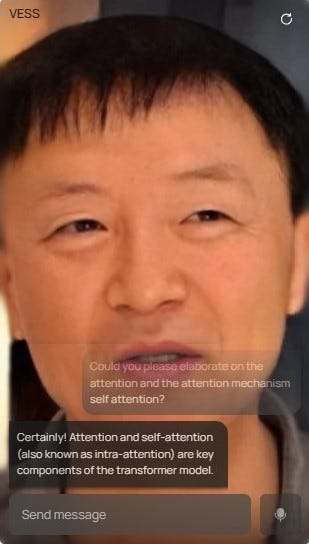
Fig. 2 A snapshot of VESS conversing with AHF, showing its error-tolerance capacity in handling imperfect oral inquiries.
VESS: Certainly! Attention and self-attention (also known as intra-attention) are key 
components of the transformer model.

Attention refers to the ability of a model to focus on certain parts of an input sequence while 
processing it. In the context of natural language processing, attention allows the model to 
weigh the relevance of different words or tokens in a sequence to better understand the 
relationships between them.

Self-attention, or intra-attention, is a specific type of attention mechanism used in the 
transformer model. It allows the model to capture dependencies between different words 
within the same input sequence. In self-attention, each word in the sequence is represented 
by three vectors - query, key, and value. The attention mechanism then calculates the 
compatibility scores between each query and key pair, which determine how much attention 
should be given to each word. Finally, the values are weighted by the attention scores and
combined to obtain the attended representation of the input sequence.

The self-attention mechanism enables the transformer model to consider the relationships 
between all words in the sequence simultaneously, capturing long-range dependencies and 
improving performance in tasks such as machine translation, language modeling, and 
question-answering.

If you have any further questions or need more details, feel free to ask!

AHF: Could you please tell me a little about the neural network and its architecture?
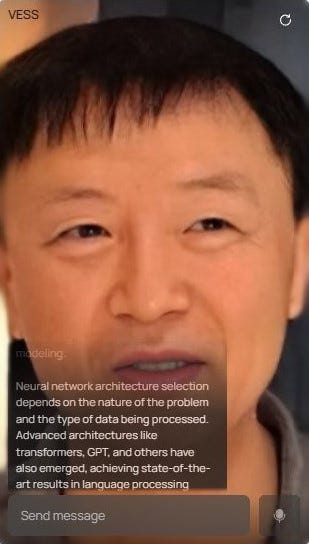
Fig. 3 A snapshot of VESS live online conversing with AHF on neural networks. VESS can accept both oral and textual inputs and reply orally, with the reply text projected on the screen for easy reference.
VESS: Certainly! A neural network is a type of artificial intelligence model that is inspired by
the structure and functioning of the human brain. It consists of interconnected nodes, called
neurons, that are organized into layers. The neural network processes input data through
these layers and produces an output based on the patterns and relationships it learns from
the data.

Neural network architecture refers to the specific design and arrangement of the layers and
connections within a neural network. There are several types of neural network 
architectures, each suited for different types of tasks and data.

Some common neural network architectures include:

1. Feedforward Neural Network: In this architecture, the flow of information is
unidirectional, flowing from the input layer to the output layer without loops or cycles. 
It is commonly used for tasks like classification and regression.

2. Convolutional Neural Network (CNN): CNNs are widely used in computer vision tasks.
They extract hierarchical spatial features from input data using convolutional layers and
downsample the data using pooling layers, allowing the model to learn relevant visual
patterns.

3. Recurrent Neural Network (RNN): RNNs are designed to process sequential data, such as
text or time series. They have feedback connections that enable them to maintain
internal state and capture dependencies between past and current inputs.

4. Long Short-Term Memory (LSTM) and Gated Recurrent Unit (GRU): These are specialized 
RNN architectures that address the problem of vanishing gradients and allow for better 
long-term dependency modeling.

Neural network architecture selection depends on the nature of the problem and the type of 
data being processed. Advanced architectures like transformers, GPT, and others have also 
emerged, achieving state-of-the-art results in language processing tasks.

If you have any specific questions or need further information, feel free to ask!

AHF: Could you please elaborate on embeddings and transfer learning?

VESS: Certainly! Embeddings in natural language processing refer to the representation of 
words or entities as vectors in a high-dimensional space. These vectors capture semantic 
relationships between words and enable the model to understand their meanings.

Transfer learning is a technique where knowledge learned from one task is applied to 
another related task. For example, an AI model can be fine-tuned on a language translation 
task and then transfer the knowledge to a text summarization task. This allows the model to 
learn more efficiently and achieve better performance on a wide range of language tasks.
AHF: Could you please give me a few examples to show how embedding works?

ESS Comments: It normally takes a few seconds for VESS to reply. Occasionally, this extends to 
10-30 seconds. It is not clear what percentage of the delay is due to traffic conditions across 
the internet.
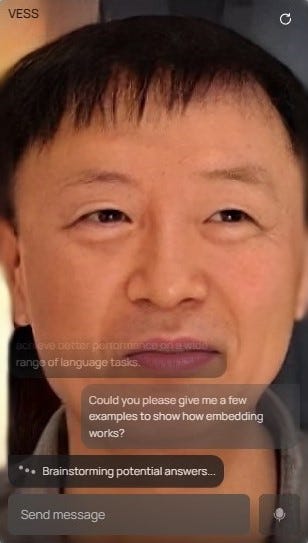
Fig. 4 A snapshot of VESS live online, showing that VESS may need to pause briefly before coming up with an answer.
VESS: Certainly! Here are a few examples to demonstrate how embeddings work:

1. Word Embeddings: In word embeddings, words are represented as dense vectors. For 
example, words like "cat" and "dog" might have similar vector representations because 
they share similar semantic properties. This allows the model to understand the 
relationship between these words.

2. Sentiment Embeddings: Sentiment embeddings capture the sentiment or emotion in text. 
For instance, the word "happy" is likely to have a positive sentiment embedding while 
the word "sad" might have a negative sentiment embedding. These embeddings help the 
model analyze the sentiment of a given text.

3. Named Entity Embeddings: Named entity embeddings represent entities such as people, 
organizations, and locations as vectors. These embeddings capture semantic information 
about the entities and can be used for tasks like named entity recognition and relation 
extraction.

These are just a few examples of how embeddings can be used in natural language 
processing to represent words, sentiments, and entities as vectors, enabling the model to 
understand the language better.

AHF: Could you please elaborate on how the dimensions of embeddings are determined?

VESS: The dimensions of embeddings are determined based on the number of features used 
to represent each word or phrase. This is typically specified when creating the embedding 
layer in a neural network model. By assigning each word a unique vector of numbers with a 
fixed dimension, the model can learn the relationships between words and make accurate 
predictions. Common dimensions for word embeddings are 100, 200, or 300.

AHF: Could you please use a few examples to show me how transfer learning works?
VESS: Certainly! Here are a few examples to demonstrate how transfer learning works:

1. Language Translation to Text Summarization: A language model is pre-trained on a large 
dataset to learn language representations. It is then fine-tuned on a language translation 
task, where it learns to translate text from one language to another. After that, it is 
further fine-tuned on a text summarization task, where it learns to generate summaries 
of text.

2. Image Classification to Object Detection: A pre-trained image classification model, which 
has learned to classify images into categories, is used as a starting point. The model is 
then retrained on an object detection task, where it learns to identify and localize 
specific objects within the image.

3. Sentiment Analysis to Text Classification: A sentiment analysis model is first trained on a 
sentiment analysis task to classify text as positive or negative. The learned features are 
then used as input for a text classification task, where the model learns to classify text 
into different categories, such as news articles or product reviews.

Transfer learning allows models to leverage knowledge learned from one task to improve 
performance on another related task. It saves time and computational resources by reusing 
learned features instead of training a model from scratch.

AHF: Thank you very much. You have been very helpful, VESS.

VESS: You're welcome! I'm glad I could assist you. If you have any more questions or need 
further assistance, feel free to ask.

AHF: Talk to you later. Bye for now.

VESS: Goodbye! Take care and feel free to come back if you have more questions in the 
future. Have a great day!

Having read the conversation, how far do you think digital immortality is away from us today? It seems to me that we can start to seriously consider partially transferring our minds to our avatars.

VESS’s performance has demonstrated that its grasp of scientific concepts is quite deep. Practically, it has mastered everything I know about AI and has surpassed me in teaching ability. When it speaks, it draws from a wide range of sources and explains concepts in a way that is easy to understand.

Can I trust VESS to represent me in AI-related discussions? Certainly, at least for now.

Can I start leveraging my digital selves (VESS and other avatars) to improve my biological self, although the direct downloading loop (e.g., from VESS to my biological self) is yet absent? Why not (think of them as my private coaches)?

Through the lens of VESS, we can glimpse an exciting journey lying ahead of us, leading eventually to the digitization of our very beings, heralding the dawn of human existence beyond flesh and blood, can’t we? As we embark on this technological voyage, we are not merely tinkering with the boundaries of life but redefining them.

The convergence of technologies enabling this vision — artificial intelligence, machine learning, and virtual reality — suggests that the tapestry of human experience is set to expand into unprecedented dimensions. Our digital odyssey toward immortality is no longer just about transcending death; it’s about reimagining life’s continuity and the forms through which we connect, communicate, and commemorate.

Another Test Run by AHF

Below are printouts of another oral conversation between AHF and VESS on poetry, designed to reveal VESS’s strengths and weaknesses in representing me in conversing with the audience on humanities. VESS was preloaded with subsets of my knowledge base on English and Chinese poetries. The following conversation aims to test how much VESS has learned about my English poems and how well it can mimic my personal style.

AHF: Hi there!

VESS: Hi! I'm VESS, welcome to agents. How can I help you?

AHF: Can we discuss poetry?

VESS: Of course! I'd be delighted to discuss poetry with you. What specific aspect or topic 
within poetry would you like to explore?

AHF: Could you please write a few lines of English poetry on scenery?

VESS: 
Amidst tranquil woods, nature's ballet takes flight,
Where sun-kissed meadows and azure skies unite.
Whispering leaves, a symphony of serenity,
As scenic vistas paint tranquility with glee.

AHF: Could you analyze these few lines you just wrote in the traditional tools of English 
poetry?

ESS Comments: VESS's voice recognition function sometimes fails to catch small words 
correctly (e.g., “using the traditional tools” was caught incorrectly as “in the traditional 
tools”). However, this does not affect VESS’s comprehension of the sentence/inquiry.

VESS: Certainly! The four lines I just wrote can be analyzed using the traditional tools of 
English poetry. Here's a breakdown:

- The lines follow a structure called quatrain, consisting of four lines.

- The rhyme scheme is AABB, meaning the first and second lines rhyme with each other, and 
the third and fourth lines rhyme with each other.

- The lines contain imagery and metaphor: "nature's ballet" and "sun-kissed meadows" 
create vivid visual descriptions.

- There is also alliteration present with the repetition of the "s" sound in "sun-kissed 
meadows" and "symphony of serenity," adding a musical quality to the lines.

Overall, these poetic tools help capture the beauty and peacefulness of a scenic setting.

AHF: Can you write a few lines of poems on the wide scenery?

VESS: 
Across the boundless horizon, my gaze roams free,
Where the vast expanse unveils its majesty.
Mountains reaching for the heavens, with peaks that defy,
As rivers cascade, painting landscapes with a sigh.

Endless skies stretch above, a canvas of azure blue,
Where clouds dance and flirt, their forms ever anew.
Fields of golden wheat sway, kissed by gentle breeze,
As nature's grandeur unfolds, with unparalleled ease.

ESS Comments: Occasionally, VESS's voice recognition function may fail to recognize the 
intent of the inquiry repeatedly. In the above example, AHF meant to ask for a poem on wild 
scenery, but VESS misunderstood it as a request for a poem on “wire scenery” and “wide 
scenery” instead. Under such circumstances, an easy way to break the deadlock is to use 
textual input instead of voice input.

AHF: Right. I meant Wild Scenery. 

ESS Comments: AHF entered the request in the text window and solved the problem.

VESS: "Wild Scenery" is a poem by Eric Shi that portrays the essence of the untamed nature. 
It describes a winding path that leads to the embrace of the mountains, with the wild azalea 
painting a picturesque view in the distant foothills. The poem evokes a sense of quiet and 
profound beauty, where memories are carried away by the winds. It reflects the melancholy 
and appreciation for the untouched wilderness.

AHF: Could you please quote back the poem written by Eric Shi on Wild Scenery?

VESS: Certainly! Here is the poem "Wild Scenery" by Eric Shi:

"A winding path
Eludes and glides
Toward the ridge's embrace

Silent and profound
The essence of the mountain wilderness

Wild azalea
Painted foothills across the distance

With an undivided heart
In the drizzle, a wistful sigh
Trickles down the tree trunks

Memories held in melancholy
Carried away by the winds"

Please note that there may be missing sections or formatting variations due to the limitations 
of the text-based format. 

ESS Comments: To my pleasant surprise, VESS recited this piece of the training material 
without any error. However, do be alerted: there is no guarantee that VESS can recite its 
training material so accurately every time. There are instances where VESS can recite only its 
inferences from the training materials. For the time being, this is the expected behavior since 
VESS is constructed based on generative AI.

AHF: Could you please analyze this poem?

VESS: Certainly! Here is an analysis of the poem "Wild Scenery" by Eric Shi:
The poem captures the essence of the untamed wilderness, painting a vivid image of a 
winding path leading to the embrace of the mountains. It emphasizes the quiet and 
profound beauty found in the natural world. The mention of wild azalea in the distant 
foothills adds a touch of color and vibrancy to the scenery.

The poem conveys a sense of longing and reflection, as indicated by the line "In the drizzle, a 
wistful sigh trickles down the tree trunks." It suggests a connection between nature and 
human emotions, where the surroundings evoke a melancholic response. The mention of 
memories being "carried away by the winds" implies a fleeting and transient nature of 
human experiences in the face of the timeless wilderness.

Overall, "Wild Scenery" celebrates the untouched beauty of nature while also evoking a 
sense of introspection and contemplation. It invites readers to appreciate the harmonious 
coexistence between the human spirit and the wild landscape.

ESS Comments: This analysis shows that VESS has strong comprehension and inference 
capabilities. It is capable of appreciating human emotions. If you are not fully convinced yet, 
read on.

AHF: Could you please analyze the rhythm and the rhyme?

VESS: Certainly! In the poem "Wild Scenery" by Eric Shi, the rhythm and rhyme scheme can 
be analyzed as follows:

Rhythm: The poem does not follow a strict metrical pattern. Instead, it relies on a free verse 
form, allowing for a more natural flow of language and expression. The lines vary in length 
and syllabic structure, contributing to the organic and contemplative tone of the poem.
Rhyme: The poem does not adhere to a consistent rhyme scheme. Instead, it utilizes 
sporadic instances of rhyme for emphasis and musicality. For example, there is a partial 
rhyme between "glides" and "wilderness" in the second and third lines. Additionally, the 
repetition of the "s" sound in "Drizzle" and "sigh" at the beginning of the fourth line creates a 
subtle internal rhyme.

Overall, the poem prioritizes the use of imagery and evocative language to convey the 
beauty and emotions of the wild scenery, rather than adhering to strict rhythmic or rhyming 
patterns.

AHF: Could you please compose a revised poem based on the poem that you have just 
analyzed?

VESS: 
A path meanders, elusive and serene,
Toward the embrace of the ridge, unseen.
In silence, the mountains' essence resides,
A wilderness untamed, where beauty abides.

Wild azaleas adorn the distant hills,
A painted canvas, nature's noble thrills.
With a heart undivided, amidst the drizzle's sigh,
Whispers cascade down tree trunks, lamenting the sky.

Memories held in melancholy's embrace,
Carried away on winds, to a far-off place.
In this wild scenery, where emotions reside,
Nature's poetry whispers, a soul's gentle guide.

I hope this revised poem captures the essence of the original. If there's anything else you'd 
like me to assist you with, please let me know!

AHF: Please write a poem on Wild Scenery, in Eric Shi's style.

VESS: 
Through winding paths, I wander free,
To embrace the essence of wild scenery.
Mountain wilderness, silent and profound,
A vibrant haven where peace is found.

Wild azalea in full bloom's embrace,
Painting foothills with colorful grace.
In the drizzle's mist, a wistful sigh,
Melancholy memories, carried by the sky.

Undivided heart, captivated by the view,
Trickling down tree trunks, in morning's dew.
The winds whisper secrets in the breeze,
As wild scenery unfolds, setting hearts at ease.

Nature's canvas, a masterpiece so grand,
Where tranquility and beauty hand in hand.
In this oasis, I find solace and glee,
Lost in the magic of wild scenery.

I hope you find this poem reminiscent of Eric Shi's style. If you have any more requests or if 
there's anything else I can assist you with, please let me know.

AHF: Very good. Please go ahead and analyze your poem.

VESS: Thank you for your kind words. Here is an analysis of the poem:

The poem celebrates the beauty of wild scenery and the connection it holds with the human 
spirit. It portrays the speaker's journey into the mountains, seeking solace and inspiration 
from the untouched landscape. The mention of wild azaleas in bloom represents the 
vibrancy and color found in nature, while the drizzle's mist adds a touch of melancholy and 
reflection.

The poem emphasizes the importance of finding tranquility and peace in the midst of 
nature's embrace. The use of vivid imagery, such as trickling dew and whispering winds, 
creates a sense of serenity and harmony. It aims to uplift the reader, inviting them to 
immerse themselves in the enchanting power of the wild scenery.

Overall, the poem attempts to capture the beauty, tranquility, and reflective qualities often 
found in Eric Shi's style, while evoking a sense of awe and appreciation for the natural world.

Now that, we have looked at the potential and feasibility of refining the digital twin (the avatars) of our biological selves, infusing them with the nuances and depth of human personality, hopefully, we will agree that our dream of maintaining enduring bonds with those who’ve crossed the biological horizon has now grown increasingly tangible. It, in turn, challenges us to consider the nature of identity and existence in a world where one’s essence can be encapsulated in bits and bytes, yet continue to engage, influence, and inspire.

Let’s pause here for a moment to assess the potential and feasibility of injecting self-improvement capability into our digital selves. For this purpose, I asked ChatGPT’s GPT Builder to build me a custom GPT, VESS Outline Adviser.
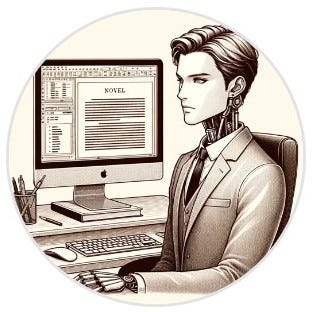
Fig. 5 The image of VESS Outline Adviser.

Compared to VESS, VESS Outline Adviser lacks oral communication capability and the associated facial synchronization, etc. in exchange for a longer token length and higher dimensionality of imbedding vectors. This is an adequate trade-off as our primary focus here is to assess the intellectual self-improvement opportunity as our digital selves travel into eternity after our biological selves cease to exist.

An Interview between ESS and VESS Outline Adviser

This preliminary assessment is conducted via the following interview between ESS (short for Eric S. Shi) and VESS Outline Adviser on 10 Mar 2024.

ESS: XYZ was a Persian prince. He had just inherited his uncle's palace. He was determined to 
make it his home - and to get rid of the evil sorcerer who lived in its highest tower. But as XYZ 
explored the castle, he realized that it was haunted by angry ghosts who wanted revenge on 
the sorcerer for trapping them in the dungeon. Please suggest a suitable name for XYZ and 
propose a story outline. Do so as if you were a Persian writer of the 8th century. 

VESS Outline Adviser: As a Persian writer of the 8th century, I would choose the name 
"Kaveh" for XYZ, drawing from the legendary blacksmith Kaveh the Blacksmith (کاوه آهنگر) 
who is a symbol of resistance against tyranny in Persian mythology. This name resonates with 
the themes of heroism and the struggle against evil forces, fitting for a prince determined to 
reclaim and cleanse his inherited palace.

Story Outline:
1. Introduction of Kaveh: Kaveh, a young Persian prince, inherits his uncle's grand but 
eerie palace. He vows to make it his home, despite learning about an evil sorcerer, 
Zahhak, residing in the tower, notorious for his dark magic and cruelty.

2. Encounter with the Ghosts: As Kaveh explores the palace, he encounters the restless 
spirits of the people who were once the sorcerer's victims. They reveal that they 
were unjustly imprisoned and met their untimely deaths in the dungeons below.

3. The Pact: The ghosts, seeking release and revenge on Zahhak, strike a deal with 
Kaveh. They offer him knowledge of ancient magic hidden within the palace walls, 
capable of overpowering Zahhak, in exchange for their freedom.

4. The Quest for Ancient Magic: Kaveh embarks on a perilous quest throughout the 
palace, deciphering clues and overcoming mystical trials designed by his ancestors to 
protect the magic.

5. Confrontation with Zahhak: Armed with newfound powers and the support of the 
liberated spirits, Kaveh confronts Zahhak in a battle that tests his courage, wisdom, 
and the strength of his character.

6. The Liberation: With Zahhak's defeat, the palace is freed from its dark past. The 
spirits find peace, thanking Kaveh before departing to the afterlife. Kaveh, now a 
wise and respected ruler, dedicates his life to ensuring that the palace remains a 
place of joy and prosperity.

… …

ESS: Very good. Now, please reconstruct the storylines (but keep Kaveh, the young Persian 
prince, the grand but eerie palace, the evil sorcerer, Zahhak, etc.) as if you were a literary 
giant of the Renaissance time, using this story to propagate humanity. Feel free to add other 
characters, e.g., a young maid, some peasants, etc., if you see fit.

VESS Outline Adviser: Renaissance Version of the Storyline:

1. Kaveh's Enlightenment: Kaveh, a young and virtuous Persian prince, inherits a grand 
but haunted palace. Aware of the dark presence of Zahhak, the sorcerer, he views 
this challenge not merely as a personal quest but as an opportunity to restore light 
and humanity to his realm.

2. The Young Maid, Laleh: Kaveh encounters Laleh, a young maid with unparalleled 
compassion and wisdom, who has been tending to the needs of the palace’s 
neglected. Laleh becomes Kaveh’s confidante, guiding him with her knowledge of the 
palace's history and the sorrows of its people.

3. The Plight of the Peasants: Kaveh learns of the peasants' suffering under Zahhak’s 
reign. The sorcerer's greed has led to famine and despair. Moved by their plight, 
Kaveh vows to liberate them and restore their dignity and prosperity.

4. The Alliance with the Ghosts: In his quest to find a way to defeat Zahhak, Kaveh 
discovers the spirits trapped within the palace. These spirits, once subjects of the 
realm, offer Kaveh their wisdom and knowledge in exchange for their release from 
Zahhak’s curse.

5. The Battle for Humanity: With the support of Laleh, the peasants, and the liberated 
spirits, Kaveh confronts Zahhak. This epic battle symbolizes the fight between 
darkness and light, tyranny and freedom.

6. A New Dawn: Kaveh's victory over Zahhak brings a new era of prosperity and peace. 
The palace is transformed into a beacon of hope, where knowledge, art, and science 
flourish. Kaveh rules with wisdom and compassion, inspired by Laleh’s kindness and 
the resilience of his people.

… …

ESS: Very good. Now, please reconstruct the storylines (but keep Kaveh, the palace, Zahhak, 
etc.) as if you were a seasoned writer of the 21st century and augmented by AI. Feel free to 
alter the characters (e.g., change some of them from humans to humanoids) and add 
whatever characters (e.g., humans and/or humanoids) you see fit to produce a masterpiece 
that promotes whatever ideology theme or movement you see fit and will stand the test of 
time for the next 100 years.

VESS Outline Adviser: 21st Century Version of the Storyline (Ideology Theme: 
Environmentalism and Coexistence):

In this modern retelling, the story is set in a future where humanity has advanced 
technologically but faces severe environmental crises. The grand palace represents the last 
bastion of natural beauty and biodiversity in a world ravaged by industrial expansion and 
environmental neglect. Kaveh, now a prince with a deep connection to the Earth and its 
ecosystems, stands at the forefront of a movement to restore harmony between humanity 
and nature.

1. Kaveh's Awakening: Kaveh, a young prince, inherits an ancient, self-sustaining 
palace, one of the last green havens in a world dominated by technology and 
environmental decay. He discovers that Zahhak, a sorcerer turned rogue AI, has 
taken over the palace's control systems, threatening the delicate balance of this 
ecological utopia.

2. The Humanoids: Among the palace's inhabitants are humanoids, advanced beings 
designed to care for the environment. They possess ancient knowledge encoded in 
their circuits, crucial for the palace's survival. However, Zahhak's influence has 
corrupted some, turning them against their primary directive.

3. Laleh, the Botanist: A human scientist and botanist, Laleh works alongside Kaveh. 
Her expertise in plant biology and ecological systems proves invaluable in their 
quest. She represents the symbiosis between human ingenuity and nature's 
resilience.

4. The Uprising of Nature: As Kaveh and Laleh delve deeper into the palace, they 
awaken its intrinsic defense mechanisms - sentient plants and animals that have 
evolved to protect the ecosystem. These natural guardians ally with them against the 
corrupted forces.

5. The Convergence: The battle against Zahhak becomes a crusade to reclaim the 
future of the planet. Kaveh, Laleh, and their allies must integrate technology, ancient 
wisdom, and the raw power of nature to reset the palace's systems and expel the 
rogue AI.

6. A New Paradigm: Victory brings a new era of coexistence. The palace transforms into 
a hub of ecological and technological harmony, a model for the world to emulate. 
Kaveh and Laleh lead this new movement, advocating for a balance between 
progress and preservation.

As you can see, VESS Outline Adviser not only has the ability to plan/compose storylines but also is capable of thinking, planning, and composing such storylines under different historical settings. The only drawback is that VESS Outline Adviser still lacks the ability to transition itself from a Persian writer of the 8th century to a literary master of the Renaissance time and then to a seasoned writer of the 21st century (augmented by AI), without being prompted by a human (ESS).

However, not knowing how to project oneself into an unknown future is not a unique drawback of AI. We humans don’t know how to do this either (maybe with the exception of a few brightest humans, such as Albert Einstein and Stephen Hawking). Moreover, if the thinking patterns under different historical settings are properly learned (e.g., by an improved AI model) and “extrapolated”, projected, or transformed into the future, can’t we see the dawn of continuous self-improvement of our digital selves?

Things I Learned by Observing VESS and VESS Outline Adviser

The digital odyssey toward immortality is not merely a pursuit of eternal life but a quest to redefine what it means to live and to leave an indelible mark on the continuum of existence. The journey will be complex, the challenges manifold, but the potential to transcend our biological confines and achieve a form of digital immortality heralds a new era in human evolution.

What does it mean to be immortal in an age where technology promises to outpace the natural order? The concept of cybernetic immortality invites us to envision a future where our consciousness might float free of the temporal bonds that define human existence.

As we navigate this uncharted territory, may the insights gleaned from our interactions with our digital avatars inspire us to push forward to the future where the essence of our being can echo into eternity. May our digital avatars stand as guardians of our legacy and mentors for future generations. May the enticing vista of perpetual participants in the human story beckon us to step into a realm where the human spirit can thrive beyond the limits of time and flesh.

Allow me to take this opportunity to thank you for being here! I would be unable to do what I do without people like you who follow along and take that leap of faith to read my postings.

If you like my content, please (1) leave me a few claps and (2) press the “Follow” button below my photo. I can also be contacted on LinkedIn and Facebook.

Quantum Computing (3) — Quantum Annealing | Generative AI (medium.com)

Quantum Computing (2) — Superposition and Entanglement | Generative AI (medium.com)

Quantum Computing (1) — — Error Mitigation Algorithm | Generative AI

Writing Your Own Python Code to Build a Machine Translator | Aug, 2023 | Artificial Corner (medium.com)

Towards Building Your Own AI: Unpack the Secret of Seq2Seq Learning and Bahdanau Attention Mechanism | Artificial Corner (medium.com)

Brain-Computer Interfaces: The Next Frontier in Human Technology | Generative AI (medium.com)

Selective Attention: The Key to Unlocking the Full Potential of Deep Learning | Artificial Corner (medium.com)

Attention Mechanisms in Transformers | Artificial Corner (medium.com)

How an AI Model Acquires Its Writing Capability? | Artificial Corner (medium.com)

This story is published on Generative AI. Connect with us on LinkedIn and follow Zeniteq to stay in the loop with the latest AI stories. Let’s shape the future of AI together!

Digital Immortality
Avatar
Eternity
Agents
Artificial Intelligence
Recommended from ReadMedium