
How Elon Musk Is Applying First Principles Thinking To All The Different Processes In His Company
Learning from the successes and failures of Elon Musk.
“You shouldn’t do things differently because they are different. They need to be…better.” — Elon Musk
Tesla Motors has been making splashes lately. Thanks to its 700 billion US dollar market valuation, Elon Musk has officially become the world’s richest man. Yet, it could have been different.
“I really didn’t want to be CEO of Tesla,” stated Musk during a recent interview. He had already taken up Space-X, and his sights were set on Mars. However, the former founder of Paypal also liked solving problems on Earth.
Investing into an electric car startup, his initial approach was to be hands off. There was a problem though. The visionary wasn’t satisfied with the way things were going. The costs were skyrocketing, and the prototype was heavier than the competition.
Musk wasn’t happy:
“The car ending up weighing like 60% more than an Elise. We went through a lot of trouble trying to shoehorn everything in there. The costs ended up being crazy.”
After squabbles with the founders of the start-up, he decided to take the reigns into his own hands. The South Africa-born serial entrepreneur has been in charge of the company ever since.
The road towards a mass-produced electric car has been bumpy. At one point, Musk attempted to get out of the business, offering to sell the company to Apple. For some reason, the sale never happened. Elon ended up holding onto the struggling firm.
Under his leadership, Tesla has become one of the world’s most well-known brands. For many people it is a symbol, a hint of the future situated in the present. While still far from making a steady profit, the company is now worth more than all the biggest traditional auto-makers combined. Whether this valuation is real or smoke and mirrors, is still to be seen.
Tesla, the company is in many ways an enigma, just like its CEO. Elon Musk is quite a controversial figure, attracting legions of loyal followers, but also countless detractors. While Musk’s antics have earned him a lot of criticism, his way of solving technical problems is exemplary.
There are lots of lessons that can be learned from his approach, both positive and negative. When things are going right, the key is to build upon the success, and try not to get a big head. When things go wrong, you take the failures with your chin up, and learn from the mistakes.
Luckily, Musk is not a guy who stubbornly tries to put a square peg into a round hole. When he sees that his approach isn’t working, he does often take a step back and rethinks the process. The story of Tesla Motors is a prime example of that.
Bringing first principles thinking to business process improvement
Elon Musk is known as a first principles thinker when it comes to inventing new things. Recently, he started applying this type of thinking not just to create new technologies, but across all the different processes in his company. In a letter to his employees, he outlined how the spending practices in the firm would be reformed:
“Going forward, we will be far more rigorous about expenditures. I have asked the Tesla finance team to comb through every expense worldwide, no matter how small, and cut everything that doesn’t have a strong value justification.”
Musk continued further down:
“All capital or other expenditures above a million dollars, or where a set of related expenses may accumulate to a million dollars over the next 12 months, should be considered on hold until explicitly approved by me. If you are the manager responsible, please make sure you have a detailed, first principles understanding of the supplier quote, including every line item of parts & labor, before we meet.”
He wants to have his managers apply first principles thinking to everything they do, including how they source different components from suppliers. In an analysis of how subcontracting works in his company, Musk found out that it is a complicated system that creates a lot of overhead.
“I have been disappointed to discover how many contractor companies are interwoven throughout Tesla. Often, it is like a Russian nesting doll of contractor, subcontractor, sub-subcontractor, etc. before you finally find someone doing actual work. This means a lot of middle-managers adding cost but not doing anything obviously useful. Also, many contracts are essentially open time & materials, not fixed price and duration, which creates an incentive to turn molehills into mountains, as they never want to end the money train.”
What this means is that all his employees, especially the ones in management positions, need to be first principles thinkers. No matter whether they create new inventions in a lab, or sit in front of the computer looking at Excel tables all day, everyone working for Tesla has to have the ability to rethink their normal way of working from the ground up.
While first principles thinking has served Elon Musk well in his career, is it a strategy that can be applied in all cases?
Should you be a first principles thinker 100% of the time?
First principles thinking is a powerful tool. Its application can help you solve problems in new ways, but it can also create problems when you use it indiscriminately. You don’t always need to reinvent the wheel. Thinking in analogies, and the reuse of best practices can often be superior in many circumstances.
In fact, this blind adherence to trying to figure out things using first principles can be behind the many challenges that Musk had faced in the initial production run of the new Model 3 Tesla car. This is his first mass-produced electric car, but the entire process proved quite difficult to implement from the get go.
In the beginning stages, Musk needed to shut down the manufacturing line several times. Many commentators described it as “production hell”. During the toughest stretches, Elon Musk himself spent countless nights sleeping on the factory floor. The new Tesla Model 3 cars were often coming out with various defects, and confidence hit all time lows. With the problems piling up, Musk got nervous.
He stalked the manufacturing halls, often erupting in fits of rage, firing people on the spot for no reason. At last, it dawned on him that he needed to rethink the entire production operation. Charles Duhigg, in an article for “Wired” magazine, described what happened when Musk conceded that his vision for a fully automated process was not meant to be.
“Even Musk had conceded that the company’s fully automated factory vision, the “alien dreadnought,” wasn’t working. Workers ripped out conveyor belts inside the Fremont plant. Employees began carrying car parts to their workstations by hand or forklift and stacking boxes in messy piles. In April, Musk halted production for an entire week to make repairs.”
The Tesla company set up a tent in its Fremont factory’s parking lot. Instead of robotic arms, the tent was fitted up with a system of gantries, which are used to help humans move different parts of the cars around. However, all these redesigns of the manufacturing process ended up costing Musk dearly.
The first mover advantage that Tesla had with its electric vehicles had started to diminish in the last few years. While Tesla is still the overwhelming leader, many of the traditional car companies are beginning to produce their own electric vehicles. Their strong point is that they are using their proven and tested processes in the manufacturing of these cars, only innovating incrementally.
The strategy that Elon Musk initially put in place for the mass production of his new Tesla Model 3 differed completely from the traditional way of building vehicles. He tried to redesign the entire process of manufacturing a car. This radical change was based on his vision of a fully-automated manufacturing plant run by robots. Unfortunately, the factory of the future concept proved not to work very well in the present.
Musk himself even acknowledged his mistake in a Tweet:
“Yes, excessive automation at Tesla was a mistake. To be precise, my mistake. Humans are underrated.”
Many industry analysts blamed the challenges on Musk ignoring old industry wisdom and lessons from the past, which ended up hurting him.
There was one major mistake:
Too much automation, too fast.
Elon Musk tried to go first principles on the manufacturing process itself, and to replace the humans by robots. This failed and created a mess on the production floor. Apparently full-scale automation had already been tried by other car manufacturers, but had to be abandoned.
Musk hadn’t learned from history. The innovator did not consider the analogies from other car manufacturers when he set up his mass production. In the 1980’s General Motors, at the time the juggernaut of car manufacture and a leading American company, tried to take advantage of the robot revolution of that period. It attempted to fully automate, but failed miserably.
Many of the traditional car manufacturers do innovate, but they do it gradually. For example, the Japanese have a very incremental approach towards automation, very unlike the Big Bang model of Elon Musk. To quote Benny Daniel, who is the Vice President of Consulting on Mobility in Europe for Frost & Sullivan:
“The Japanese style of production is to try and limit automation initially as it is expensive and statistically inversely correlated to quality. The approach is to get the process right first, then bring in the robots, basically the opposite of what Musk did.”
One of the main problems with automation is that the technology is still not there, and cannot replicate some of the delicate tasks the same way that humans can. Toni Sacconaghi and Max Warburton, authors of a report by Bernstein company, summarized the differences between what the humans can do and the robots cannot:
“In final assembly, robots can apply torque consistently — but they don’t detect and account for threads that aren’t straight, bolts that don’t quite fit, fasteners that don’t align or seals that have a defect. Humans are really good at this. Have you wondered why Teslas have wind-noise problems, squeaks and rattles, and bits of trim that fall off? Now you have your answer.”
These are the main reasons why according to many experts, the first principles process was not the right one to adopt when trying to mass manufacture the new Tesla Model 3. Instead, what could have worked better is adopting the tried and tested processes from the old car manufacturers (using an analogy), and then incrementally innovating on those. This is what Musk later realized, as he once again began relying more on manual labor in his factories.
It looks like that in his attempt at mass-manufacturing an electric vehicle, Musk used first principles thinking in the wrong place. Despite this, Tesla is still the overwhelming market leader in the electric car market, thanks to its buzz, bigger range, and more advanced software features. It has also learned from its initial production troubles.
By scaling down the automation, and putting humans back into the equation, Tesla has been able to improve its manufacturing process. This seems to be serving it well, as it has succeeded in ramping up production. It can also use the lessons from the experience in its new Gigafactories in places like Nevada, Shanghai and Berlin.
With this new approach, Musk’s company could have even built itself a competitive advantage. Elon seems to think so:
“We’re getting way better at making cars. You can see that in Shanghai. You’ll see that even more with Berlin. And we’re really changing the design of the Model 3 in order to make it more manufacturable.”
However, there are signs that many of the traditional car manufacturing companies might catch up in the long-run, negating Tesla’s first mover advantage.
Why? Because they have experience in the mass manufacture of cars and used these analogies when developing their own electric models. This means that you don’t always need to reinvent the wheel. Instead, the reuse of best practices and already existing solutions can get you to your destination much faster.
Learning and experience curves are the leading factors here. Manufacturing processes rely heavily on them. The initial cost is high at the beginning of setting up the process, but diminishes greatly as the process matures and the people working on it are more experienced. This is because people need to learn how to do things the right way first, but once they have the skills and experience, the efficiency increases.
There is also another Elon Musk innovation that is a key feature of how his company produces cars.
Agile development processes without a long testing period.
Musk initially made his money developing software. When you are developing software, one of the most common methods is agile development. With this type of methodology the aim is to come out with a minimally viable product as quickly as possible, and then improve upon it through succeeding waves of development.
When thinking about cars, Musk chose this method as an analogy for the production of Teslas. This is a good methodology for developing things like software, but how does it fare when manufacturing cars?
Traditional car-makers spend a long time on designing prototypes, testing them, and only once they are happy with the result do they move into the production phase. This type of process ensures that the risk of future mistakes or faulty parts is minimal. Peter Schwarzenbauer, a member of BMW’s Board of Management described the reasons for this approach:
“We want to get our products right first time. Customers should not expect to receive lots of patches and updates on their vehicles like they do with some other manufacturers, we want to release a product when it is ready.”
However Musk chose to go with the agile process for the manufacture of his electric car. This has not always resulted in the best quality cars. Teardowns of his car by different car industry testing groups have determined that the Tesla Model 3 is a mix of cutting-edge high-tech parts which are best in class, with some really shoddy parts.
University professor and expert on manufacturing, Roger Bohn, explained in a blog post why there was such a high rate of errors in the production of Tesla Model 3. It basically comes down to the process:
“Fundamentally, Tesla has a product design and production process that are “not manufacturable.” That is, the product tolerances are considerably tighter than the process variation. The result is that they produce lots of junk that must be scrapped or reworked. They can partially reduce process variation by stopping more often to adjust machines, but this causes downtime and creates “bottlenecks.””
While I had initially chalked up applying agile processes to the mass manufacture of cars as a mistake, now I am not so sure. This has its advantages and disadvantages. Tesla is lightyears ahead of its competition when it comes to software in cars. This gives it a huge competitive advantage over its rivals.
Kyle Field, writer for “CleanTechnica” believes that this agile approach could accelerate the speed of car innovation.
“The future is electric, but it will come faster with Tesla’s rapid iteration and agile development.”
Some commentators are arguing that the advent of new technologies could mean that agile development is becoming more viable when it comes to hardware. One of the game changers could be 3D printing. This allows Musk’s companies such as SpaceX and Tesla to quickly build several prototypes and rapidly test them.
As IT consultant Cliff Berg noted:
“Instead of spending months or years on design and then carefully building one perfect prototype, they build many, and they test them all in myriad ways. They want to get the thing to the test stand, even if it has imperfections. To reduce the cost of making parts whose design is always changing, they use 3D printing. This allows the design to rapidly evolve.”
Yet, as things scale up, and electric vehicles become more mainstream, the permanent beta mode could cause problems when the general public starts switching over from their old gas vehicles. The big burning question is how will they react?
Tesla cars often go out into the road with many software bugs that only get smoothed out later. This is something that Musk enthusiasts don’t mind. However is it something that won’t bother the bigger population, the average Joes who just want to buy a car?
When to apply first principles thinking to reinvent the wheel and when not to?
This brings about the question: When should you use first principles thinking and when analogies? This is a hard question to answer. A lot of times it isn’t always that clear cut. The analogies strategy is the less risky one, but the first principles one has higher rewards.
Musk successfully used first principles thinking in order to develop an electric car. It’s the mass manufacture in production mode of his Tesla that didn’t seem to be working. The old tried and tested methods were performing better when it came to actually rolling out the vehicles on a major scale.
If Musk wants to get to the fully automated factory, he will most likely have to get there incrementally. Sometimes the technology to be truly innovative simply isn’t there…yet. This is the case for the full automation of production. Some of the processes there are so complex that we will have to wait until machine learning and AI improves to the point where it can do things just like humans.
That time might not be too far off. There have been some rapid advances in artificial intelligence lately. The GPT-3 deep learning algorithm which is still in beta mode is proving to be revolutionary. It can produce blocks of text that often cannot be distinguished from the writing of a human.
Computer sight, one of the major stumbling blocks for automation for Musk, is also getting better. According to Ryan Kottenstette, these advances could solve many of Tesla company’s problems with robotic manufacturing.
“New approaches are rapidly expanding the envelope of computer vision in terms of applications, robustness and reliability. Not only do they hold the promise to solve Mr. Musk’s manufacturing challenges, but they will also dramatically extend the boundaries in myriad critical applications.”
However, as a report in “Wired” magazine stated, there are some things that the machines still can’t do. Full automation of the factory is some years away.
“There are still many things that machines can’t do, such as understanding the nuances of language, common-sense reasoning, and learning a new skill from just one or two examples. AI software will need to master tasks like these if it is to get close to the multifaceted, adaptable, and creative intelligence of humans.”
It’s a matter of when, not if. Robots will take over the industry eventually. Once the technology catches up, Musk’s vision of a fully automated manufacturing plant will be a reality. A failed idea can become a success when the time is right. You can see that with the example of the Dot.com busts at the end of the 1990s. Many of the ideas that went bust at that time now form the basis of successful companies in recent years.
Why didn’t they work then, at the end of the 20th century? One of the problems was that these companies came too early. The technology just wasn’t there. The internet was slow, and not widely rolled out yet, and the people were still used to their usual ways of doing things. It took Amazon many, many years to actually get profitable.
In order to decide which type of strategy (first principles, analogy, or something else) to adopt, you will have to look at the different factors carefully and then determine which is the more promising course of action. Is the time right for a first principles approach?
3 Questions to ask yourself
There is no perfect strategy. Whether to use first principles thinking and innovate radically, or instead use analogies and focus on incremental innovation is often a gut decision. There are three questions you can use to determine whether a first principles radical approach can work.
1) Is the need there?
2) Are the tools readily available?
If you take the example of one of the most radical innovations of the past decade, the smartphone, you can see how this works. Even though most consumers did not realize it, Steve Jobs and the people at Apple saw that there was a potential need for a device that combined the functions of a phone, music player, and the internet. They also saw that the tools and technology were there to make this come about.
On the other hand, while many people might see the need to travel to other solar systems, the tools to do that don’t exist and won’t exist for a while. So whatever first principles thinking you do in order to try to solve that problem, it won’t do much good right now.
Even though the first two questions might be answered in the positive, there is a third question which you can pose in order to determine your chances of success with first principles thinking.
3) How complex is the process?
The more complex the process is, the more parts to the system there are, the harder it will be to use first principles thinking and innovate radically straight away. Instead, a more step by step incremental approach will be more likely to succeed.
Radical innovations might arise out of this process, but they will take a while. If they are complex, then some radical innovations will have to come about in an incremental way. Things like charging grids for electric vehicles will take a long time to set up, so the change will be gradual.
Let’s see how the car manufacturing process stacks up against the three questions.
Is the need there? Yes, there is a need to have better car manufacturing processes.
Are the tools readily available? Probably not yet. Some parts of the car manufacturing process are so complex that the current state of development of robotics still hasn’t caught up. It will catch up in the future, but it is not there yet.
How complex is the process? The manufacturing process is really complex with many different parts. In order to change things up, you will need to do it in many sectors, which might not be feasible if you want to do it fast.
A study looked into the processes for radical and incremental innovation. There is no standard process for either one, but there are some patterns. The radical process is usually more iterative, and needs the refining of efforts during the development stage.
“Firms are more likely to use more non-linear processes with newer (less incremental) products. Product development for discontinuous products is more of a “learn and probe” process, rather than a linear one.”
This explains why it is so hard to innovate in a manufacturing process quickly. If you want to mass produce cars straight away, you cannot really tinker with the process too much. It requires a more linear approach.
The illustration below shows how the process of coming up with a radical innovation works. It is pretty messy, and you often have to rework solutions and go back a few steps. That is kind of hard to do in the middle of full production mode. This is also the reason behind the many stoppages at Musk’s factory.
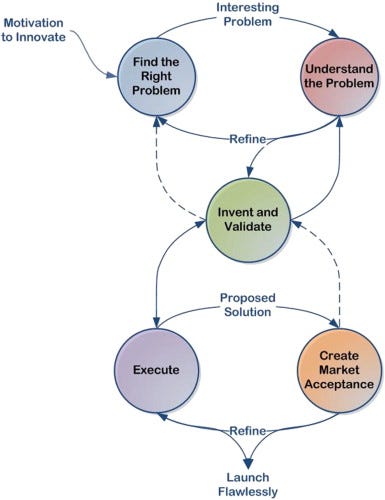
Here, how to set up the problem to be solved is very important. Elon Musk stated that he wants to mass produce electric cars right now. The problems is that the process of mass manufacturing cars is so complex that it would be really hard to succeed through the first principles thinking approach. Others have tried and failed.
However, if he had instead set up his goal as mass producing cars in a fully automated way in 10 years, then the approach could be different. There you go about things more gradually, tinkering with certain parts of the entire system, finding out what works, and discarding the things that you find out don’t work.
Overall, it is still to be seen what will happen with the mass production of Tesla cars. Musk was successful in rolling it out in full scale. However, he needed to go back to the old tried-and-tested car manufacturing strategies. Individual workers continue to be an essential part of the process. A full-blown automation is some time away, but each year it’s getting closer.
This shows that in order to be successful you will need to be able to think both in a first principles way, but also have a toolbox of analogies to fall back upon. The key skill will be knowing when to use which strategy.
Note: An earlier version of this article appeared on my blog a few years ago. I revised many of the sections according to the latest developments. The idea here is not to focus on Tesla, but instead on the thinking model behind the way things are implemented. There is a wider application in a variety of fields for different thinking models. Tesla is just a case study to illustrate first principles thinking and thinking in analogies.