
How To Think Like Elon Musk And Come Up With Creative Solutions To Problems
First-principles thinking can help you solve tough problems and succeed where others have failed.

“There will be a lot of jobs on Mars!” — Elon Musk
Elon Musk thinks that the future of humanity is in space. According to the brilliant, if sometimes controversial entrepreneur, our species faces many challenges: environmental, societal, and technological. Leaving our planet could be one way of solving them.
At the beginning of 2020, Musk announced that in the next few years he will focus a lot of his energy on colonizing Mars. By 2050, he predicts there will be around 1 million people living on the Red Planet.
In order to make that a reality, Musk plans to build over a thousand starships and start launching them into space. At the moment, his company has been testing the initial prototypes.
These test launches have been met with mixed success. Yet, such is the price of progress. His first starship, the SN1 burst due to pressurization. Learning from this failure, Musk’s company SpaceX stripped down the second prototype to the bare minimum. The test was a success.
Recently, a configuration error led to the destruction of the third prototype in the series, the SN3. No matter, SpaceX is working hard on building and then launching the next version, SN4.
Just a few days ago, this rocket became the first full-scale prototype to pass the cryogenic proof test. The exact date for its test launch has not been set yet, but it will be in the next few months.
The thinking process behind Elon Musk’s ideas
“If something is important enough you should try, even if the probable outcome is failure.”
— Elon Musk
The development process of the different SN prototypes is based on Musk’s unique way of thinking. At the heart of this is what he calls first-principles thinking. Applying this method has helped him solve some really tough problems.
This is an approach he borrowed from physics, where you start from a set of basic assumptions that you hold to be true. These cannot be broken down further, and form the underlying propositions of the discipline. You then reason up from there.
Let’s analyze a bit what Elon Musk means by first principles thinking:
“I also think it is important to reason from first principles, rather than, by analogy. So the normal way we conduct our lives is we reason by analogy. We’re doing this because it’s like something else that was done or like what other people are doing, iterations on a theme. It’s kinda mentally easier to reason by analogy rather than from first principles.
First principles is kinda a physics way of looking at the world and what that really means is you kinda boil things down to the most fundamental truths and say okay, what are we sure is true? Or sure as possible is true? And then reason up from there. That takes a lot more mental energy.”
Musk states that there are two basic ways that people reason:
- Through analogy
- Through first-principles
Using analogies is probably the most common way of thinking for the majority of people. It is much easier for someone to take something that they already know, and apply it as an analogy on how things should work. It’s tried and tested. The average individual won’t take a second look, accepting that that’s how things should be done.
However, Musk believes that this is not the best way to think about problems. In his opinion, this type of thinking can often prevent people from coming up with the most optimal solution.
For him, if you want to come up with a truly innovative solution, you need to go back to the basics. In physics, the basic propositions of the field are called first principles.
A first principle is a basic foundational assumption that cannot be broken down further, and that forms the basis of the thinking in its own particular field. All the other works in that field are based on this basic assumption being true. Any further knowledge is built up from there.
If you want to make progress, then you need to go back down to these first principles. By taking them as a basis, you can reason on what is really true. This reflection allows you to distinguish between the optimal way of doing things, and what is in fact just a stubborn orthodoxy dependent on not being able to see beyond the way things are now.
“Somebody could say… in fact, people do… that battery packs are really expensive and that’s just the way they’ll always be, because that’s the way they’ve been in the past. Well, no, that’s pretty dumb, because if you applied that reasoning to anything new, then you would never be able to get to that new thing.
You can’t say, oh, horses — nobody wants a car because horses are great and we’re used to them and they can eat grass and there’s lot of grass all over the place and you know, there’s no gasoline that people can buy, so people are never going to get cars. People did say that, you know.”
Most people are incremental thinkers and think within established paradigms. They take the reality of the world as given, and can’t really fathom that other different ways of doing things are possible.
Musk gives the example of horse-drawn carriages. For hundreds or thousands of years, that was the way people would transport themselves from one place to another. During those times, if you would ask a person to think of transportation, that would be what they would think of.
If you were to ask a person in today’s world the same question, they will say cars, trains, airplanes, and similar types of transports. That is the transportation paradigm for people in this age.
In the past two centuries, the way humans go around has completely changed. Horse-drawn carriages and similar modes of transport have basically disappeared. This is because someone went back to first principles and completely changed the fundamentals of transportation.
“And for batteries, they would say, oh, it’s going to cost — you know, historically it’s cost $600 per kWh and so, it’s not going to be much better than that in the future, and you say no, what are the batteries made of? So first principles mean you say okay, what are the material constituents of the batteries? What is the spot market value of the material constituents?
So you can say, it’s got: cobalt, nickel, aluminum, carbon and some polymers for separation and a steel can. So break that down on a materials basis and say okay, if we bought that on the London metal exchange, what would each of those things cost? Like, oh, jeez, it’s like $80 per kWh. So clearly, you just have to think of clever ways to take those materials and combine them into the shape of a battery cell. And you can have batteries that are much cheaper than anyone realizes.”
Musk gives an example how you can challenge the common view on a certain subject by going back to first principles. He uses batteries to demonstrate this.
Most people assume that batteries are expensive and not much can be done to change that. That’s just the way things are. However Musk shows how he went down to the basic constituent parts of the batteries, the raw materials that make them up, and turned that impression upside down.
The first-principles approach is a time tested approach
The notion of first principles is nothing new. Thousands of years ago, several Ancient Greek thinkers deliberated on the nature of this world and how it works. They asked themselves big questions like how do we know that something is true or how do we know what we know?
Aristotle, one of the most famous philosophers of that era, built many of the concepts that subsequent generations of philosophers, scientists and inventors used in order to explore the way the world functions. In one of his works, Aristotle introduced the idea of first principles.
For him, a first principle was the first basis from which a particular thing is known. In his mind, finding these first principles was fundamental for any type of reasoning you wanted to engage in.
Basically, whenever you are looking into the nature of a problem, you need to dig deep down and start your inquiry with a set of basic assumptions that cannot be broken down further. The ideas of Aristotle on how to examine the world were further refined by thinkers who came after him.
Euclid was another great ancient Greek philosopher. His most famous work is titled “The Elements”. It’s a groundbreaking treatise on geometry, mathematics, and logical thinking in general.
“The Elements” is one of the foundational texts of science and went on to influence many famous thinkers. Even today, ideas from it are taught in schools around the world.
In the book, Euclid introduced the notion of postulates (or axioms). A postulate is a basic statement that is taken as true. It serves as the premise from which you can deduce all kind of other statements.
For example, one of Euclid’s postulates is that all right angles are equal to each other. Based on this basic assumption you can make all kinds of different assumptions and calculations. Or if you start reasoning backwards, you can break down different statements into these postulates.
Postulates can be used in order to create proofs for more complicated principles in geometry, like the Pythagorean Theorem. The postulate on all right angles being equal is one of the fundamental assumptions that you are making in order to create a proof for it. Without it, the Pythagorean Theorem wouldn’t work.
In “The Elements”, Euclid uses these postulates as the basic building blocks for much of his work. The very use of the word “element” as the title of the book gives us a clue as to its purpose. An element is a basic statement that is fundamental to all other statements.
Thomas Heath, in his modern translation of Euclid’s work tried to explain the basics of the great mathematician’s theory. He relied on quotes from the commentaries of Proclus, a 5th century AD Neo-Platonist philosopher, to shed a light on the process:
“There are, says Proclus, in the whole of geometry certain leading theorems, bearing to those which follow the relation of a principle, all- pervading, and furnishing proofs of many properties. Such theorems are called by the name of elements; and their function may be compared to that of the letters of the alphabet in relation to language, letters being indeed called by the same name in Greek.”

These works of Aristotle, Euclid and other ancient philosophers and scientists went on to influence many famous thinkers in later ages. One of the most prominent of these was the medieval Persian polymath Ibn Sinna (sometimes known as Avicenna).
He took the ideas of Aristotle and started thinking about the process of arriving at first principles itself. He listed two ways for doing this: induction (as described by Aristotle) and examination/experimentation.
For Ibn Sinna, the second of these was the superior process, since it is much better at providing certainty. He expounds on these thoughts in his work “The Book of Healing”. Despite the name, the book is not about medicine. Instead its aim is that of “curing” ignorance.
Another person who was influenced by the works of Euclid was Ramon Llull, a medieval Catalan polymath. He believed that in every type of knowledge, there are some basic principles that must be assumed without question and on which the rest of that discipline is built up.
He actually came up with the analogy of science being like a tree, with roots, trunk, branches and leaves. This analogy is quite useful when trying to wrap your head around which things you need to learn first in order to master a discipline. It has been echoed by the words of Elon Musk himself, when he compared knowledge to being like a semantic tree.
Scientists such as Nicholas Copernicus or Isaac Newton were also influenced by the works of Euclid and especially his book “The Elements”. In fact, as a student at the University of Krakow, one of the first books that Copernicus bought was this treatise.
It was the first principles thinking of these two guys that brought about the scientific revolution and our modern world. Another thinker that was shaped by the ideas of Euclid was Rene Descartes. If you’ve heard of the expression “I think, therefore I am”, then you know who he is.
Descartes is considered one of the great philosophers of history. He is known for questioning and doubting everything. One of his main contributions to posterity is his method of doubt that he used to come up with answers to basic questions. The aim of this method was to discover the fundamental truths of the world.
These fundamental truths are his first principles. This is how he described them in his work called “Principles of Philosophy”:
“Now these principles must possess two conditions: in the first place, they must be so clear and evident that the human mind, when it attentively considers them, cannot doubt of their truth; in the second place, the knowledge of other things must be so dependent on them as that though the principles themselves may indeed be known apart from what depends on them, the latter cannot nevertheless be known apart from the former.
It will accordingly be necessary thereafter to endeavor so to deduce from those principles the knowledge of the things that depend on them, as that there may be nothing in the whole series of deductions which is not perfectly manifest.“
This type of thinking is at the basis of modern philosophy. Descartes tried to find some self-evident truths and then build up his understanding of the world from them. His ideas became the foundation of the modern scientific method.
Basic truths and how to build up knowledge
These basic self-evident truths are called “a priori”, meaning from earlier. These are the things that are independent of any type of experience or observation. They simply are.
There are also “a posteriori” statements, meaning from the latter. These types of statements are dependent on previous knowledge, observation or some more basic principles.
“A priori” statements are first principles statements. They are things like 5 + 5 = 10 or “a male has two chromosomes (XY)” or definitions (things like “a widow is a woman whose husband died”). “A posteriori” statements on the other hand are dependent on previous knowledge or more fundamental “a priori” statements.
This is very similar to the type of reasoning that happens in physics. There you start with “ab initio” (meaning from the beginning) statements. These are the first principles, the fundamental laws that all of physics is dependent on.
For example these might be the laws of thermodynamics or the fact that an electrically neutral hydrogen atom is made up of one positively charged proton and one negatively charged electron.
This is what Musk means by first principles thinking. In physics you need to go back to the “ab initio” statements, the ones that everything else is built on. Based on these fundamental truths you can start reasoning up and come up with innovative solutions to problems.
However physics is not the only field that has these fundamental truths. Other disciplines have them too. These are the different “a priori” statements that you can get just by reasoning and are self-standing. Using these, you can build up your answers to problems.
In fact, this is how human knowledge is created. The different human disciplines are built upon other disciplines. Psychology is built upon principles from biology, which itself builds upon principles from chemistry, going all the way to a pure theoretical explanation using equations from mathematics. Each of these is an application of another discipline.
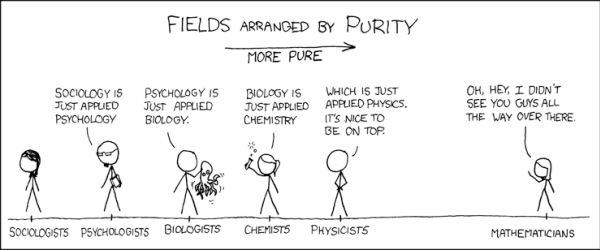
This means that if you want to be able to come up with a solution to a complex problem, you need to understand the fundamentals first.
Barriers to first principles thinking
There is a reason why thinking in first principles is hard, and it is easier to think in analogies. You are simply built that way. The brain evolved to favor speed and efficiency over novelty and innovation.
Think about it. It is much easier to solve a problem if you have already faced a similar one. From a survival perspective, if you are faced with something you have to do, it would not be very efficient if every time you did something you had to come up with a new way of doing it.
Instead, the brain memorizes the steps and then quickly executes whenever they are needed. That’s why experts are so good at what they do. They don’t need to think about what they are doing. They have done it so many times, that their processes have become automatic.
An explanation for how this works is probably due to the internal wiring of the brain. The brain is not a static organ, but can in fact change. This is often referred to as brain plasticity.
The brain is made up of neurons, which are basically cells that pass electrical signals and thereby allow the brain and the entire nervous system to function. These neurons are connected together by structures called synapses, which allow signals to pass through from one neuron to another.
Learning how to do things takes advantage of the fact that the brain is moldable. The learning process consists of a lot of repetition. What is happening is that through this process of repetition, more and more synapses between the neurons are created and strengthened.
This then creates deep connections between the two or more neurons that are involved in that particular activity and hardwires the entire process. With this creation of strong associations between the neurons, anything that stimulates one of the neurons also ends up stimulating the other neurons that have strong connections to it.
This allows you to quickly access knowledge and make decisions, but also results in cognitive biases like the Einstellung Effect and functional fixedness. As you become an expert in a subject, this hardwiring in the brain becomes stronger and stronger, making it much harder for you to think in other ways besides the ones you learned and are familiar with. That’s why it is difficult to think in first principles.
At most times, this type of rigid thinking is beneficial. That’s why your brain has developed in such a way as to favor it. However this also causes several drawbacks, which are especially apparent when you try to come up with new ways of solving problems.

The Die Hard way of solving problems
In order to illustrate what I am talking about, let’s go back to 1942. In that year, Abraham Luchins, an American psychologist conducted an experiment. He gave each participant 3 water jugs: one with the capacity of 21 units (A), one with a capacity of 127 units (B), and the last one with a capacity of 3 units (C). Then he told them to measure out 100 units exactly just by using those three jugs.
How would you solve this problem?
In order to help you, let’s see how John McClain solved a similar problem in “Die Hard with a Vengeance”:
Got it? The most efficient method would be to fill up jug B (the one with 127 units) to the top and then pour out enough of the water to fill out jug A (the one with 21 units) once and jug C (with 3 units) twice. In mathematic notation the answer is B — (A +2C) = 100 units (or B — A — 2C).
Now you have another problem in front of you, once again with 3 jugs. Jug A has a capacity of 14 units, jug B 163 units and jug C 25 units. You need to measure out exactly 99 units.
How would you do that?
Ready, set, go! Solve!
So what did you come up with?
The most efficient answer is to take jug B (163 units), fill it up, pour some water from it into jug A (the one with 14 units) and then fill up jug C (25 units) twice with the water from jug B. By doing that you will end up with 99 units of water in jug B. How does this look mathematically? B — A — 2C!
I see you like math, so let’s try another problem. Jug A has 18 units, jug B has 43 units and jug C has 10 units. Your goal is to measure out 5 units. How would you do that?
Start working it out!
Got it? What is the solution to this problem?
Well, the most efficient answer is to take jug B (43 units), fill it up, and then pour some water from it into jug A (18 units) in order to fill it up, then pour water into jug C (10 units) twice, filling it up each time. Finally you end up with 5 units of water in jug B. Your task is finished successfully. Mathematically, it looks like this: B — A — 2C.
Did you come up with this solution? If you did, then congratulations, you came up with the right way of doing it.
Here is another similar problem. You once again have 3 jugs: jug A with 18 units, jug B with 48 units and jug C with 4 units. You need to come up with exactly 22 units of water. Let’s get to it. How would you do this?
What’s your answer? You take jug B (48 units), fill it up with water, then pour it into jug A (18 units) and fill it up, and then fill up jug C (4 units) twice. You end up with 22 units in jug B. B — A — 2C!
Is that the way you did it? You are on a roll!
However think about it. Is that the most efficient answer?
Wouldn’t it have been easier just to fill up jug A (18 units) and jug C (4 units) and then pour them into jug B? You would have ended up with 22 units with just two steps (A + C)!
What we have demonstrated now is called the Einstellung effect. If you fell for it, don’t worry. Most people (even those with high IQs) fell for it. If you didn’t fall for it and came up with the most efficient answer (A + C) for the last problem straight away, then congrats!
In Abraham Luchins’ experiment, the participants were given a set of problems that all ended up being solved just using one way (B — A — 2C). This was the way that worked for all the previous problems, so this way of doing things became fixed in the brain of most participants.
So when these participants were faced with a problem that had a more efficient solution, they still continued to use the tried and tested way of doing things, even if it was less efficient. They did not even think there could be a better way to solve the problem.
The brain likes to approach problems in time-tested ways
From an evolutionary psychology perspective, this is perfectly logical. In real life, most problems have a simple pattern and don’t deviate from it. If you come up with one way of solving the problem, you can use the same template for other problems. This ensures that you don’t spend too much time and energy on each of the problems.
Time is precious and back in the day energy was also something not to be messed around with. Meals were sometimes hard to come by, after all. So the brain evolved in such a way as to ensure that you do things that give you a higher chance of survival. This did just that.
The Einstellung effect is one type of mental set. A mental set is the tendency to approach problems in the same way as you have done with problems in the past. This works on a subconscious level (you are not really aware that you are doing it) and has both its benefits and drawbacks.
The benefit is that it helps you solve problems fast and without expending too much energy on them (and many times it works), however the drawback is that it sometimes impedes you from seeing better, more efficient ways of solving that same problem. This is a cognitive bias.
The paradox is that the existence of good solutions can sometimes be more impeding than the actual absence of any solution.
Luchins ran his experiment by dividing the group into parts. The first part of the group were the people we used as an example above. They were given a set of problems, with all of the first problems being solved using the same method.
This resulted in them falling for the Einstellung effect (you could argue that they were primed for it). So after a series of problems where the most efficient method of solving that particular problem was the same as the previous one, they subconsciously started assuming that that was the best method overall.
When they finally came across a problem where another way of solving the problem was better and more efficient, the tendency was to overlook this better method and continue solving the problem using the old, but tried and tested method.
However, the second group followed another way of doing things. Their problems were set up differently and no single, most efficient method emerged out of them.
Each of the problems had a different way of being solved. So when the members of this group came up to the jug A (18 units), jug B (48 units), jug C (4 units) problem, they usually ended up by solving it using the most efficient (A + C) method.
For the first group, there was a tried and tested method that worked in previous cases available. This made them blind to other potential methods.
However for the second group, there was no such thing and they had an absence of such standard methods and solutions. So in each case, they were forced to come up with an original way of solving the problem.
You see here how the mind tends to work and why it is often so hard to think using first principles, especially in cases when standard solutions that work already exist.
Another example of a mental set and one that also has a tendency to block first principles thinking is called functional fixedness.
This concept can be well-illustrated by an experiment conducted before WWII by Karl Duncker, a German psychologist who lived in exile in the UK and then in the US.
Imagine that you are given a box of thumbtacks (with the thumbtacks inside the box), a candle and a book of matches. You are then given the task of fixing a lighted candle to a cork board (wall) without having the candle drip wax onto the table below it.
Think about the problem. How would you do it?
Well, the way to do it is to take out all the thumbtacks out of the box, use them to nail the box to the cork board on the wall, light a match and use it to melt the bottom part of the candle, then put the candle (the melted bottom will make it stick better) into the box that is now fixed to the wall, and then use another match to light the candle.
However most of the participants in the study did not do this. Instead, they tried other ways, but ultimately failed in accomplishing the task. The problem was that they perceived the box only as a tool to hold the thumbtacks and did not see the other potential uses of it.
This is functional fixedness. Functional fixedness is a mental block that has you thinking of a particular object as being used only in the way that it is traditionally used.
For example, if you have a hammer, then you will think that the hammer can be used only to hammer down nails and will fail to perceive other potential uses for a hammer, like serving as a paper-weight or a measuring stick (you can even scratch your back with it).
This cognitive bias is a major one when it comes to hampering your efforts at problem solving. Most people when they see an object usually cannot move away from thinking of the traditional ways of using that object.
Other potential and more exotic or non-traditional ways of using it are blocked from entering their thinking. This is one of the main barriers to first principles thinking.
This bias is not something that is due to our modern world, but has been passed down to us from our more primitive ancestors. Studies have shown that even tribes living deep in the Amazon jungle, and having very limited contact with the outside world succumb to it.
It’s something that is a product of evolutionary psychology and deeply ingrained in our brains.
There are several tests that you can take to determine your ability to think creatively and come up with alternative uses for different items. One of these is Guilford’s Alternative Uses Test. You can find it online.
Luckily, these things can be overcome, although with a lot of effort. The fact that the brain is not static, but instead moldable, means that nothing is fixed.
And that’s good news. Through different techniques you can overcome these limitations and learn to think in first principles.
Note: I had published a previous version of this story on Elon Musk’s first principles thinking method on my blog.