
How does space acquire quantum-like properties? (# 8)

The mathematician Alfred Tarski proved that Elementary Euclidean Geometry (EEG) is a complete axiomatic system in three dimensional Anti-de Sitter (AdS) space i.e. a space with negative curvature. Euclid postulated that geometry was based on five axioms including a parallel postulate. Euclid stated that in two-dimensional geometry:
If a line segment intersects two straight lines forming two interior angles on the same side that sum to less than two right angles, then the two lines, if extended indefinitely, meet on that side on which the angles sum to less than two right angles.
Neither Euclid nor any subsequent mathematician was able to prove this postulate using only the other four postulates. Tarski, however, has proved there is no need for this postulate when EEG is in AdS space.
The previous article — How could mathematics be the foundation for reality? (# 7) — suggested that an AdS space consisting of the five Platonic solids in EEG would automatically evolve into a four dimensional AdS space-time with a topology of a Klein bottle.
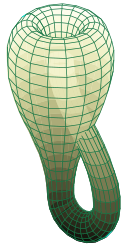

In this article, further consequences of an AdS space-time with the topology of a Klein bottle will be examined. In particular, it is argued that the topology of the AdS space-time becomes more complicated when all components of that space acquire quantum-like properties.
Inside a mathematical singularity
The fourth dimension of AdS space with a topology of a Klein bottle has a time-like quality. Assume for now that the time-like quality can be represented by numbers in the Fibonacci sequence. In this sequence, each number is the sum of the previous two numbers with the first two numbers being 0 and 1. Numbers in the sequence constantly increase and become very large. At some point, the numbers in the sequence become so large that they create a mathematical singularity. This mathematical singularity has similarities to a black hole in AdS space-time when the composition of that space-time includes quantum particles and matter.
As a mathematician, I am all too familiar with singularities as a calculational convenience to believe they are physical phenomena. Rather they are a boundary and an indicator or transition from one regime to another.
This and other articles follow Andersen’s approach that a mathematical singularity is an indicator of a transition.
According to cosmologists investigating the properties of AdS space with black holes i.e. mathematical singularities, the interior of a black hole has an additional time-like dimension. A black hole inside four dimensional AdS space has three spatial-type dimension and two time-like dimensions. Some cosmologists suggest that a black hole will eventually collapse with the content of that black hole re-emerging in the original AdS space-time. Such content could appear in the AdS space-time ‘before’ the black hole which is the source of the content. A white hole is the opposite of a black hole: nothing goes into a white hole. Through a black/white hole sequence, content emerging from a white hole could be the content of a hologram in a boundary inside a black hole because that content would only have one time-like dimension not two.
A graphical representation of the relationship between black holes and white holes is:
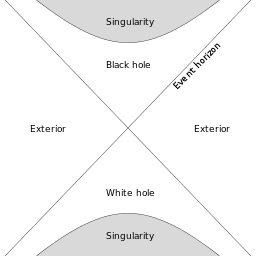

An AdS space-time constructed out of Platonic solids does not yet include energy or particles. Nevertheless, the Platonic solids in this AdS space keep getting larger and create the equivalent of a mathematical singularity. The solids increase in size because they instantiate information about the history of solids entering into and emerging from Klein bottles (see the next article in this series). This mathematical singularity is incorporated into a boundary in the AdS space-time. The AdS space inside the boundary is still an AdS space. Thus the space inside an AdS boundary has its own boundary. In the latter boundary, however, there are two time-like dimensions.
As the constituents of the AdS space inside a mathematical singularity contain information about the topology of the AdS space, content in the boundary of that space could be renormalised as if the content were another Klein bottle made out of parts with Klein bottle properties. In brief, a mathematical singularity in an AdS space-time arising out of Platonic solids appears analogous to the black hole/white hole cycle suggested by some modern cosmologists for AdS space consisting of energy and particles. Very large Platonic solids (Klein bottles) are re-scaled with the solid re-emerging through the equivalent of a ‘white hole’ in the original AdS space-time as a much smaller solid.
An example of a second time dimension uncorrelated with, but nevertheless related to, the original time-like dimension is the Golden Ratio φ which is the ratio of the sum of two adjacent numbers in the Fibonacci sequence divided by the larger number. φ is an irrational number i.e. an infinite decimal where no set of consecutive digits repeat and which cannot be expressed as the quotient of two integers. As the sequence of digits of φ (1.618033…..) never repeats, this sequence has time-like characteristics. A number ‘later’ in the series can only be known once all the numbers ‘before’ it have been calculated.
Crossing boundaries
There are boundaries in AdS space-time and there are boundaries inside boundaries in an AdS space. Content inside these boundaries can be described mathematically. In Spencer-Brown’s mathematics, crossing an event horizon in AdS space makes a Distinction. Becoming part of a boundary inside a boundary in AdS space-time also makes a Distinction. When the mathematics of AdS space-time is defined in terms of two separate categories, namely ‘inside’ or ‘outside’, crossing into another region means the status of the second region should be different to the first region i.e. if the first region was ‘inside’, the next region should be ‘outside’. But when a boundary collapses and its content re-emerges in the original AdS space-time, what happens to the ‘inside’ / ’outside’ distinction?
Spencer-Brown’s Law of Condensation argues that multiple Distinctions of the same sort e.g. crossing over the event horizon of a boundary, simply condense into the same Distinction (p 7). On the other hand, Spencer-Brown’s Law of Cancellation argues nested Distinctions can erase Distinction (p 8).
These two laws (Condensation and Cancellation) govern all two-valued worlds. Life begins by making Distinctions, by creating boundaries. These laws are the only ones possible within space created by making Distinctions. No matter how many Distinctions are made, the Distinctions simply become combinations of paired or nested Distinctions (p 10). Spencer-Brown’s Laws provide conclusions about the deepest archetypal nature of reality. These laws formally express the little we can say about something and nothing.
As discussed in the next article, Spencer-Brown goes onto to conclude that space emerges from the mere fact of making a Distinction (p 11). Neurobiologist, Francisco Varela, subsequently argued that when self-referencing is introduced into the analysis, this addition leads to the creation of time. Furthermore, the process of content repeatedly going into and coming out of mathematical singularities provides an explanation for how quantum phenomena arise.
Mathematically, Platonic solids and their duals have identical descriptions when combined with (0, 1) bits of information. The description of a Platonic solid inside a boundary can be distinguished from the description of a Platonic solid outside the boundary by being the dual of itself. Furthermore, a solid in the boundary inside a mathematical singularity can be the dual of the solid in AdS space. In such cases, the values of the (0, 1) bits of information fluctuate between 0 and 1.
Mathematical singularities content in AdS space-time
In summary, a three dimensional AdS space consisting of Platonic solids automatically takes on the topology of a Klein bottle. The reconstituted AdS space acquires another dimension which is time-like. The new four dimensional AdS space automatically takes on the topology of a Klein bottle made out of individual Klein bottles. The re-entry of Klein bottles into this macro topology causes content in the AdS space to have bits of information with values fluctuating between 0 and 1.
The next article explains how an AdS space-time containing quantum-like features causes new phenomena to emerge such as energy and matter. The mathematical description of this new AdS space-time provides a foundation for describing how both consciousness and our universe might arise.
These articles do not attempt to prove the origin of our universe. The purpose is to suggest that, contrary to the belief that there is something inexplicable about our universe, logical explanations are possible.
The focus of these articles is on using the results of published research. Once the idea of the existence of a logical explanation for our universe is generally accepted, new research may uncover other ideas that explain possible processes in more detail.
The question for this article is:
Could the origin of our universe arise from geometry?
You can access all 47 of these articles in the book Orbiting Stars by Michael Dalton. To obtain a copy of the book ‘Orbiting Stars’, please visit https://www.amazon.com
To view the headings of all the articles to be published in this series please click on https://readmedium.com/orbiting-stars-and-origin-of-our-universe-338906930f51