
How could mathematics be the foundation for reality? (# 7)
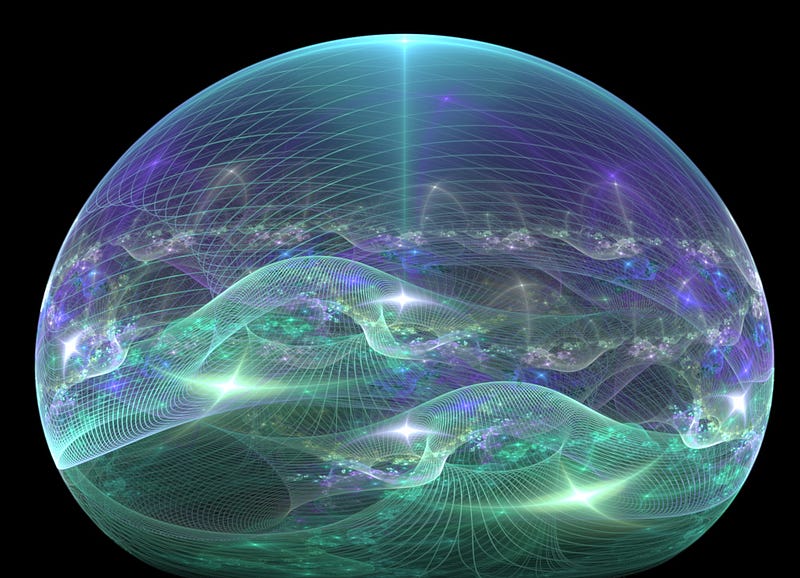
Each of these articles is a relatively independent discussion about how our reality may have emerged from mathematics, particularly geometry. The mathematician, Alfred Tarski, has shown that the geometry associated with Platonic solids i.e. Elementary Euclidean Geometry, exists eternally in an Anti-de Sitter (AdS) space, a space with negative curvature. Cosmologists have studied various types of AdS space because their analyses potentially provide a better understanding of what happens inside a black hole. This article considers some of the theories developed by these cosmologists.
Dimensions of space
Two of the most important theories in physics are incompatible, namely Einstein’s Theory of General Relativity and Quantum Mechanics. Nevertheless, both theories provide excellent predictions for the phenomena they focus on. They disagree on the nature of gravity. Professor Carlo Rovelli has developed a theory called Loop Quantum Gravity to describe the nature of quantum gravity. Rovelli argues that (Kindle location 2124–2133):
Space is a spin network whose nodes represent its elementary grains, and whose links describe their proximity relations. Space-time is generated by processes in which these spin networks transform into one another, and these processes are described by sums over spinfoams. A spinfoam represents a history of a spin network, hence a granular space-time where the nodes of the graph combine and separate.
… So what is the world made of? The answer now is simple: the particles are quanta of quantum fields; light is formed by quanta of a field; space is nothing more than a field, which is also made of quanta; and time emerges from the processes of this same field. In other words, the world is made entirely from quantum fields.
In these articles, it is proposed that the fabric of space consists of Platonic solids whose corners and sides are analogous to the nodes and links of Rovelli’s Loop Quantum Gravity.
Tarski’s conclusions about Elementary Euclidean Geometry being a complete axiomatic system in AdS space do not depend on the size of the Platonic solids i.e. many different sized Platonic solids could exist in the same space.
Anti-de Sitter space
One of the features of AdS space is that while the space is potentially infinite, that space contains a boundary describing all the contents of AdS space in one less dimension. In brief, AdS space contains a boundary of finite size which is a hologram of the contents of a potentially infinite AdS space. A visual example of such a boundary is the wood carving ‘Circle Limit 111‘ by M.C. Escher).
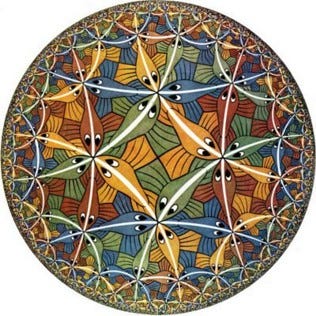
The original AdS space consists of Platonic solids of many different sizes. The boundary inside the AdS space describes all the content (solids/shapes) in the AdS space as a hologram i.e. in one less dimension. Each shape may be described in the hologram by its length and the number of sides that it has i.e. by two instead of three vectors. Another feature of the boundary in AdS space is that only a finite number of shapes are needed to describe the space to infinity. One way to include this feature in the hologram is by ordering the shapes in terms of increasing size with fractal descriptions i.e. self similar shapes. The collapse of an infinite series to a finite number of shapes is analogous to the idea of renormalisation in mathematics. According to Wikipedia: ‘Renormalisation is a technique … in the theory of self-similar geometric structures … [that is] used to treat infinities arising in calculated quantities by altering values of these quantities to compensate for effects of their self-interactions’.
Shapes inside the boundary could be ordered by fractals of decreasing size. To distinguish i.e. make a Distinction, between shapes in AdS space before the boundary and shapes beyond the boundary, the shapes representing shapes beyond the boundary could be the same as the original shape turned upside down.
In geometry, a pseudosphere is a surface with constant negative curvature. Mathematicians have shown that the surface area of a pseudosphere is finite, despite the infinite extent of the shape along the axis of rotation. Imagine AdS space as a three dimensional pseudosphere.
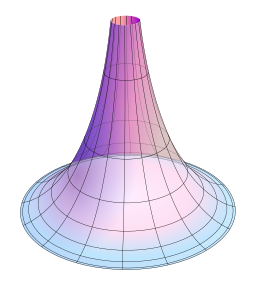
The rim of the pseudosphere is like a boundary in AdS space; a boundary that contains information about all the Platonic solids ‘beyond’ the rim. Mathematically, these Platonic shapes will ‘overlay’ other shapes. As discussed in Appendix D of book ‘Physics from Finance’, fibre bundles are mathematical constructions used in quantum mechanics. These bundles help describe the product of two space e.g. how one space is mathematically mapped onto another space. A Platonic solid could be a type of fibre.
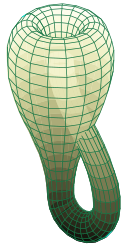
One point of a Platonic solid could be attached to a point of another Platonic solid in the same space. Most of these connections or attachments would be random or trivial. But occasionally, bundles would arise with a non-trivial global structure. One example is a Mobius strip; a line is attached to each point of a circle with a twist in the fibres moving around the circle. Another non-trivial example is a Klein bottle. When the fabric of space is in the shape of a klein bottle, Platonic solids in that space become inverted. In brief, the negative curvature of AdS space filled with Platonic solids automatically leads to the creation of non-trivial descriptions of the fabric of that space.
An AdS space is isotropic i.e. uniform in all orientations. AdS space is also spatially homogenous i.e. the same everywhere at the same time. As a boundary contains a hologram of all shapes in the AdS space, the shapes in that boundary are also part of the content of the rest of AdS space i.e. the AdS space is composed out of right-way-up and upside-down shapes. Inclusion of both types of shapes is consistent with AdS space having the topology of a Klein bottle; locally, the surface has negative curvature, globally, the topology is a Klein bottle.
Inside a Klein bottle
Each Platonic solid has a dual i.e. a solid whose vertices are the midpoints of the faces of the original solid (in two dimensions, a Platonic solid and its dual can be described using the same mathematical notation). Rotation of a two dimensional Platonic shape reveals its three dimensional appearance. Mathematically, a Platonic solid and its dual can be described in one less dimension when that description is combined with another parameter with a value of 0 or 1 where 0 represents one form of a solid and 1 represents its dual. Thus a three dimensional Platonic solid or its dual can be mathematically described by a two dimensional shape in association with one (0, 1) bit of information.
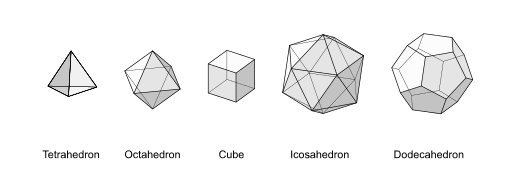
The duals of the Platonic solids are:
- The cube and the octahedron and duals of each other;
- The icosahedron and the dodecahedron are duals of each other;
- The tetrahedron is self dual.
George Spencer-Brown’s Laws of Form describes the mathematics of what could happen when information passes into a different region such as the event horizon of a black hole. Information inside a black hole represents a Distinction, a ‘mark’ in a region that is distinct from the original AdS space. Spencer-Brown’s Laws of Form is discussed in more detail in a later article. The point is that entry into and exit from a black hole can be interpreted as an application of Spencer-Brown’s mathematics.
In mathematics, an abstract polytope is an algebraic partially ordered set or poset which captures the combinatorial properties of a traditional polytope without specifying purely geometric properties such as angles or edge lengths. A polytope is a generalisation of polygons and polyhedra into any number of dimensions.
According to the website wiki.org:
Duality of a pair of abstract polyhedra is a particular relationship between two partially-ordered sets, each representing the elements (faces, edges, etc) of a polyhedron. Such a ‘poset’ may in turn be represented in a Hasse diagram. The diagram of the dual polyhedron is obtained by turning the diagram upside-down.
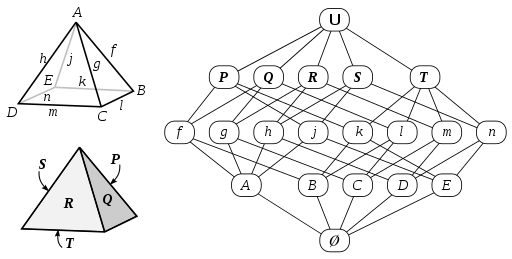
Topology is a kind of geometry without dimensions or a kind of geometry in more than three dimensions. Topology is often called ‘rubber sheet geometry’ since it is a study of forms that can be ‘stretched and pulled’. The only rule is that all basic surface features must be retained during the transition or ‘mapping’ of one form to another. When a form is ‘stretched’ into an additional dimension, the form still retains characteristics or ‘memory’ of its original form. Three dimensional Platonic solids ‘stretched’ into a fourth ‘time-like’ dimension would still retain the memory of their three dimensional forms.
The topology of a Klein bottle is equivalent to a three dimensional shape having a fourth dimension. When the topology of AdS space resembles a shape like a Klein bottle, abstract polyhedrons such as Platonic solids, on the surface of the space could return to their original place i.e. come out of a boundary, but be turned upside down, thus appearing as their own duals. The topology of a Klein bottle is consistent with an AdS space that makes a Distinction where that Distinction is encoded as a (0, 1) bit of information. Each element of such an AdS space contains information about the topology of the whole space.
According to Spencer-Brown, the creation of a Distinction causes the creation of another dimension, a time-like dimension. In brief, when a three dimensional AdS space has the topology of a Klein bottle, that AdS space becomes four dimensional with the addition of a time-like dimension. As discussed in Article 4, ‘Could there be a logical explanation for our universe’, a time-like dimension in AdS space could be represented by the Fibonacci series.
Klein bottle and mathematical singularity
In summary, an AdS space consisting of Platonic solids can be mathematically described by the topology of a Klein bottle. That space automatically creates a time-like dimension. Each element of that space contains information about the topology of the whole space. Subsequent articles build on the idea of AdS space-time having the topology of a Klein bottle to explain how content in that space-time acquires quantum-like properties.
The question for this article is:
Could the origin of our universe have a rational explanation?
To obtain a copy of the book ‘Orbiting Stars’ which contains the first drafts of all these articles, please visit https://www.amazon.com
To view the headings of all the articles to be published in this series please click on https://readmedium.com/orbiting-stars-and-origin-of-our-universe-338906930f51


