
Black holes probably don’t have a singularity
Albert Einstein denied many times through his life that black holes were possible. He even tried to disprove them in a paper published in 1939, but his argument was wrong. They are real, and we have now detected several.
A black hole forms when a star collapses on itself. Its mass is so large that the gravitational pull squeezes it down to a size where even light cannot escape. The point of no return is called the event horizon and it cloaks the interior of the black hole with complete secrecy. If you fall into a black hole, you will never return to tell the tale though the information making up your quantum particles might one day.
A black hole will tear apart anything that falls into it. It doesn’t matter how strong the thing is. As something falls in, it will always have part of it that is slightly farther away from the black hole than other parts of it. The difference in gravitational pull between those two parts will increase the closer it gets. At some point, that difference becomes effectively infinite. That is why you hear of “spaghettification” as one of the consequences. It is more like a trail of breadcrumbs with each breadcrumb being an indivisible subatomic particle falling in. The one exception might be another black hole in which case the two will spiral into one another and merge themselves in an extremely violent encounter, but it isn’t clear that anything can tear apart a black hole singularity.
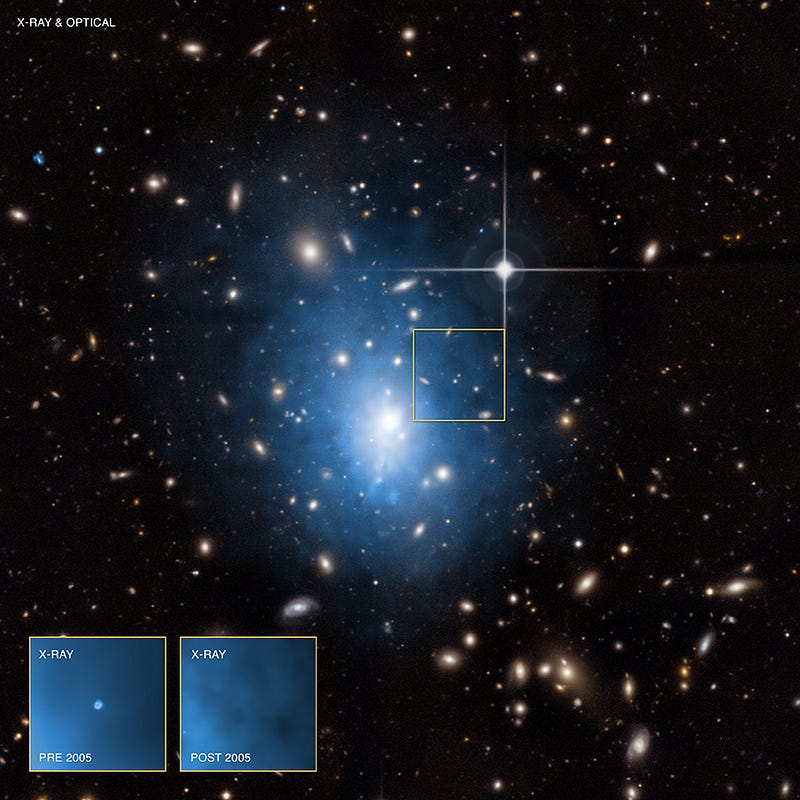
The simplest type of black hole is called the Schwarzschild black hole. This is a black hole that does not rotate or have any charge, but, since black holes generally form from stars that are rotating, they will likely have a rotational component, which makes them Kerr-type black holes.
Black holes are interesting from a physics perspective because they create intense gravitational fields, which makes them a perfect way to study gravity. We have detected a number of black holes now through optical and X-ray astronomy, and we have also detected what we think are black hole mergers using gravitational wave detectors.
The light that passes near to a black hole will be significantly bent to the point where it can bend light right around itself. Einstein predicted this light “echo” in 1916, and it has actually been observed. This creates the odd effect that you can theoretically see stars near a black hole event horizon that are not behind it but in front of it from your perspective. (In practice you need a light source much brighter than a star.)
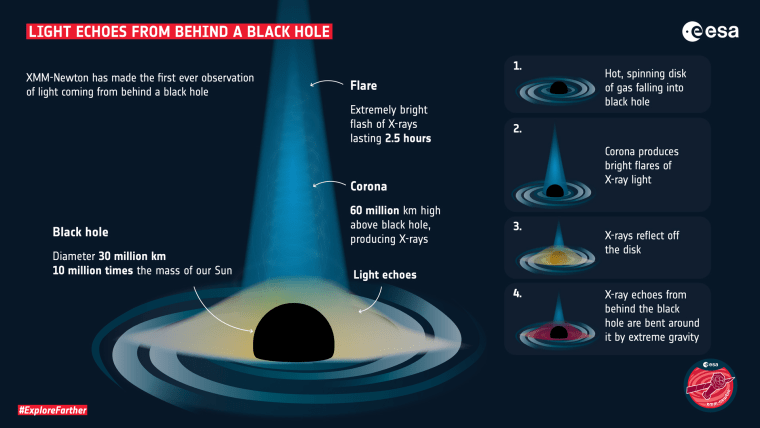
Most of the light you see, however, comes from matter falling into the black hole. The gravity also spreads the matter out and squishes it so it appears smeared into a sort of halo called an accretion disk.
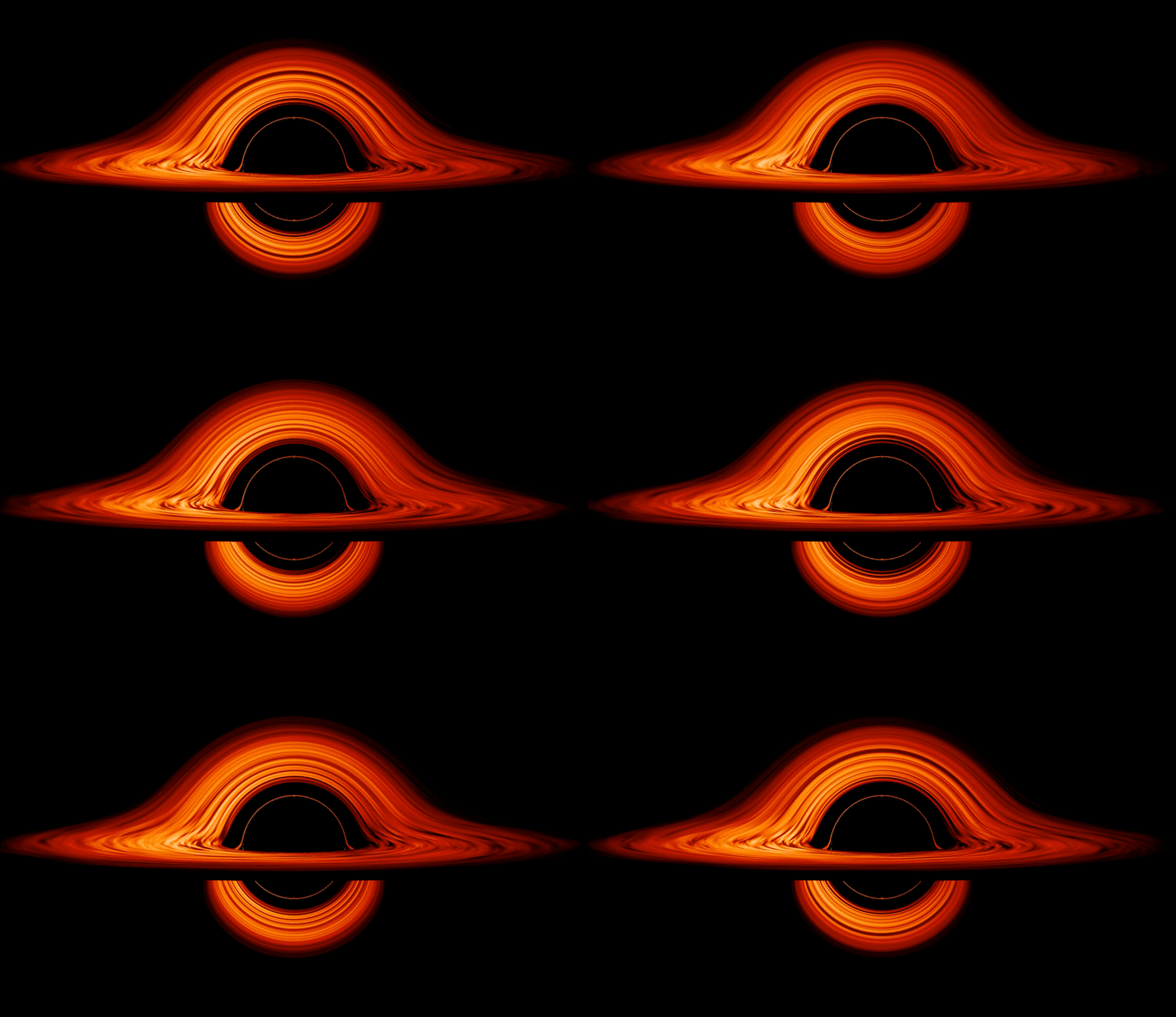
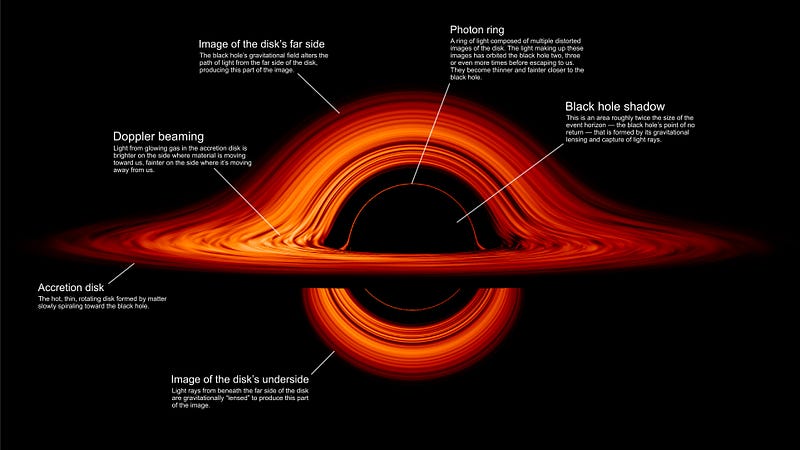
Most of what you see in the animation is caused by gravitational warping of light. The actual disk is like the ring of Saturn. Here is a schematic of what you are really seeing.
If the Earth were turned into a black hole, its event horizon would have a radius of about 1 centimeter or half an inch. Yet, at a distance of 6400 km or so from the center, you would experience the same gravity as you would if standing on the surface of the Earth, 9.8 m/s/s.
You could theoretically construct a thin shell around an Earth mass black hole and have precisely the same gravitational pull on it as the real Earth (with a few differences because of density variations).
This means that a hollow Earth is, at least gravitationally, more plausible than a flat Earth, which would have vastly different gravity than our own. This gives a much more plausible reason for Elon Musk’s investment in boring technology to get at that sweet central black hole.
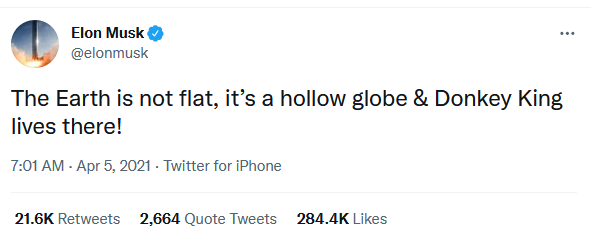
Flat earthers don’t agree but may believe in flat black holes.

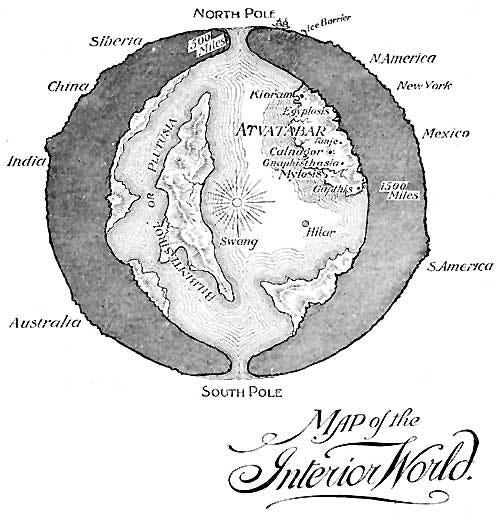
Rather than containing a number of lands as in the image below, however, objects would tend to fall from the underside of the hollow Earth into the central black hole, meaning that the crust would have to be made some some very strong stuff.
Nothing can escape a black hole for reasons that have little to do with the strength of its gravity. Although smaller star-size black holes do have intensely strong gravity at their event horizons, supermassive ones can have comparatively weak pull. You would think that with a weak pull you would just be able to escape, but it turns out not to be that simple.
As you make a black hole larger and larger, it eventually ceases to have much of a pull at all from the perspective of an outside observer. No, rather than the intense gravity being the cause, it is the nature of causality that the event horizon bends so completely. Anything that crosses a black hole event horizon has simply had its future causal structure bent into the black hole so that it can no longer affect anything outside the event horizon.
You can read more about this in my article:
Any attempt to lower a rope to pull someone out is doomed to failure. Even if it could overcome the actual acceleration due to the black hole’s gravity, it could not alter the light cones of the matter that had fallen into it. As an outside observer, you would just see time slow down as your rope approached the black hole. As part of it crossed, you would no longer see it beyond that point — it would appear frozen in time and infinitely redshifted. If you tried to pull it taut, the rope would break from tidal forces on your side of the black hole.
If you were so unlucky to fall into a black hole, before you die from spaghettification, you would head towards the “singularity” which would appear like a dark planet before you. You would not be able to see it or any matter in it. In fact, you would not be able to see any matter closer to the singularity than you are.
The reason is because, as you fall in, your future light cone, which is the region of space that you can affect in the future, bends towards the singularity. Your past light cone, meanwhile, which is all the things that can affect you bends towards the event horizon. That means that anything closer to the event horizon than you is in your past while anything closer to the singularity than you is in your future.
You can think of this as if you were walking along on a flat plain due North. North is your future while South is your past. You encounter a pit with a gradually steepening slope. As you head down the pit, you are no longer heading North but North-Down. Now you slip and start falling, the pit is steeper and steeper. Eventually you are heading mostly Down and barely North at all. The way you came is mostly up not South. This is what falling into a black hole is like as well. It really is like a hole in space.
The singularity is less like a point and more like a wall in time. Not only does it become your future, once you “hit” it, you cease to have one, almost as if you went back in time and erased yourself like Marty McFly.
A lot about what really happens at singularities is speculation, however, because it derives from a theory, Einstein’s theory of General Relativity, that doesn’t take quantum theory into account at all.
Einstein himself became preoccupied with singularities but tended to fixate on what are called coordinate singularities like his attempt to disprove gravitational waves. These are not real but originate from the coordinate system you are using. For example, the north pole is a singularity in geodetic coordinates but you can easily remove it by going to another system. Yet, some real singularities exist in his theory and the question is whether these are just artifacts of an incomplete theory or point to a real breakdown of physical reality.
That isn’t a big problem when you want to talk about how things behave outside the singularity because there is nothing there but gravity itself, but, if you want to know what happens in the singularity, General Relativity can’t give you an answer. Theoretically, the singularity has infinite density and the fabric of space and time just “breaks” there.
Ordinary stars and planets also have singularities in their description according to General Relativity. But these are just simplifications because we don’t care about their interior.
Non-rotating black holes have points while rotating have ring singularities or ringularity. Like hurricanes, these are like an eye of calmness in the midst of the singularity’s time stopping fury.
A body can theoretically pass through a ring singularity, in which case it is sort of like passing through the wardrobe into Narnia. The matter could emerge into another place entirely since the ringularity can act like a wormhole.
Wormholes can be traversible or non-traversible and require some kind of exotic, negative mass matter to stay open. They are also intimately connected with black holes, with black holes being the primary means to construct them. There are quite a few kinds of wormholes that differ mathematically in their construction and stability. Folding space is a useful idea but not quite accurate.
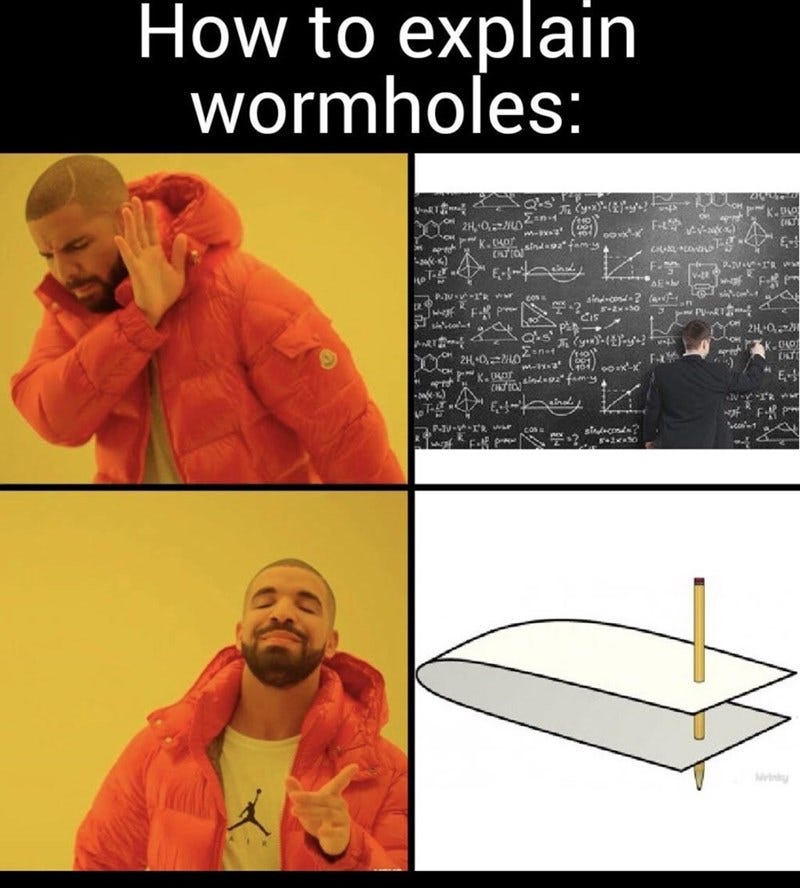
In order to be traversable, a ringularity would have to be a “naked singularity” meaning it could not have an event horizon around it. Otherwise the traveler would not be able to emerge. That makes collapsed stars a poor candidate for traveling through space and time. It is possible, however, in the quantum realm for wormholes to form spontaneously, and this could be a possible means for quantum information to escape blackholes since they can form across the event horizon. If so, that means that while matter’s future would end at the singularity, its information could continue on, albeit in a scrambled form. It could take aeons for the information to actually emerge and the black hole to collapse and dissipate, but it would eventually happen which proves that even black holes can’t take it with them when they go.
Whether humans can use wormholes to travel in time or faster than light would require some very clever spacetime engineering. The answer is probably no but still up for debate.
Both point and ring singularities are, at best, toy models that make it easy to talk about what is going on around them. They make the equations easier because you don’t have to deal with the boundary conditions between the exterior and interior of the singularities themselves because they don’t exist.
Mathematicians and physicists do this kind of thing all the time with things that are thin or small compared to the space around them. We make tornadoes into one dimensional lines and stars into points because we don’t care about what is going on inside. The reality is that quantum effects almost guarantee that there is no such thing as a singularity and that what we think of as singularities are very small but still extended objects.
There is no known force in the universe that can prevent the collapse of matter into a black hole once it has begun. Stars avoid collapse initially as they burn fuel, so there is a tendency for the heat and pressure to push matter outward. That is merely electromagnetism at work. As they cool, they collapse further. Smaller stars turn into dwarf stars and slowly simmer until they turn dark. A sufficiently massive star can collapse into a neutron star which is one of the densest objects in the universe.
Neutron stars maintain themselves using a quantum phenomenon called the Pauli exclusion principle. All that means is that the neutrons making them up cannot be in the same place at once. Therefore, they avoid one another and that creates a kind of repulsive force.
Enough mass and you overcome that principle and all the matter can be theoretically in the same place at once. Black holes may be made of matter that can all exist in the same place called bosons.
Without the exclusion principle or electromagetism, there isn’t another repulsive force to withstand the gravity and prevent the collapse and so, theoretically, the matter could all collapse into one spot.
As the matter collapses together however, forces stop behaving as they do in ordinary ways. We know for example that at very small scales the very constants of the universe change. There is good reason to suppose that the gravitational pull matter has on itself actually gets weaker at smaller scales. Meanwhile, self-gravitational interactions (the push or pull gravity has on itself) becomes stronger and more highly nonlinear. That means that gravity behaves more like the turbulent waters of a whirlpool inside a blackhole and less like a smoothly rotating vortex. This is called “backreaction” and is an active topic of black hole research.
A potential source for preventing the collapse of matter into a blackhole is simply that gravity itself in the form of waves and nonlinear turbulence within the blackhole prevents the matter, which is now more weakly interacting gravitationally, from completely collapsing.
A similar phenomenon occurs in fluids. When you have a rotating fluid vortex, the viscosity can be a negligible influence far away from the vortex, but as you come closer to it viscosity plays a major role. Viscosity is, of course, caused by fluid interacting with itself. Inside a turbulent vortex, you cannot neglect viscosity. If you don’t care about what is happening inside the vortex, but need to understand how it interacts with its surroundings, you pretend that the vortex is a one dimensional filament and mathematically incorporate the action of viscosity into the behavior of the filament itself, just like singularities.
In fact, water vortices have been used to simulate black holes for this reason:
Black hole singularities, likewise, have an internal structure that is vastly different from outside of them because gravity goes from behaving smoothly outside to being extremely turbulent inside. You can no longer neglect small scale interaction that gravity has with itself that are far stronger than those it has with matter. Gravitational waves no longer behave like waves but are noisy and chaotic. That chaos is not a substance but spacetime geometry itself and so it tends to prevent any stable configuration of matter, including a singularity.
Unfortunately, analysis of black holes that contain a “core” of non-zero size rather than a singularity have shown that they are unstable in Einstein’s relativity, meaning that they cannot exist for long without mitigating factors. Those mitigating factors must be fundamentally quantum and cannot come down to classical backreactive behavior in Einstein’s theory alone because those effects are too small. Quantum effects most likely magnify backreaction and create regions of stability that would be unstable in classical physics. Add to this that at these scales quantum uncertainty prevents a fixed configuration of matter and space time geometry but smears them out across a range of values, so localizing any of the matter at a single point is prevented.
Few scientists believe that black hole singularities are real but so far a coherent description of non-singular black holes has eluded us. As a mathematician, I am all too familiar with singularities as a calculational convenience to believe that they are physical phenomena. Rather they are a boundary and an indicator of transition from one regime to another. We can only hope to understand what the interior of black hole cores are like by finding a coherent description of gravity at the smallest scales — a quantum theory of gravity.
Einstein, Albert. “On a stationary system with spherical symmetry consisting of many gravitating masses.” Annals of Mathematics (1939): 922–936.
Carballo-Rubio, Raúl, et al. “Inner horizon instability and the unstable cores of regular black holes.” Journal of High Energy Physics 2021.5 (2021): 1–16.
Patrick, Sam, et al. “Backreaction in an analogue black hole experiment.” Physical Review Letters 126.4 (2021): 041105.